Skip to content

Bethesda

May 23 12

MontgomeryModern: discover Mid-Century Modern buildings during Preservation Month

by scott whipple

Montgomery Modern


MontgomeryModern explores mid-century modern buildings and communities that reflect the optimistic spirit of the post-war era in Montgomery County, Maryland. From International Style office towers to Googie style stores and contemporary tract houses, MontgomeryModern celebrates the buildings, technology, and materials of the Atomic Age, from the late 1940s through the 1960s. A half century later, we now have perspective to appreciate these resources as a product of their time.


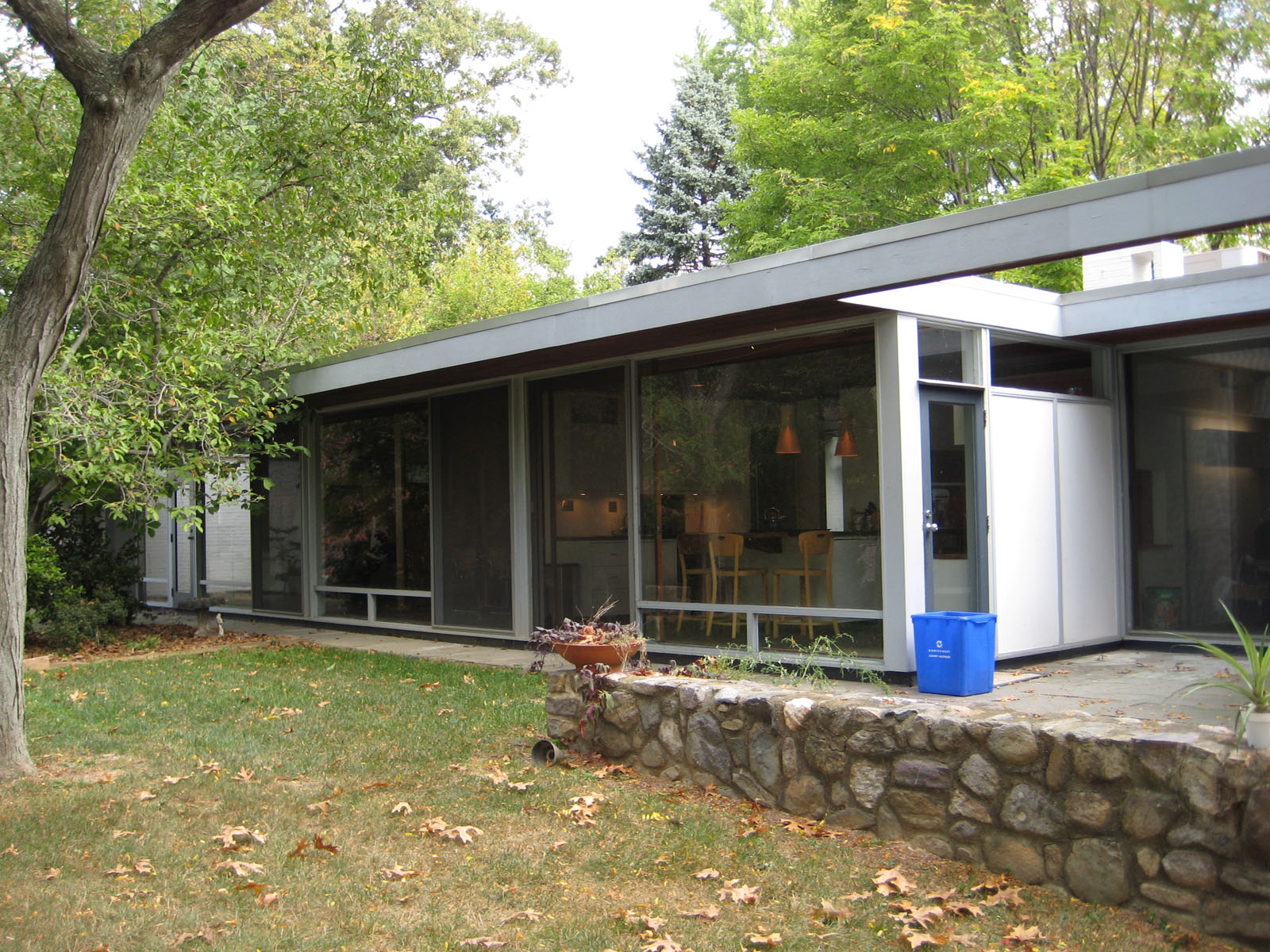
The Seymour Kreiger House

The Seymour Kreiger House

If you read my previous post for Historic Preservation Month, you know that in picking a theme for this year’s Preservation Month, the National Trust for Historic Preservation issued a challenge to people in communities across the country to discover hidden gems and celebrate local historic resources.  Montgomery County historic preservation planners responded by preparing a list of historic resources we hope you will discover.

While Preservation Month has become a fun annual event to raise awareness and celebrate historic preservation nation-wide, our exploration of the county’s historic resources will continue long after we turn the page on May. Our efforts have led us to look beyond what many people recognize as historic, and to start thinking about buildings and places from a period of our history that historic preservationists have only recently begun to consider.  Not long ago Montgomery County historic preservation planners launched a new initiative to study local mid-20th century modern buildings and communities, part of an effort we call MontgomeryModern. The historic value and design significance of the mid-century era — the 1940s through the 1960s — has, until recently, been largely overlooked. But as more than 50 years has passed since these buildings and communities were constructed, we have begun to investigate their historical, cultural and architectural importance.  As a result of a more complete understanding of these mid-century resources, property owners and decision-makers may find more of these resources appropriate for historic preservation.

Carderock Springs

Carderock Springs

MontgomeryModern is exploring mid-century modern buildings and communities that reflect the optimistic spirit of the post-war era in Montgomery County, Maryland. Preservation planners want to help raise the public’s understanding of – and appreciation for – these buildings and communities developed during a time of tremendous growth in Montgomery County. To encourage your discovery of mid-century architecture we included four Modernist buildings or communities in our Preservation Month list of Montgomery County gems. Carderock Springs, a community of 275 houses designed by Keyes, Lethbridge, and Condon and developed by Edmund J. Bennett between 1962-1966, is listed in the National Register of Historic Places.

Rock Creek Woods

Rock Creek Woods

Also listed in the National Register is Rock Creek Woods, a 76-house development that is one of several in Montgomery County by regionally prominent architect Charles Goodman.  World-renowned architect Marcel Breuer designed the International-style Seymour Kreiger House in Bethesda.  The Kreiger House, built in 1958, is listed in the National Register and is designated in the Montgomery County Master Plan for Historic Preservation.  The WTOP Transmitter Building, built in 1939 in Wheaton, is also a landmark modernist building that has been designated in the Master Plan for Historic Preservation.

The intent of including in our list these four historic resources is to give you a taste of the remarkable mid-century modern buildings and communities we have in Montgomery County, and to encourage you to investigate our MontgomeryModern initiative as we learn more about hidden gems from the mid-century.

Jan 6 12

Superblocks in Palm Beach

by claudia kousoulas

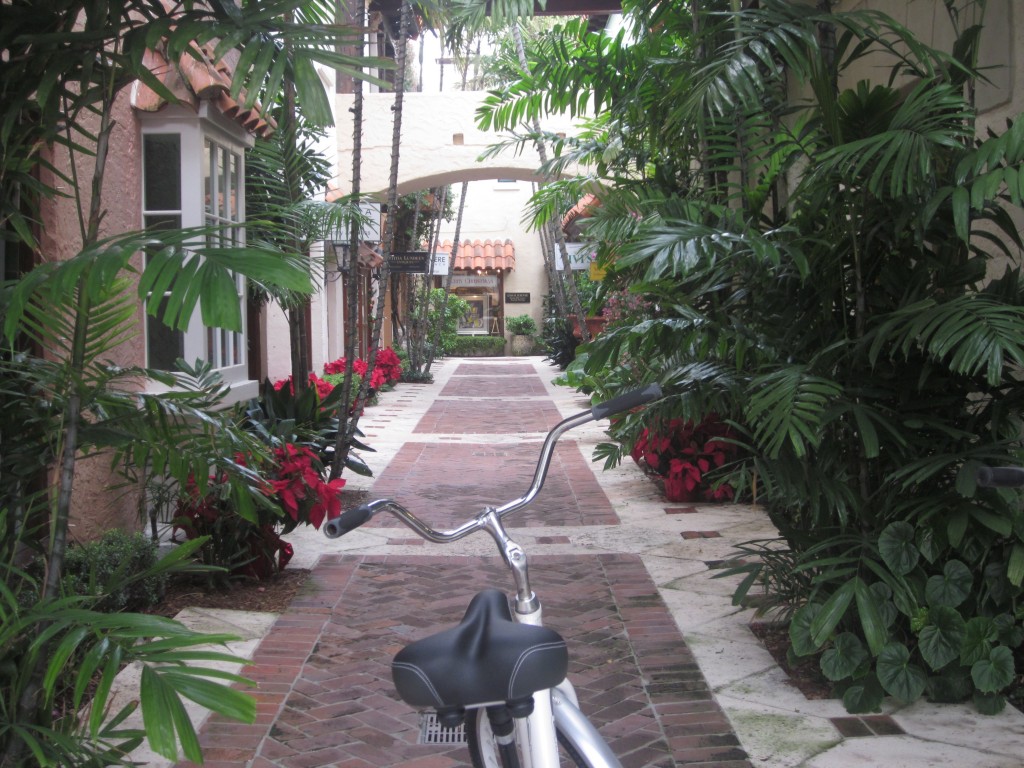
On a busman’s holiday, I had a chance to bicyle around Palm Beach and noticed that, not surprisingly, the one percent get some pretty nice urban design.

But what is surprising is that whether you’re in the one percent or the 99 percent, the bones are the same. Palm Beach’s Worth Avenue was created very much the way Federal Realty does a Bethesda Avenue or Foulger Pratt does an Ellsworth Avenue.

Worth Avenue, Bethesda Avenue, and Ellsworth Avenue are all parallel or perpendicular to the main traffic artery. You get onto Palm Beach island via Royal Palm Way, a spectacularly landscaped boulevard with green median and four travel lanes. But make no mistake, shopping and strolling are a few blocks to the south on the much more intimately scaled Worth Avenue. The same bones are in Bethesda and Silver Spring; the car traffic is out on Wisconsin and on Georgia.

And it points out a lost opportunity in Friendship Heights (which has the bones and the money). Friendship Boulevard and Jennifer Avenue run parallel to busy Wisconsin Avenue, but are lined with parking lots and loading docks instead of using them to create a retail enclave conducive to strolling and cafe lingering.  

Furthermore, Worth Avenue’s little piazzas and mid-block connections seem to be the accreted decisions of varied builders over time.

let's see where this leads!

It is, in fact, a real estate development created out of assembled properties, just the way our CBD zoning encourages assembly by offering optional method density increases for sites over 20,000 square feet.

note the easy mix of office, residential, and retail. In fact, Mizner lived above the shop

It’s what you do with your superblock that makes the difference. Worth Avenue and much of Palm Beach’s (and South Florida’s) Spanish-Mediterranean architectural character was created by Addison Mizner. He didn’t go to architecture school, but did attend university in Salamanca, Spain and apprenticed with a Beaux Arts practice.

In the Beaux Arts, God truly is in the details. From “An American Country House,” a 1925 monograph on the work of Mellor, Meigs, and Howe, this column capital is carefully drawn, scaled, and constructed.

pastiche or perfection?

Sure it’s easy if you’re doing a luxurious country house, but these details come from the Bush Terminal Building on 42nd Street and Broadway in New York City as recorded in the 1925  ”Architectural Construction, An Analysis of the Design and Construction of American Buildings.”

included for its "conspicuous orginality," though "using letters from the Gothic alphabet"

and it was not only decorating the building, but knowing how to put it together using the proper scale and materials. No dry-vit here

And one more thing. At the time, Palm Beachers used to clapboard cottages objected to Mizner’s “ugly, foreign-looking buildings.”

Nov 16 11

Planning Board to hear recommendations about Capital Crescent Trail

by Matt Johnson
Georgetown Branch Trail

Interim Georgetown Branch Trail. Photo by thecourtyard on Flickr.

As a part of the Purple Line, Montgomery County will fund upgrades to the Capital Crescent Trail between Bethesda and Silver Spring. Tomorrow, the Planning Board will hear recommendations from its transportation planning staff about several issues facing the trail. After hearing testimony, the Planning Board will send recommendations to the Montgomery County Council.

The current design from the Maryland Transit Administration includes a number of improvements to the trail. The upgraded trail will be expanded to 12 feet wide, where  feasible, and paved. Additionally, the trail will be extended from its current terminus at Lyttonsville 1.5 miles farther east to Downtown Silver Spring. New overpasses or underpasses will be provided over Connecticut Avenue, Jones Mill Road, 16th Street, and Colesville Road.

This is good news for trail users.

Planning staff is calling for the installation of lighting along the new trail from Bethesda to Silver Spring. The trail would be lit during the hours the Purple Line is open, and would allow the trail to be used safely during commuting hours. The recommendation is to design lighting so that it does not disturb neighboring properties.

Staff is also calling for emergency call boxes to be placed at intervals along the trail. This will help to promote security and reduce crime. New landscaping will help to create a pleasing trail experience and will screen trail users and neighbors from the Purple Line.

Bethesda tunnel

The Bethesda tunnel. Photo by thisisbossi on Flickr.

The most costly decision that will have to be made is whether to put the trail above the train in the tunnel under Wisconsin Avenue.  Right now, estimates place the cost of keeping the trail in the tunnel at $40.5 million, which is 43% of the cost of the entire trail. Planning staff have recommended against putting the trail in the tunnel if the price remains so high. For a fraction of that cost, the surface alignment could be significantly improved. The Planning Department is calling for more study before making a final decision.

Not having the trail in the tunnel would mean that trail users would need to cross Wisconsin Avenue at grade. If a surface alignment is chosen, the staff recommends prioritizing pedestrians and cyclists crossing Wisconsin Avenue. They recommend a working group be convened to hammer out the design details.

A surface alignment is clearly not as nice for pedestrians and cyclists because of the Wisconsin Avenue crossing. But there are plenty of ways to make the crossing of Wisconsin safe and efficient for trail users.

The Planning Department recommends that if the surface alignment is used through Bethesda, that the trail will be made as user-friendly and safe as possible. While the exact design solutions have not been determined, many solutions will be considered, including creating a bicycle/pedestrian only signal phase for crossing Wisconsin Avenue, a separated “cycle track”, raised crosswalks, and more.

Hornby Street cycle track

Above: a separated cycle track in Vancouver. Image from Paul Krueger on Flickr.

And let’s not forget that even if the tunnel under Wisconsin is lost to the Purple Line, the trail will still be vastly improved. It will be paved, bridge several major arterials where people have to cross at grade now, and extend 1.5 miles farther to downtown Silver Spring.

Oct 6 11

Beauty and the Eye of the Beholder

by claudia kousoulas

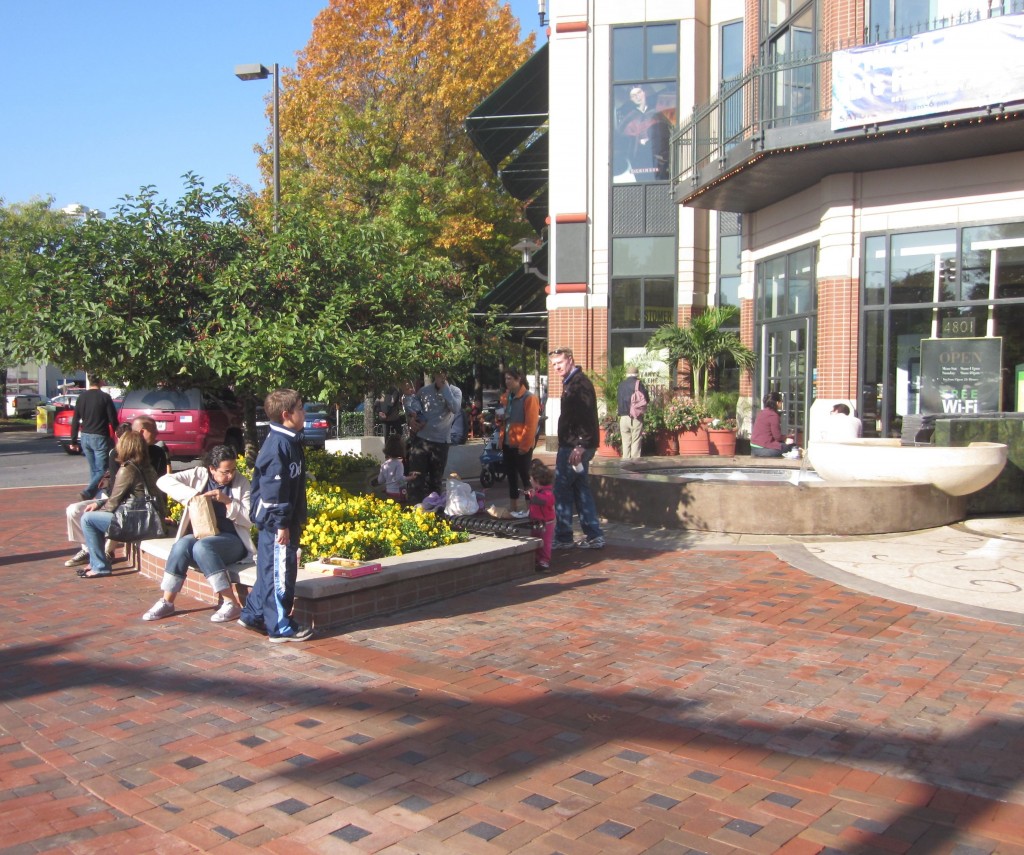
Everyone has an opinion about the new fountain at what people consider the “town square” of Bethesda–the plaza in front of Barnes & Noble Bookstore.  

latte anyone?

As reported online in the Bethesda Patch most of the commenters think it was at best unecessary and at worst, a scheme to keep people from sitting out in front of the store. You can chime in as well by voting online. Unfortunately, out of 209 votes so far, 121 people (57%) don’t like it.

are there enough places to sit?

This is not a Bethesda phenomenon. In fact, just last week, the New York Times reported that Portland, Maine has removed a sculpture called Tracing the Fore. The article quotes Shawn McCarthy, who owns the bar across the street from where the artwork stood.

“In one way it was a conversation piece, but the conversation just was never positive.”

But what are we talking about these days? In earlier eras, we shared a language of methaphor and images, as well as a way of looking at public space and events. Today, victory columns and story-telling pediments are irrelevant media. Even our view of history has changed; the great men are gone. And the lines between public and private space haveblurred. Streets and spaces that are designed to appear public may  be adjunct commercial space.

The interesting thing is that this Bethesda space hardly needs public art, let alone a contentious scultpure. As one Patch commenter noted, this is percieved as Bethesda’s town square, an active intersection of streets, bikes routes, sidewalks, and shops. It already had almost everything that urbanist William H. Whyte claimed you needed for a good urban space–sun, touchable water, food–just needed some movable chairs.

William H. Whyte: The Social Life of Small Urban Spaces – The Street Corner from MAS on Vimeo.

Jun 15 10

Complexity and Confusion in the Suburbs

by claudia kousoulas

The suburbs are often derided for being one-dimensional–row after row of “ticky-tacky.”

Turning a corner reveals no surprise, but sameness to the point of confusion. Isn’t the tired Dad who pulls into the wrong driveway a popular trope of movies, sit-coms, and commericals?

We can’t expect urban richness of the sort described by Alfred Kazin in A Walker in the City. The noise, smells, and general decrepitude would be unacceptable. But the hand of generations  can add layers, paths, and landmarks to a suburban landscape.

In Bethesda, a place more varied than you might imagine, there is some complexity created by the old B&O rail line that is now a segment of the Capital Crescent Trail. You can walk or bike into downtown and the Metro and gain new perspectives on roads and properties. Even more complexity will be added by a proposed trolley line.

By contrast, does Garage 59 create complexity or confusion? This is how the website directs you to the B-CC Regional Services Center:

“Take the long escalator to the bus bay level and then the escalator by the cascading fountain up to the plaza level. Turn left. Keep the Food Court on your left and walk up seven steps next to the red-painted railing. Walking straight ahead and then to the right, cross the pedestrian bridge with blue/green-painted ironwork. At the end of the bridge, follow the signs on your right to the “B-CC Center” entrance.”

Cascading fountain? Long escalator? Red-painted railing? What about the sword-wielding elf? Will I need to answer any riddles?

the beginning of your urban quest

now turn 180 degrees

the pilotis stand sentry

a bridge to somewhere?

can you get there from here?

good luck young quester

Where is the complexity or confusion in your neighborhood?

Apr 2 10

The Next Step for Bicycle Infastructure

by anthony pins

As the weather has started warming up I’ve been riding my bike more often between home, work, and school. It’s been great for my commute because the County has a number of good trails and off-road routes for getting from place to place. While certain parts of the County are extremely bike-friendly – think Bethesda on a weekend morning – others could use some work. It’d be nice to see the County expand it’s on-street bicycle infrastructure. When it does, here’s one idea I think is pretty effective.

Feb 23 10

What Walkscore Reveals about Montgomery County

by anthony pins

Earlier this winter, the New York Times ran an article on a CEO’s for Cities study revealing a substantial premium on home sale prices in areas with an above average Walkscore, the informative, if simplistic online measurement tool that ranks neighborhood “walkability” based on proximity to community services and amenities. According to the study, for every additional Walkscore point a neighborhood earns, home prices increase by $700 and $3,000. On average, highly walkable homes sold for $4,000 to $38,000 more than their auto-centric competition.

This past weekend, I attempted to use Walkscore in conjunction with Zillow.com to (at least loosely) confirm the study’s findings for Montgomery County. While zip-code data gave a soft nod in the affirmative, I couldn’t find data fine-grained enough without searching individual listings. I did, however, spend some time seeing how different areas in the County fared on the walkability test.

Not surprisingly, the County’s results range from laudable to loathsome. At the positive end of the spectrum, Bethesda (97), Wheaton (97), and Silver Spring (94), all rank in the top 10% nationwide. They succeed in large part because of their concentration of diverse retail and abundant transportation options. Less exemplary are the Beltway-adjacent areas of Forest Glen (51) and Grosvenor (48) which, despite Metro accessibility, are both physically constrained and poorly served by neighborhood services.

What was most notable about the County is the discontinuity of our walkable fabric. If you own a home three-quarters of a mile west of the Bethesda Metro Station, your Walkscore is probably about 38. Travel the same distance in the opposite direction and you’re likely to earn a score of 55. This trend is pretty consistent throughout the MD-355/Red Line corridor. Worse, though, are the number of pockets in between Metro stations that have diminished Walkscore. This trend suggests that residents and office workers are unlikely to walk to services or use transit without driving to the station (which is still much better than driving to work). Pooks Hill, for example, located just south of the Beltway between the Medical Center and Grosvenor stations barely ekes out a score of 30. As distance between stations increases, this trend becomes increasingly common.

Downtown DC, by contrast, is consistently walkable. According to the CEO for Cities study, DC has a median score 71. A quarter of District neighborhoods score better than 82 on the Walkscore scale, ranking seventh among US cities. Where in Montgomery County the walkable street network extends only a limited distance from Metro, in the District the street network ties together neighborhoods creating a continuous pedestrian environment. As a result, it is just as easy to walk from Adams Morgan to Georgetown where there is no Metro service, as it is to Dupont Circle or Penn Quarter where there is.

Walkscore is also a valuable indicator of a site’s inherently sustainable characteristics. The LEED for Neighborhood Development rating system addresses these considerations in two full sections dedicated to Smart Location and Linkages, and Neighborhood Pattern and Design sections. LEED for New Construction, however, allots only a four points related to walkable site selection (SS 1:Site Selection, SS 2:Development Density & Community Connectivity, SS 4.1: Public Transportation Access and SS 4.4 Parking). Why is this important?

Consider the following buildings in Montgomery County. The first is a LEED-Platinum rated office building just off I-270 with almost non-existent transit service, no proximal services or amenities, and no real concentration of nearby housing. To construct the building, a swath of forest was cleared not only to accommodate the building footprint, but also the parking structure, which incidentally has twice the footprint of the building itself. Its Walkscore is 35.

The second project is the Silver Spring Library, which is scheduled break ground on a site that will eventually serve as a station for the Purple Line light rail system. The library building accommodates ground floor retail, an arts center, additional office space, and a 60,000 square foot library. It sits on a previously developed site, requires no additional parking, will eventually also accommodate 140 residential units, and is located adjacent to the Silver Spring CBD. Its walkscore is 97. The library, however, is projected to only earn a LEED-Silver rating.

According to one study, 30% more energy is expended by workers commuting to a traditional office building than the building itself uses. For an average office building built to modern energy codes, more than twice as much energy is used by commuters than by the building itself. This highlights the importance of building within a walkable framework. You can argue that a “green” auto-dependence is better than the traditional form of auto-dependence, and in the case of Tower Oaks, attractive auto-dependence is better than your run-of-the-mill schlock. But this misses the point. Ultimately, sustainability comes back to a few basic principles. Walkability, and automobile independence, is one.

Other areas in Montgomery County: Olney: 91; Friendship Heights: 89; White Flint: 80; The Kentlands: 78; Germantown: 63; White Oak: 60; Gaithersburg Life Sciences: 55.

Switch to our mobile site