Posted: by ...

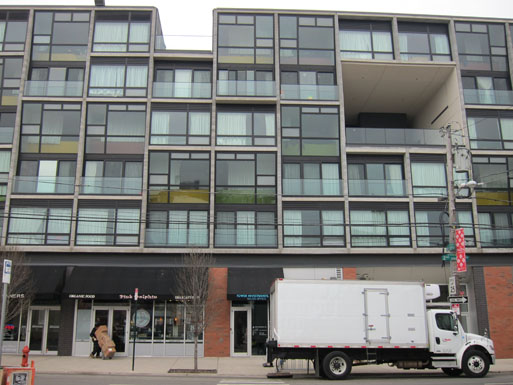
Last week, the County Council approved a new kind of hybrid zoning — the Commercial Residential (CR) zones. Combining traditional zoning provisions, such as use and dimensional standards and form-based provisions, such as street façade requirements and angular plane setbacks, these zones have been created to ensure : • Better predictability of allowed use, density, and height • More integrated services, residential opportunities, and public amenities • More sustainable growth patterns concentrated in existing commercial areas

The CR zones are a family of zones based on a combination of use, density, mix, and height. A zone combines these factors and will be seen on the zoning map as, for example: CR2 C1 R1.5 H60. This sequence means that any … Continue reading

Posted: by ...

The Building Museum’s current exhibit, Drawing Toward Home, begins with the spidery lines of a Samuel McIntire plan of a Federal style house to be built in Salem, Massachusetts in the late 1700s. The rooms aren’t labeled, but simply marked with their measurements. The single sheet is a design, a contract, and a builder’s directive.

Very quickly, the exhibit’s drawings of houses turn into drawings of home. Along with color and detail, they add emotion.

“The architect must keep his client’s enthusiasm alive and active by sending or submitting bright, jaunty little perspective sketches of his contemplate work,” wrote Benjamin Linfoot in Architectural Picture Making (1884).

The drawings are partially the ploy of an architect to keep his client engaged … Continue reading

Posted: by ...

Johann Wolfgang von Goethe — yes, THAT Goethe — is credited with describing architecture as “frozen music.”  As the snow melts away from the brightly colored and delightfully detailed Pyramid Atlantic, some of that music will be pooling for public consumption.

Sonic Circuits, an organization dedicated to providing “DC’s music and art communities with the opportunity to sample experimental and avant-garde electronic music, with an emphasis on improvisation and artistic use of new technologies,” will be holding its next performance at the center on Friday, March 19, 2010, at 8:00 pm.

Last week I saw Ms. Chen perform as part of a ten-piece improvisational group playing John Zorn’s “Cobra”, part of Baltimore’s excellent Mobtown Modern series; her contributions were … Continue reading

Posted: by ...

Parking garages aren’t always the most attractive members of built society. If a group of buildings got together for a social event, skyscrapers would be the leggy blonde at the center of attention while parking garages would play the overweight louse, disheveled and stinking of cheap cigars, that foils the attempts of potential suitors. (What, you don’t think about buildings talking to one another?)

Yes, far too often parking garages are the ugly brutes ruining all the fun, occupying whole city blocks, deadening street life, and filling the air with noxious fumes. It’s hardly a coincidence that they are featured most prominently in movies where the threat of evil looms in every shadowy crevice.

Parking structures have experienced a … Continue reading

Posted: by ...

Well, at a cost of more than $100,000 per space, it had better be. High design–using Swiss architects Herzog & de Meuron–costs and the New York Times takes a shot at figuring how the numbers work. But never mind the numbers, the structure is a location scout’s dream. Look for it soon on an episode of CSI Miami.

Miami Beach is actually developing a reputation for cool parking garages, using design than relies on more than just a tropical climate that can soften and structure with palm trees and cushions of impatiens.

Okay, this one is palmed and cushiony, but it also has a strong retail base, a car entrance that is as narrow as possible on the … Continue reading

Posted: by ...

Earlier this winter, the New York Times ran an article on a CEO’s for Cities study revealing a substantial premium on home sale prices in areas with an above average Walkscore, the informative, if simplistic online measurement tool that ranks neighborhood “walkability” based on proximity to community services and amenities. According to the study, for every additional Walkscore point a neighborhood earns, home prices increase by $700 and $3,000. On average, highly walkable homes sold for $4,000 to $38,000 more than their auto-centric competition.

This past weekend, I attempted to use Walkscore in conjunction with Zillow.com to (at least loosely) confirm the study’s findings for Montgomery County. While zip-code data gave a soft nod in the affirmative, I couldn’t find data … Continue reading

Posted: by ...

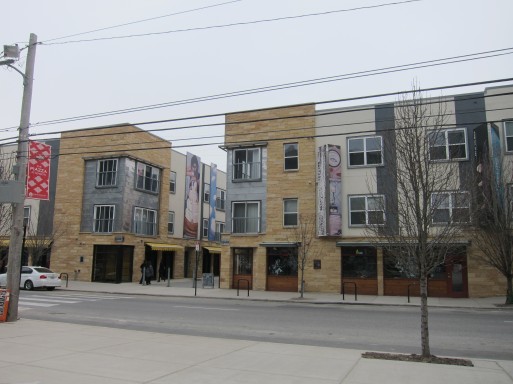
On the rare occasions that the words “architectural character” and “Fenton Village” are used in the same sentence, they are usually also joined by the words “lack”, “dearth”, and “paucity” (ADMIT IT!).  (For the uninitiated, the Fenton Village is centered one block east of Georgia Avenue in Silver Spring, north of the train tracks.)   These exclamations are not without foundation: Silver Spring Towers, Safeway, and 8120 Fenton Street are not doing the street any favors.  Nor do the converted and expiring bungalows and four-squares suggest a Village with a unique character (cf. Forest Hills Gardens, et. al).

But the dedicated observer (thank you!) will notice that, scattered about its ten or twelve blocks, Fenton Village has many buildings … Continue reading

Posted: by ...

After months of study and deliberation, New York City has decided to make its pedestrian-priority spaces a permanent fixture on sections of Broadway around Times and Herald Squares. The decision to keep the revised street plan, which had been operating under trial review since last summer, came despite vehicle travel times falling short of projected improvements. The plan was originally sold on the basis that it would improve vehicle flow by 17%. It improved 7%.

More importantly, the roadway enhancements vastly improved pedestrian and motorist safety. According the City’s Department of Transportation, pedestrian injuries are down 35% while motorist and passenger injuries decreased 63%. And 80% fewer pedestrians are walking in the streets despite increased usage of Times and Herald Squares, ostensibly due to … Continue reading

Posted: by ...

Before moving to the DC area two years ago, I had lived in New York City for the previous 18 . Never owned a car there (or a local driver’s license!),and it wasn’t until I relocated here that I realized how effortless it was to live a pedestrian life there…Stores were abundant and usually well stocked; restaurants, museums, and galleries were everywhere (…mostly frequented by tourists that we locals had to put up with); and in general whatever you needed ), was at your disposal 24 hours a day.

It’s been a bit of a struggle for me to sustain a similar pedestrian life here. I am still coming to terms with giving up an almost zero carbon footprint … Continue reading

Posted: by ...

Tacking onto Elza’s post on Silver Spring’s future form, I came across this building a few weeks ago and couldn’t help but think of Fenton Village. It’s cheerful, gritty, and almost certainly would feel at home in a neighborhood that already boasts an array of colors, from the similarly red Pyramid Atlantic to the tastefully pink Jackie’s Restaurant.

And while the Burnside Rocket may seem to offer little in the way of architectural distinction other than a few eccentric shutters painted by local artists (which I think are quite neat), between its crimson painted walls is a powerhouse at work. The LEED-Platinum certified structure is built both to last, approximately 300 years according to the project’s website, and operate … Continue reading