An Accessory Dwelling Unit (ADU) is a second dwelling unit that is subordinate to the principal dwelling on the same lot and they have been a part of the American housing tradition for over two centuries. ADUs within existing neighborhoods can solve many of the housing problems faced by Montgomery County residents today. Imagine a backyard cottage that lets an aging parent live close by, or a basement apartment that helps a returning college graduate afford a place to live in the neighborhood where they grew up, or a converted garage rented to a local teacher that helps an owner pay down a large mortgage. These small units, which can be found tucked into backyards, basements, and converted garages of single-family neighborhoods, are proving to be one of the most flexible and community friendly tools in the housing toolbox across the country. But as many jurisdictions have learned, simply legalizing ADUs doesn’t mean they’ll get built.
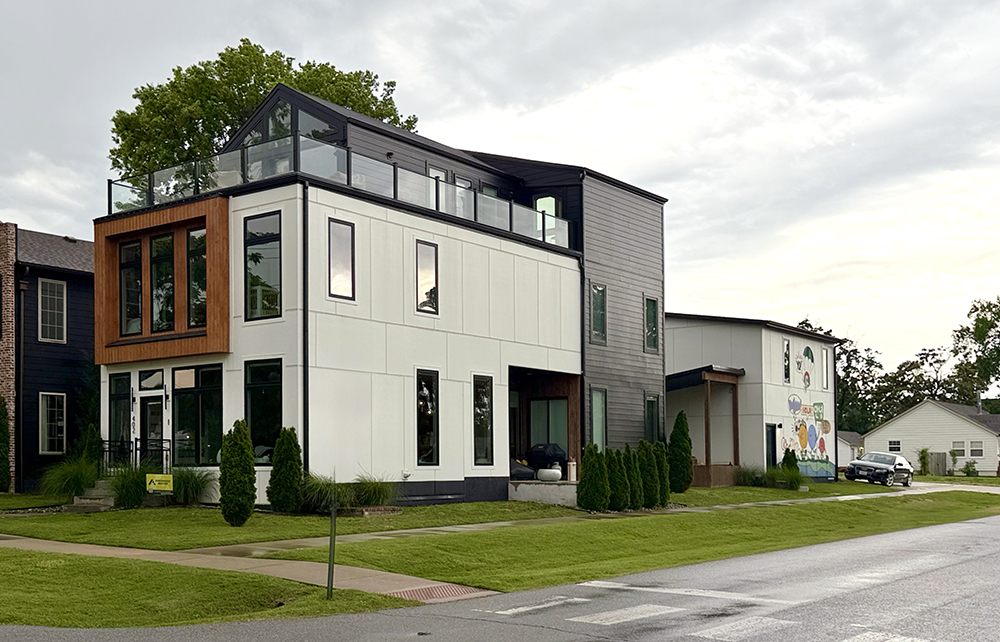
A new infill, contemporary-designed home on a narrow lot includes an ADU over the garage and provides additional rent for the homeowner. Photo by Paul Mortensen
A long history we’ve forgotten
ADUs have been very successful throughout our nation’s history. In the late 1800’s many of the brownstone neighborhoods in New York and Chicago were built for middle-class families and were financed through owners renting out a basement unit for income. It was also common throughout our history for someone to live in or rent an affordable unit over a stable or garage so that they could work in the adjacent house or within the town. With the advent of single use Euclidean Zoning in the early 1900s, ADUs were discouraged or not allowed on a single-family parcel.
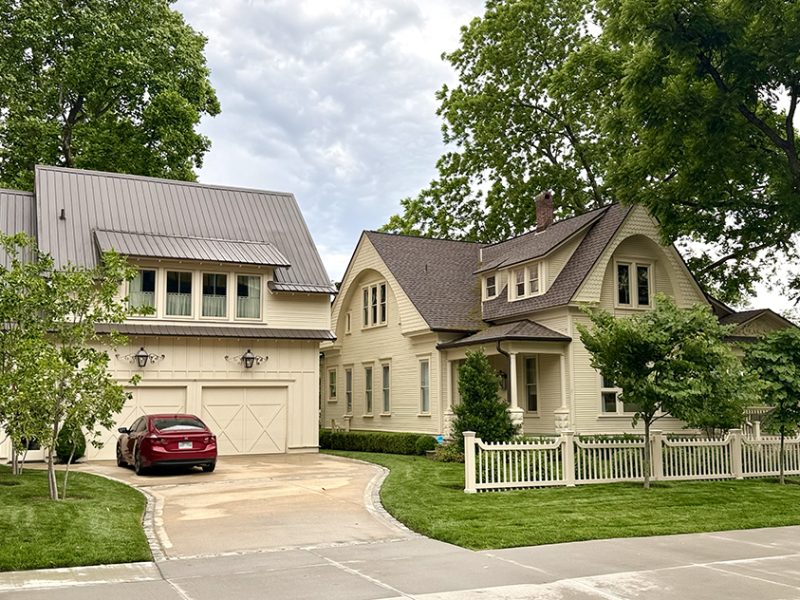
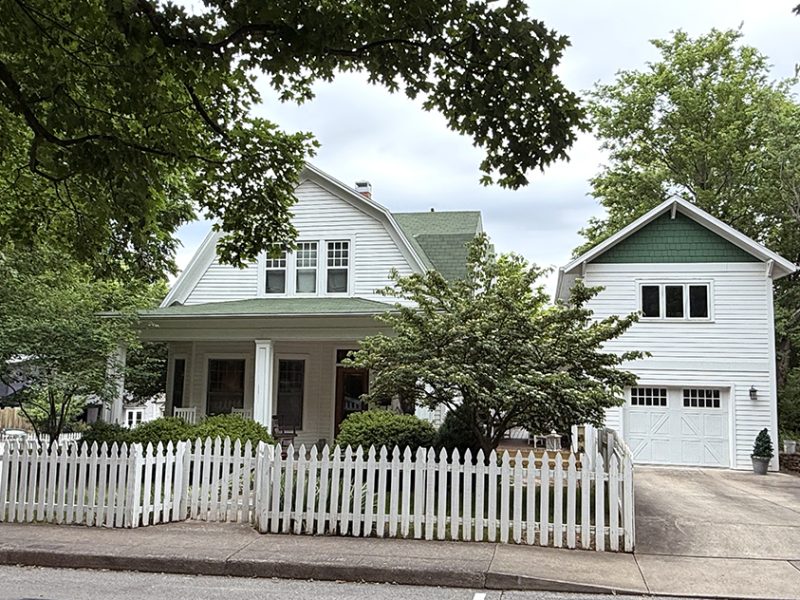
 A detached garage with an ADU above was added to this historic house in downtown Bentonville, AR to provide additional housing in a growing city and region. Photo by Paul Mortensen
Today, with many people being priced out of single-family neighborhoods, connections and proximity have become more important to younger generations and empty nesters as fewer homes are on the market. Those affected the most by a lack of this type of housing alternative are lower income residents; single or couple, moderate-income households; young people getting started in their careers; and older people who want to stay in their neighborhood and are looking to downsize or who have disability requirements. Many of these people realize that smaller living spaces in closer proximity to others in walkable communities are ideal, whether they are buyers or renters. For renters, these units are attractive for those who want to live in a quieter residential neighborhood rather than a larger apartment building. For owners, the ability to generate income and offset mortgage costs becomes a powerful advantage in uncertain economic times.
In 2019 Montgomery County saw that ADUs were an opportunity that could provide more housing in residential neighborhoods to accommodate the needs of the people who live there.
Without changing the character of a neighborhood, ADUs could provide income or generational support for owners, or an affordable place to live closer to work or to their community for renters. Although many jurisdictions have now legalized ADUs in their zoning codes, there are several building and managing obstacles that keep them from being produced.
The most prevalent include building regulations and approval processes, parking requirements, utility hook-up and fees, the cost of construction, financing and a lack of comfort by lenders, the time necessary for design, permitting and construction, permitting uncertainty, owner-occupancy requirements, a lack of awareness of ADUs as a housing option, and a lack of many homeowners wanting to build them.
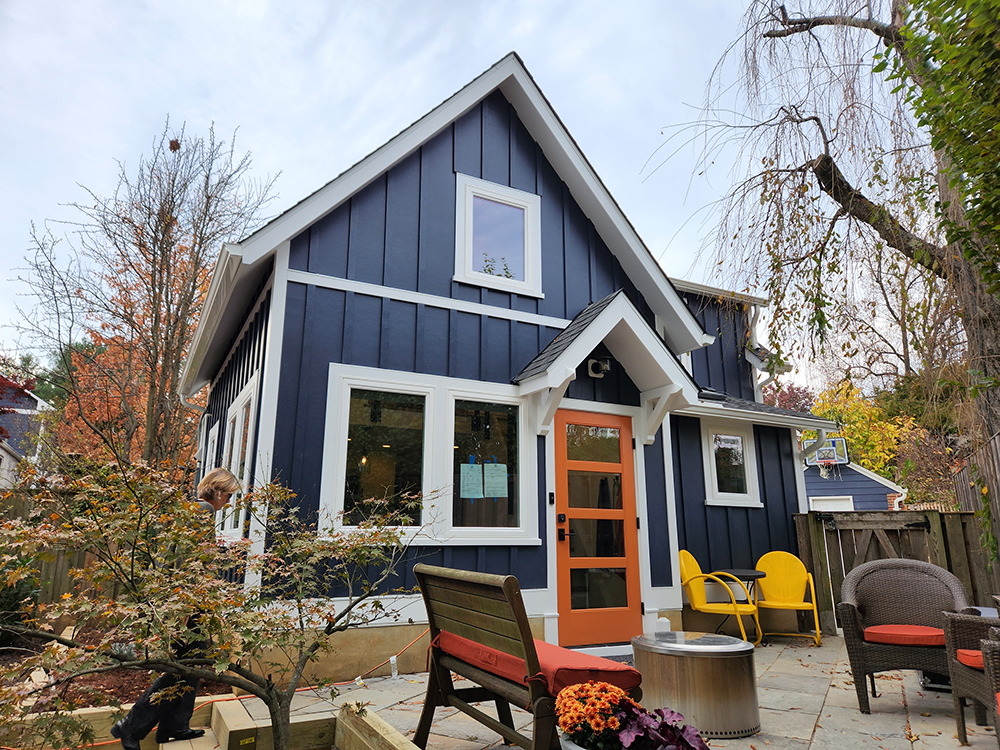
A well designed detached ADU by Eric Saul Architect creates a compact home that is perfect for an aging family member, a returning college student, or a renter on this single-family lot. Photo and permission by Eric Saul
Through the process of updating ADU rules across the country, several jurisdictions have found the following changes most helpful to increase production:
- Remove on-site parking requirements for an ADU. This regulation makes many more lots within residential neighborhoods feasible for ADUs and no city or town has yet to see parking problems within existing communities.
- Do not require owner occupancy rules. This has dramatically unlocked more investment in ADUs by property owners.
- Allow up to two ADUs on a site. Allowing more than one ADU has allowed those who own ADUs to invest further in their property.
- Dramatically reduce approval processes and impact fees.
ADUs from across the country
California
ADUs have been allowed for almost 40 years in California, yet very few have been constructed. In 2019 the state passed a handful of bills that mandated ADUs be allowed in all single-family and multi-family zones and that they must be approved within 60 days of submission for permits. They barred localities from implementing minimum lot sizes and they eliminated impact fees on ADUs smaller than 750 square feet (SF). They also removed owner-occupancy rules. These changes have led to an over 200% increase in ADU permitted and constructed units by 2022. Here are the highlights of California’s ADU law:
- No minimum lot size requirement for dwelling units.
- Detached ADUs must be a minimum of 150 SF and a maximum of 1,200 SF. A one-bedroom ADU cannot be larger than 850 SF.
- Attached ADUs can be 50% of the primary residence in size.
- Owners of the site are not mandated to live on site.
- Created an up to $40,000 grant program to reimburse owners for pre-development costs such as design and closing costs for ADUs with the state of California contributing $40 million into the program.
- Property owners with a primary residence can sell their ADU separately from the primary house.
- Expedited approval process requires local agencies to act on completed applications within 60 days and to determine completeness within 15 days. New laws also require pre-approved plans to be reviewed within 2-3 weeks, and it allows applicants to hire private inspectors to further expedite review. Final inspections are now required within 10 days of completion of construction. Prior to these laws, local jurisdictions would often delay reviews and inspections to discourage ADU construction.
Los Angeles
The City of Los Angeles takes California’s ADU law and goes further within the municipal boundaries. ADU construction in Los Angeles has seen a marked increase following the new state legislation. Several benefits have been realized by those who create the units. With the very high cost of housing, ADUs can rent for as much as $3,000/month which provides mortgage relief for owners. They are also ideal for aging parents, adult children and guests without damaging the character of existing neighborhoods. ADUs also add up to 30% in resale values of homes. One of the biggest options for ADUs in LA is garage conversions because they are cost efficient and require less structural work. To increase the construction of ADUs and to “improve” on state mandates, Los Angeles did the following:
- Reduced permitting fees for ADUs.
- Streamlining approvals for ADUs.
- Property Tax exemptions for ADU owners, particularly for those willing to rent to low- to moderate-income tenants.
- Although the state requires ADU rentals to be not less than 30 days, LA has no restrictions on short-term rentals.
Washington
In 2023 Washington State enacted legislation that dramatically changed requirements for ADUs throughout the state. They created standards that would be applied across the entire state and mandated that as many as two ADUs would be allowed on a lot containing a principal dwelling unit in all residential and mixed zones except in historical and shoreline districts. They also provided for the following:
- No off-street parking requirements.
- No requirement for an owner living on site.
- Maximum size of an ADU is 1,000 SF, or no more than 60% of the principal dwelling, whichever is larger.
- Minimum 60-day rental of ADU.
Seattle
The City of Seattle advanced Washington State’s ADU law with bolder action. Because Seattle is a land-locked city with little room for expansion, housing affordability has always been a significant issue and on the minds of Seattle officials over time. In 2015, Mayor Ed Murray set a goal of creating 50,000 new homes in 10 years, 20,000 of which would be affordably priced. ADUs were an ideal housing type to meet this enthusiastic goal.
Prior to new state legislation, Seattle in 2019 approved bills that allowed 2 ADUs per lot, eliminated owner-occupancy rules, reduced minimum lot sizes and eliminated ADU parking space requirements on site. With these changes, by 2022, construction of ADUs outpaced single-family construction within the city and the number of ADUs being built was up 253% with over 1,000 permitted per year. Even with more units being produced in the early 2020s, high interest rates and high utility hookup fees have continued to slow down construction momentum and permits are down 40% over the past year. Additional changes to the ADU rules included:
- Height limits were increased from 18 feet to 32 feet in residential zones and from 20 feet to 40 feet in other areas which removes barriers that limited 2 story units.
- The city eliminated street improvement fees except when the project necessitates street repair.
- The city also now allows ADUs to be subdivided from the original lot to create separate ownership options for resale.
- Limitations to ADU entrance locations and exterior stairs have been removed.
- In 2020 the city followed up ADU legislation reforms with the launch of a webpage with pre-approved ADU designs.
Oregon
Since introducing legislation that promotes ADU construction in 2018, Oregon has become the largest producers of ADU’s in the country. Overall, after trial and error, they realized that simply allowing ADUs by right would not get ADUs built. Other incentivizing legislation was necessary to make development of ADUs as simple as possible. New legislation included:
- No special permits or public notice are required.
- No off-street parking requirements for ADUs on a property.
- No requirement of having the property owner live on property.
- Allowing up to two ADUs on a lot. If you have more than one, then the second must be accessible.
- The state requires ADUs to be rented for a time not shorter than one month for the first 10 years.
Portland
The City of Portland has been out front as a leader in ADU production working on rules since 1998. One of the first rules was to eliminate System Development Charges which are the fees assessed to owners for access to city services and infrastructure. This alone saved an owner up to $12,000 for an ADU. By 2020 the city increased the number of ADUs allowed on a lot to two which immediately stimulated a 34% rise in ADU permits. At the same time, they removed all off-street parking requirements for ADUs. Other incentives for ADUs include:
- The city offers homeowners low-interest financing programs and permit waivers for the creation of ADUs
- Portland does not restrict short term rentals.
- Portland does maintain restrictions on the size of ADUs. Detached ADUs can be a maximum of 900 SF while units internal to the existing home can be up to 1,000 SF.
- Detached or attached ADU must be 40 feet behind the front property line of the primary dwelling.
Vermont
For the past decade, Vermont has been focused on reintroducing missing middle housing, including ADUs, back into production. Although zoning now says yes to ADUs, the market was saying maybe. Building these types can be expensive, slow and unpredictable. Vermont now has a different approach. Rather than just legalizing new housing types within residential neighborhoods, the state wants to allow ADUs to be a common component within the housing construction industry.
To achieve their goal, Vermont launched 802 Homes, a public catalog of construction-ready, well-designed missing-middle and ADU plans aligned with administrative approval pathways, financing, infrastructure investment, coordinated capital, builder training, and off-site construction. The standardized plans draw from Vermont’s architectural vocabulary and bring predictability to builders and financiers. The initiative does not treat design, permitting, infrastructure, and finance as separate problems, but rather treats them all as part of a single production system.
Vermont and their consultants developed construction-ready plan early which reduces downstream regulatory reviews. The plans are compatible with modular and panelized construction, which can expedite construction and minimize any need for redesign. They are paired with administrative approval pathways which shorten timelines and lowers costs. They are also free statewide.
As one Vermont Department of Housing Commissioner stated, “If infill housing requires a lawyer and months of hearings, it isn’t truly allowed.”
Vermont has aligned this housing initiative with state funded infrastructure improvements where they are needed which streamlines approvals and production efficiency making investment capital flows much easier. The hope of this new plan is that the 802 Homes catalog will reduce cost, time, and uncertainty, and it will restore dependable housing production across the state.
The primary takeaways of the Vermont 802 Homes catalogue were:
- Upstream design consensus reduces downstream conflict.
- Infrastructure and capital coordination must align with regulatory reform.
- Standardization enables industrialized construction and greater capacity.
- Scale drives affordability through bulk purchases and labor efficiency via repetition.
The real takeaway
New ADU construction is not cheap. However, this housing type achieves many goals of creating more housing within established neighborhoods for young and old alike who want to live in more bucolic neighborhoods. For ADUs to succeed as a viable type, we must make them as easy as possible to build. Where rules are simple, costs are manageable, and approvals are predictable, which quietly makes ADUs part of a community’s housing ecosystem. ADUs do not disrupt neighborhoods; they strengthen them, one small home at a time. As more jurisdictions revisit their ADU policies, the question is no longer whether to allow them. The question is whether we are willing to remove the barriers that keep them from becoming real. And increasingly, the answer is written not in theory, but in backyards, basements, and small homes where people are already building the future of housing, if we let them.

About the author
Paul Mortensen is the Senior Urban Designer in the Director’s Office at the Montgomery County Planning Department and leads the Design Excellence program. He is a registered architect in California, Washington, and Maryland, is a LEED-Accredited Professional, and is a member of the Congress for New Urbanism. Prior to joining Montgomery Planning, Paul was the lead designer and master planner for several nationally recognized firms on AIA and CNU award winning developments throughout the country.
Liana
thanks for info.