Leed
guest post: Scott Whipple
Last Wednesday, the National Trust for Historic Preservation released a report demonstrating something some will find counterintuitive or even dubious, but which many of us in the historic preservation field have thought for years: reusing existing buildings almost always offers more environmental savings than demolition and new construction. Â
-
A new, high-performance building needs between 10-80 years, depending on the building type and where it is built, to offset the environmental impact of its construction.
- In comparing new and retrofitted buildings ofsimilar size, function, and performance, energy savings in retrofitted buildings ranged from 4-46 percent higher than new construction.
- The benefits of retrofitting and reusing existing buildings are even more pronounced in regions powered by coal and that experience wider climate variations.
As you might expect, the preservation community is excited by these findings. But urbanists, environmentalists, the mainstream media, and government are taking notice as well. The buzz is palpable.Â
The marketplace has responded too. The United States Green Building Council, the organization behind the LEED environmental certification program, recently announced that LEED certification of existing buildings has surpassed that for new building construction.
The US government estimates that each year approximately 1 billion square feet of existing building stock is demolished and replaced, while the Brookings Institution suggests that one-quarter of existing building stock–fully 82 billion square feet–will be demolished and replaced between 2005 and 2030. That is a lot of construction debris going into landfills. But even if all of these new buildings are high-performing, we will not be able to build our way out of our carbon dependency.Â
As the Trust’s study demonstrates, taking advantage of our existing building stock must be central to our efforts to meet carbon reduction targets and address climate change. In addition to considering the cultural and economic arguments for preserving old or historic buildings, environmental factors should be considered.Â
Maybe, just maybe, these findings may broaden the circle of people who see value in our existing building stock.
Park-itecture
Parking garages aren’t always the most attractive members of built society. If a group of buildings got together for a social event, skyscrapers would be the leggy blonde at the center of attention while parking garages would play the overweight louse, disheveled and stinking of cheap cigars, that foils the attempts of potential suitors. (What, you don’t think about buildings talking to one another?)
Yes, far too often parking garages are the ugly brutes ruining all the fun, occupying whole city blocks, deadening street life, and filling the air with noxious fumes. It’s hardly a coincidence that they are featured most prominently in movies where the threat of evil looms in every shadowy crevice.
Parking structures have experienced a bit of renewed attention recently with the release of Simon Henley’s The Architecture of Cars, the National Building Museum’s House of Cars exhibit, and yes, even our own Claudia Kousoulas’ travels to Miami in search of The Coolest Parking Garage Ever. And while I personally prefer my parking garages as small as possible and underground, if you’re going to build an above ground structure, there are certainly some better ways of going about it. Consider the following examples:
The Santa Monica Civic Center
The Santa Monica Civic Center garage is the nation’s first LEED certified parking garage. While I’ve already shared my opinions on the sustainable credentials of auto-centric buildings, suffice to say that this building does all it can to otherwise offset its burden on the environment. The garage, which also includes two floors of office space, is powered entirely by the rooftop photovoltaic panels and employs an energy efficient mechanical system to cut down on waste. Low-VOC paint is used throughout and parts of the facade treatment are made from recyclable materials.
The building’s neon glow is an attractive addition to the street a night. It stands out proudly, rather than employing ill-fitting mimicry of appearing “like a building” that exhibits all the awkwardness and discomfort of our stinking louse in a rented tuxedo.
Veranda Parking Garage
Sleek. Slender. Sculptural. In the words of Liz Lemon, “I want to go to there.” In fact, I’d be writing this entry from my iPhone – clearly this is a fantasy – while driving to the Veranda Garage if it weren’t in France. Sigh.
Of course, this image has all the trappings of architecture photography. Where are the people? Where’s the humanity?! That’s a fair complaint. It would be nice to see something with the potential of registering a pulse. However, like the Santa Monica garage, the ground floor is dedicated to commercial uses to provide a measure of pedestrian-friendliness.
Marina Towers
Let’s just go ahead and say it, this won’t happen in Montgomery County. But that’s okay. It probably shouldn’t. The iconic Marina Towers benefit from a unique coalescence of the Chicago River, some pretty high profile neighbors (also, and here too), and a sense that if anywhere would combine a skyscraper and a parking garage , Chicago would probably be the place (one part New York, one part LA). In fact, Chicago is filled with skyscrapers designed with parking thick through their midsections. Rarely does this formula work for the benefit of architecture. But in this one instance, the right elements seem to come together.
Earlier this winter, the New York Times ran an article on a CEO’s for Cities study revealing a substantial premium on home sale prices in areas with an above average Walkscore, the informative, if simplistic online measurement tool that ranks neighborhood “walkability” based on proximity to community services and amenities. According to the study, for every additional Walkscore point a neighborhood earns, home prices increase by $700 and $3,000. On average, highly walkable homes sold for $4,000 to $38,000 more than their auto-centric competition.
This past weekend, I attempted to use Walkscore in conjunction with Zillow.com to (at least loosely) confirm the study’s findings for Montgomery County. While zip-code data gave a soft nod in the affirmative, I couldn’t find data fine-grained enough without searching individual listings. I did, however, spend some time seeing how different areas in the County fared on the walkability test.
Not surprisingly, the County’s results range from laudable to loathsome. At the positive end of the spectrum, Bethesda (97), Wheaton (97), and Silver Spring (94), all rank in the top 10% nationwide. They succeed in large part because of their concentration of diverse retail and abundant transportation options. Less exemplary are the Beltway-adjacent areas of Forest Glen (51) and Grosvenor (48) which, despite Metro accessibility, are both physically constrained and poorly served by neighborhood services.
What was most notable about the County is the discontinuity of our walkable fabric. If you own a home three-quarters of a mile west of the Bethesda Metro Station, your Walkscore is probably about 38. Travel the same distance in the opposite direction and you’re likely to earn a score of 55. This trend is pretty consistent throughout the MD-355/Red Line corridor. Worse, though, are the number of pockets in between Metro stations that have diminished Walkscore. This trend suggests that residents and office workers are unlikely to walk to services or use transit without driving to the station (which is still much better than driving to work). Pooks Hill, for example, located just south of the Beltway between the Medical Center and Grosvenor stations barely ekes out a score of 30. As distance between stations increases, this trend becomes increasingly common.
Downtown DC, by contrast, is consistently walkable. According to the CEO for Cities study, DC has a median score 71. A quarter of District neighborhoods score better than 82 on the Walkscore scale, ranking seventh among US cities. Where in Montgomery County the walkable street network extends only a limited distance from Metro, in the District the street network ties together neighborhoods creating a continuous pedestrian environment. As a result, it is just as easy to walk from Adams Morgan to Georgetown where there is no Metro service, as it is to Dupont Circle or Penn Quarter where there is.
Walkscore is also a valuable indicator of a site’s inherently sustainable characteristics. The LEED for Neighborhood Development rating system addresses these considerations in two full sections dedicated to Smart Location and Linkages, and Neighborhood Pattern and Design sections. LEED for New Construction, however, allots only a four points related to walkable site selection (SS 1:Site Selection, SS 2:Development Density & Community Connectivity, SS 4.1: Public Transportation Access and SS 4.4 Parking). Why is this important?

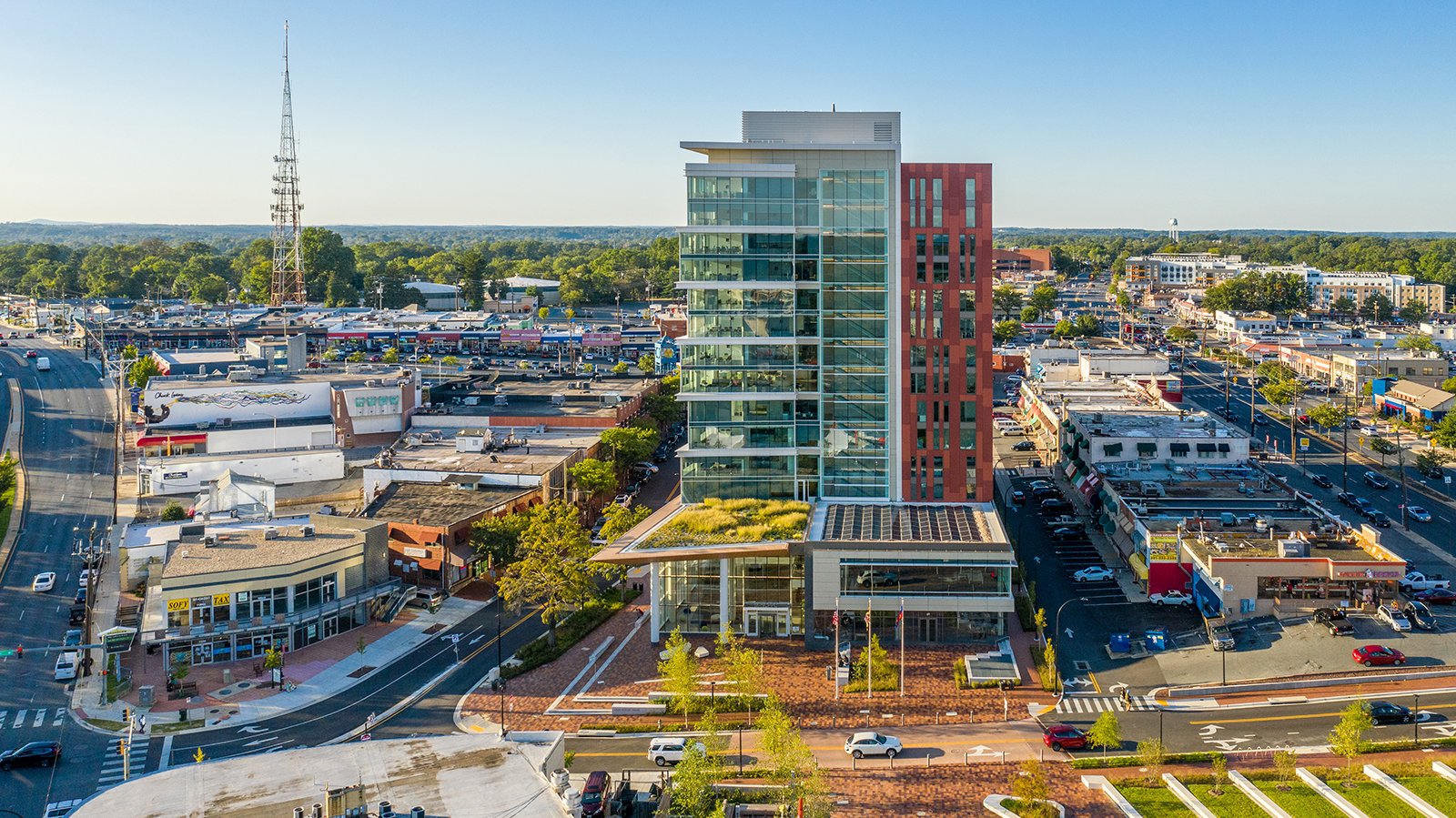
Consider the following buildings in Montgomery County. The first is a LEED-Platinum rated office building just off I-270 with almost non-existent transit service, no proximal services or amenities, and no real concentration of nearby housing. To construct the building, a swath of forest was cleared not only to accommodate the building footprint, but also the parking structure, which incidentally has twice the footprint of the building itself. Its Walkscore is 35.
The second project is the Silver Spring Library, which is scheduled break ground on a site that will eventually serve as a station for the Purple Line light rail system. The library building accommodates ground floor retail, an arts center, additional office space, and a 60,000 square foot library. It sits on a previously developed site, requires no additional parking, will eventually also accommodate 140 residential units, and is located adjacent to the Silver Spring CBD. Its walkscore is 97. The library, however, is projected to only earn a LEED-Silver rating.
According to one study, 30% more energy is expended by workers commuting to a traditional office building than the building itself uses. For an average office building built to modern energy codes, more than twice as much energy is used by commuters than by the building itself. This highlights the importance of building within a walkable framework. You can argue that a “green” auto-dependence is better than the traditional form of auto-dependence, and in the case of Tower Oaks, attractive auto-dependence is better than your run-of-the-mill schlock. But this misses the point. Ultimately, sustainability comes back to a few basic principles. Walkability, and automobile independence, is one.
Other areas in Montgomery County: Olney: 91;Â Friendship Heights: 89;Â White Flint: 80;Â The Kentlands: 78;Â Germantown: 63;Â White Oak: 60;Â Gaithersburg Life Sciences: 55.
Project Profile: The Burnside Rocket
Tacking onto Elza’s post on Silver Spring’s future form, I came across this building a few weeks ago and couldn’t help but think of Fenton Village. It’s cheerful, gritty, and almost certainly would feel at home in a neighborhood that already boasts an array of colors, from the similarly red Pyramid Atlantic to the tastefully pink Jackie’s Restaurant.
And while the Burnside Rocket may seem to offer little in the way of architectural distinction other than a few eccentric shutters painted by local artists (which I think are quite neat), between its crimson painted walls is a powerhouse at work. The LEED-Platinum certified structure is built both to last, approximately 300 years according to the project’s website, and operate efficiently. Hollow-core concrete slabs distribute conditioned air in lieu of metal ductwork. The raw, industrial aesthetic reduces the need for finishing materials and interior partitions. And a ground source heat pump provides efficient indoor air conditioning while desuperheaters recover “waste heat” for domestic water heating. It is also the first building outside Portland’s downtown to not provide parking.
Even more interesting, the roof features an edible garden that is harvested by the restaurant tenant on the top floor. No, the garden is not as photogenic as say, Chicago’s City Hall. In fact it only about half of the green roof is built into the building. But the Burnisde Rocket maximizes its roof space by providing harvestable roof space in the form of “kiddie” pools planted with vegetables, and a planter-lined parapets.
The Burnside Rocket is also an excellent case study on the economic benefits of “going green.” Because of the massive energy savings, estimated at about a 50% reduction from traditional construction, the property owner can offer tenants a full-service lease. Unlike conventional triple-net leases (NNN) where lessee’s pay for all taxes, maintenance, and insurance associated with their tenancy, the property manager assumes these costs and leaves tenants only to account for rent. The result? Property owners can charge more for rent while offering savings when compared with a triple-net lease, and achieve higher profit margins from the reduced operating costs.
Additional Information:
The Greenroof
Green Renter