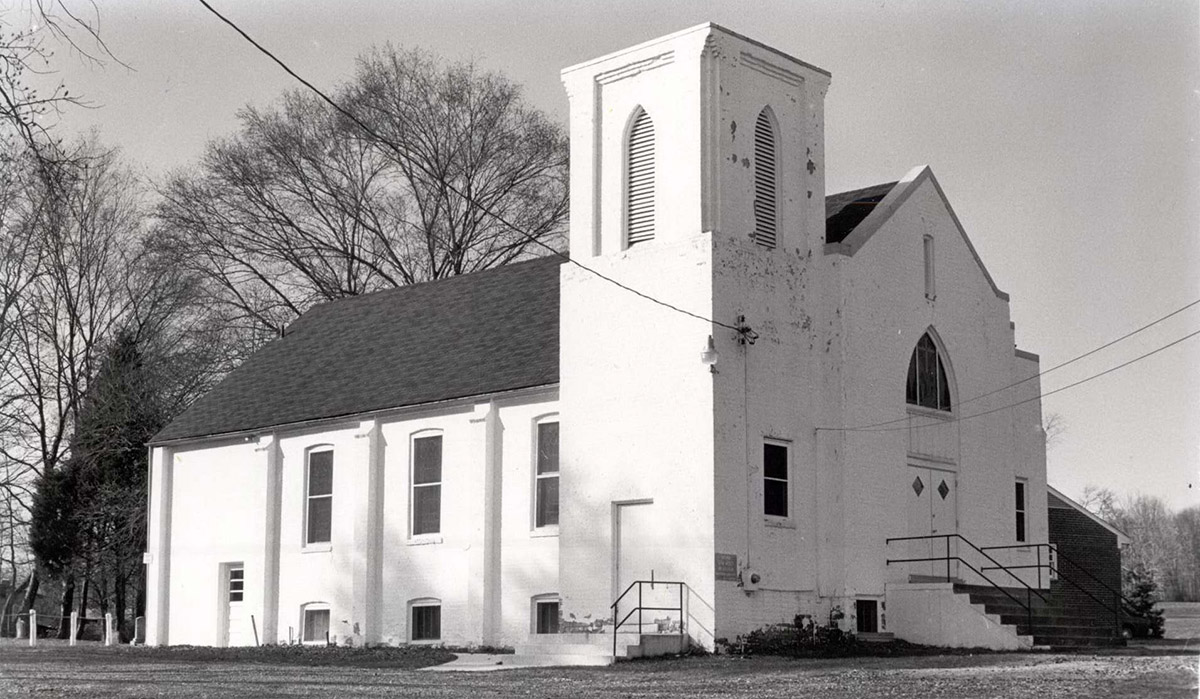
Historic Significance
Rocky Hill is one of the earliest African American communities in Clarksburg. The Community of Faith United Methodist Church (formerly known as the Pleasant View Methodist Episcopal Church and John Wesley Methodist Episcopal Church) served as an anchor for this area in the late nineteenth century. Influential members of the church including the Mason, Foreman, and Wims families are buried in the cemetery. The church is in the vicinity of two, turn-of-the-twentieth-century, African American-owned houses on Frederick Road (Maurice and Sarah Mason House and Warner and Elizabeth Wims House) and a mid-twentieth century subdivision developed by F. Wilson and Sarah Wims.
Evaluation Process
These sites were proposed for designation as part of the Clarksburg Gateway Sector Plan. Designation of resources to the Master Plan for Historic Preservation requires review by the Historic Preservation Commission (HPC) and Planning Board, and ultimately, a vote by the County Council. Each phase of the review offers opportunities for public comment and testimony on the proposed designation.
The HPC held a public hearing and worksession in January 2025 to evaluate the historic and architectural significance of the Clarksburg Heights District and the Community of Faith United Methodist Church and Cemetery. At the worksession the commission found that the resources satisfied the designation criteria for listing in the Master Plan for Historic Preservation and voted unanimously to recommend that the Planning Board and County Council designate them as Master Plan Historic Sites. The Montgomery County Planning Board concurred with these findings, listed the sites on the Locational Atlas & Index of Historic Sites, and recommended that the County Council designate the properties. The County Council voted to approve the historic designations on March 24, 2026.
The designation forms submitted to the commission in January 2025 are available here:
- II.A – Community of Faith United Methodist Church and Cemetery, 22420 Frederick Road, Clarksburg, Designation Form
- II.B – Clarksburg Heights Historic District, 12700-12712 Running Brook Drive, Clarksburg, Designation Form
Historic Preservation in Montgomery County
Adopted by the County Council in 1979, the Master Plan for Historic Preservation is the County’s preservation planning document. It includes the list of all officially designated historic sites and districts. Designation of a single property or entire district as a Master Plan historic site or historic district signifies that the particular site or district has been researched carefully by preservation specialists and, through review by the Montgomery County Historic Preservation Commission (HPC) and the Planning Board and by vote of the Montgomery County Council, determined to be of special historic significance and, therefore, to be protected under the Montgomery County Code, Chapter 24A, Historic Resources Preservation.
Designation in the Master Plan for Historic Preservation: 1) recognizes significant architectural and cultural sites; 2) protects buildings and neighborhoods from demolition; 3) manages exterior alterations to resources; 4) provides owners with information on care, restoration, and preservation; and 5) qualifies owners for special tax benefit programs.
Staff Contact
John Liebertz
301-563-3405
Email