Skip to content

Transit

Mar 25 13

New Transit & New Artwork Coming to Arlington

by joshua sloan
berstein panel 01

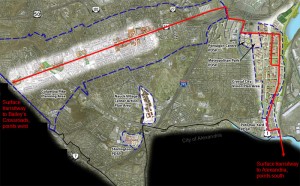
As many of you know, two streetcar lines are proposed for Arlington County: one along Columbia Pike and one through Crystal City.

Many of the benefits of the transit system are laid out in the planning vision for Columbia Pike & Crystal City, including:

  • Encouraging smart development;
  • Providing attractive, comfortable, affordable transit,
  • Encouraging revitalization, preservation, and affordability, and
  • Spurring investment.

 Arlington Streetcar Map

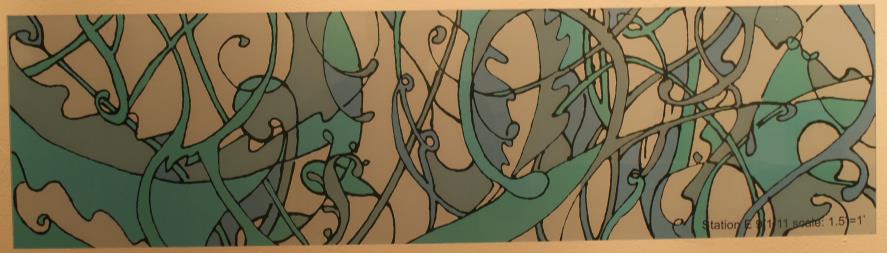
Another aspect of the project, however, is a commitment to integrate public art.  In this case, Barbara Bernstein has been commissioned to create works for several bus shelters along the Crystal City line.  Prototypes, renderings, and sample designs were on view until recently at the Arlington Arts Center, but information can still be found on their website.

bernstein plan view

The proposed artworks are large glass panels that will provide windscreens in addition to enhancing the beauty and interest of each stop.  The designs themselves are swirling, waving, looping, interconnected lines meant to serve as a metaphor for the interconnected layout of the system and the lives of the passengers.  As the lines randomly intersect they create shapes – some of which are filled with color, while others create a background of negative space.  Each station will have a distinct color palette that will provide a visual means of identification for each stop.

berstein panel 01

berstein panel 02

berstein panel 03

The panels are pretty, well-composed, and eye-catching but also serve a functional purpose as wayfinding guides.  Like many transit-oriented artworks, the identification of a site with a motif or specific installation is an important piece of a well-integrated and designed transit system.

Of course, Montgomery County is in the midst of planning a wide-ranging rapid transit system.  We would be wise to encourage public art integration in our system for many reasons, some of which were discussed in a recent panel discussion at the National Building Museum on Cultural Investments: Economic Impact of the Arts.  This discussion was part of a three-part series, Culture as Catalyst: Past, Present, Future.  (The third program, Industry to Art: Revitalizing Cities through Culture will be held on April 10, 2013.)

Robert Lynch, President and CEO of Americans for the Arts, summarized the basic economic impact of the arts industry at the discussion and also in an article at Huffington Post last June:

“Of the $135.2 billion of economic activity generated by America’s arts industry, $61.1 billion comes from the nation’s nonprofit arts and culture organizations and $74.1 billion from event-related expenditures by their audiences. This economic activity supports 4.1 million full-time jobs and produces $22.3 billion in revenue to local, state, and federal governments every year — a yield well beyond their collective $4 billion in arts allocations.”

See the Arts and Economic Prosperity IV website for more information on national and specific local findings.

There are, however, numerous other reasons why the integration of public art is important to vital transit systems; for example:

  • Establishing “brand” and community identity;
  • Making use of and beautifying infrastructure;
  • Creating vibrancy and interest;
  • Provoking emotional investment;
  • Enhancing pedestrian and user comfort; and
  • Telling stories of culture, history, process, or environment.

If we ever get the Silver Spring Transit Station finished, maybe another icon of transit-related public art, “Penguin Rush Hour” by Sally Callmer, can be renovated and reinstalled.  Let’s start the fund-raising now!

penguins 01

penguins 02

Jan 11 13

Transit improvements Should Not Be Considered Anything Paved

by joshua sloan

In response to the article, “The year ahead: A top 10 list of transportation projects to watch“, I have to say I’m quite disappointed. Not by the content per se, but the title.

Of the 10 projects listed, only 4 are truly “transit” projects; the other 6 are highway projects/roadway improvements (all 10 of which are “transportation” projects). The problem that drives some of us in the design and planning business crazy is that it is precisely because these two concepts are conflated, that we miss the opportunity to truly assess progress for more sustainable, congestion-reducing transportation solutions. Words matter because there is so much baggage attached to them.

While, broadly speaking, “transit” is the movement of something from one place to another, it should be understood more narrowly in these conversations. And transit is not just “mass-transit”, it should cover bikes, buses, light rail, heavy rail, bus-rapid-transit, or any tool to decrease travel by one driver in one car; so maybe we add HOV, or car/van-pooling. Transportation, then, should cover these, plus improvements for the average driver. And a separate argument should be pointed out that roadway improvements – adding lanes, widening roads, installing interchanges – rarely actually improve traffic flow; they typically just fill up with more cars: if you pave it, they will drive.

We fight for hard-earned victories when we can persuade policy makers to think more like transit planners rather than traffic engineers and require transportation departments to focus more on the transit side of the equation. Given the 4/6 ratio of the projects you’ve mentioned, we still have a lot to do. Thus, I think the article – in pointing out the pending projects that will impact our daily commute – you could have been more aggressive in showing that the projects that really could positively influence the environmental impacts and congestion issues are not getting the attention they deserve. For example, in our jurisdiction, the Corridor Cities Transitway, the Purple Line, and the Bus Rapid Transit Amendment to the Master Plan of Highways. These plans, and similar ones in surrounding jurisdictions need more attention and a more critical eye from journalists; we can’t pave our way out of our congestion problem and we need everyone to look at the issues more carefully and analytically.

Apparently, however, the print edition was corrected for the online version; but I think my argument is still valid.  But to prove I wasn’t going nuts:

Nov 6 12

Considering a New Way to Combat Traffic

by admin

guest post by Larry Cole

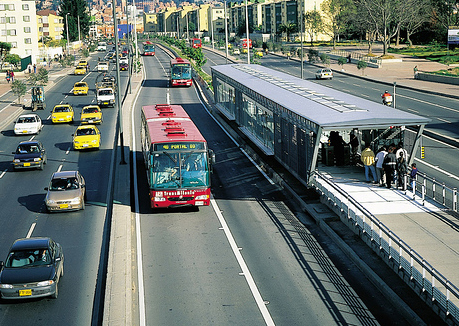
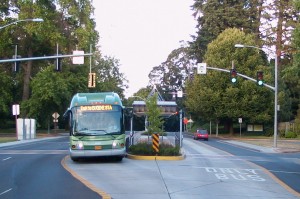
Rapid transit vehicle running down median strip.

Transportation planners often say we cannot build enough roads to fix congestion. In fact, building new roads or expanding existing roads accommodates growth but can also encourage people to move farther out. The result is more people driving longer distances, more carbon emissions, more wasted time in traffic. This effect can be amplified when increased traffic on widened roads lessens the desirability of established neighborhoods.

We believe that there is a better way. This week, we will present the Planning Board with preliminary recommendations for a countywide transit network. Our goal is to increase the appeal of transit serving our activity centers, such as Silver Spring, Bethesda, White Flint, and Germantown, and to move people faster.

The recommended transit corridors would accommodate all-day service with 10- or 15-minute wait times, stations or stops every half-mile or mile, and high-quality vehicles that resemble streetcars rather than traditional buses.

As always when considering public transportation, we estimated the number of potential riders. Sparsely populated areas don’t warrant frequent transit service, but densely populated activity and employment centers generate a greater number of transit riders in a smaller space and warrant more frequent service by high-quality transit. Pairing high-quality transit with growing mixed-use centers brings truly sustainable development, by making the best use of available road space. It’s also more sustainable from the standpoint of County finances since these high-density mixed-use centers also generate the highest tax returns per square foot, lessening the need for subsidies for transit service.

Where Should We Place Transit?
While it makes sense to put transit where people are and want to be, fitting it into existing roads will be a challenge. Our recommendations identify roads within first-ring communities inside and near the Beltway, as well as along the I-270 Corridor, where we could convert travel lanes to bus service.

As we considered where to place BRT service, we concluded that it made most sense to work within our existing master plan rights-of-way by repurposing existing lanes to serve transit, which will minimize impacts to property owners. By working within our existing roadway pavement wherever possible, we can avoid large capital costs, environmental impacts, and the problem of induced traffic. Where we can move more people in a travel lane via transit than private automobiles, we believe that repurposing lanes is a more sustainable solution than obtaining more land and constructing new lanes.

In our analysis, the threshold for dedicated lanes was 1,000 passengers per hour in the peak direction in the peak period. In areas with lower levels of forecast transit demand, we recommend that buses generally operate in mixed traffic but prioritized at traffic lights.

Our studies showed:

  • Highest forecast ridership (49,000 riders a day) along MD355 between Friendship Heights and White Flint. Dedicated lanes or a dedicated busway would provide frequent all-day service in this corridor.
  • To accommodate high ridership on more commuter-focused corridors we recommend a mix of options. For example, along US29, with 17,000 forecast daily riders we recommend a mix of dedicated lanes (south of Lockwood Drive), mixed traffic (on Lockwood Drive and Stewart Lane in the area of the White Oak Transit Center), and a median busway north of Stewart Lane.

We ran our transportation model both with and without a test of lane-repurposing on segments of four corridors: MD355/Rockville Pike, MD97/Georgia Avenue, US29/Colesville Road, and MD650/New Hampshire Avenue to determine the relative impacts on transit ridership, vehicle miles traveled (VMT), and vehicle hours traveled (VHT) in the year 2040. Our results varied by area but were generally favorable, and the benefits were greatest in the down-County area; in Silver Spring alone, VMT would be reduced by six percent.

Transit Stations

Passengers queue up at a BRT station

Sufficient forecast ridership is needed to justify transit, but we need a pedestrian-friendly environment to succeed in attracting that ridership. Safe, handicapped-accessible pedestrian facilities are needed at a minimum, but so are attractive shelters and landscaping, and sufficient bike access to the stations. Refining the standards for these items is one of our tasks for the next phase of our work.

Sustainability Goals
The master plans in some of our activity centers set an ambitious goal of up to half of all travelers using alternative transportation modes – transit, walking, cycling, carpooling – rather than driving alone in a vehicle. Half of all travelers is a large share, but this goal is grounded in our desire for long-term sustainability. BRT is perhaps the best option to get us there and we recommend moving quickly to implement transit improvements on the corridors where we currently have the highest demand.

Aug 3 12

Panel will Discuss Montgomery’s BRT Plans

by Matt Johnson
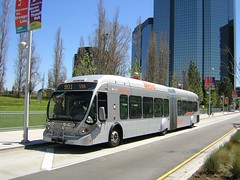
BRT in Los Angeles

BRT in Los Angeles. Image from LACMTA.

If you live or work in Montgomery County, you’ve probably heard about the ambitious plans to build Bus Rapid Transit (BRT) here. You can learn more about the proposal at a panel discussion in Silver Spring this Wednesday.

Bus Rapid Transit is a type of transit using buses, which can include many of the aspects normally associated with light rail. Attributes like reserved lanes, all-door boarding, traffic signal priority, and off-board fare collection speed up buses, and allow transit riders to get where they’re going faster.

The county has announced plans to build as much as 160 miles worth of BRT in Montgomery, to bring quick transit to as many residents as possible.

The Coalition for Smarter Growth is organizing the panel, and its Executive Director, Stewart Schwartz will be moderating. Panelists are members of the Transit Task Force, and will discuss where the lines will go, how it will work, and where the funding will come from.

If you’d like to learn more or be a part of the discussion, the free panel will be held at the Silver Spring Civic Building at 1 Veterans Place in Downtown Silver Spring. The panel, on Wednesday, August 8, will start at 7:00 p.m., and doors will open at 6:30.

If you plan to attend, please RSVP.

May 21 12

How far can you get on transit in 10, 30, 45 minutes?

by joshua sloan

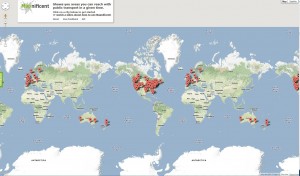
What a fun toy!  Mapnificent shows you how far you can travel on transit from any address for several cities around the world.

You can choose the travel time along a sliding bar and choose specific addresses or drag a pin on the map around.  Here’s the blob from the Planning Department’s address set at 30 minutes:

I was able to quickly look at Chicago and Philadelphia, two cities I’ll be visiting soon, and the times looked about like I’ve experienced before (as does Silver Spring’s).  Nothing for Providence, another city I’ll be visiting this summer, although I know RIPTA has a decent system.

Maybe more soon.

More info and examples were posted on The Atlantic Cities site.

May 14 12

Connecting our “Life Sciences Triangle”

by joshua sloan

On a recent trip to Savannah, we not only had a wonderful time – we learned a few unexpected things. There’s more to the city than the beautiful downtown (with omnipresent SCAD buildings), there’s the economy built on an infrastructure that allows Savannah to be the fourth busiest port in the country (according to our boat tour guide) linked to an extensive heavy rail system. And evidence was obvious on the river – even from the window of the restaurant where we had lunch one day. Transit, however, is generally absent; the free Downtown Transportation (DOT) bus is fine, but it covers an area that’s easy enough to walk.

Freighter Heading up the Savannah River

MoCo’s economy seems more diverse than Savannah’s, but is becoming focused on the life sciences, especially in the fields of health and biotech research. Our own Life Sciences Triangle is beginning to take form – between Bethesda, the Great Seneca Science Corridor, and the White Oak Science Gateway. Two keys ensuring the success of this vision will be linking these areas together and ensuring that there is a robust, mixed use, 24/7 economy around these key nodes. Generally, the latter is a matter of zoning and these areas are developing (or have the potential to develop) with housing, retail service, and employment opportunities. The former, however, is more difficult. Luckily, the early stages of creating transit links are completed and schedules are moving forward.

In the recently published ULI report, Infrastructure 2012, Montgomery County’s Intercounty Connector (ICC) is highlighted as an example of link connecting parts of our suburbs. Unfortunately, the examples of transit systems implementing visions similar to our Life Sciences Triangle are New England’s Knowledge Corridor and North Carolina’s Research Triangle.

But there is hope. The general alignment for the Purple Line transit link between the Bethesda and New Carollton Metro stations has been set since 2009 and several planning studies are being done for areas around key nodes along the line: Takoma Langley Crossroads, Chevy Chase Lake, Long Branch, and Lyttonsville-Rosemary Hills. Another study is ongoing: the Countywide Transit Corridors Functional Master Plan, which will be followed up by a BRT – Land Use Plan. Of course, the Zoning Ordinance Rewrite is also ongoing and being coordinated so that we will have the zoning implementation tools necessary to help these new opportunities succeed.

BRT Proposed Network

And now, the Corridor Cities Transitway (CCT) locally preferred alternative was announced by the Governor’s office on May 11th (press release not online yet) and the schedule has been laid out to implement phase 1 – from Shady Grove Metro station to the Metropolitan Grove MARC station, with service to begin in 2020.

CCT Phase 1

Funding is, of course, a huge issue. But, as Infrastructure 2012 points out, that there are numerous options as budgets and federal funding become constricted, such as:

  • Fuel taxes
  • Vehicle taxes and fees
  • Sales and use taxes
  • Public/private partnerships
  • Tolls
  • Vehicle mileage fees; and
  • Tax Increment Financing/Special Assessment Districts

There also will remain some Transportation Infrastructure Finance & Innovation Act funds designed to leverage these more local alternatives, and a combination of various sources is likely.

Each of these funding sources have been used by various municipalities and the pros/cons and a few examples are laid out well in the report. It’s time to look carefully at the next steps to implement these links and build on the vision that is just beginning to take shape around our evolving, focused economy.

Feb 3 12

Hear Human Transit’s Jarrett Walker in DC or Silver Spring

by Matt Johnson

Building a successful and attractive transit system takes more than drawing lines on a map and buying snazzy vehicles. In addition to the many technical issues, one of the most important factors is values. Who is the system for, and why will they use it?

International transportation consultant Jarrett Walker, who writes the blog Human Transit, has a new book by the same title about the values behind transit, transit’s limits and opportunities, and why people do and don’t ride.

On Tuesday, February 7, the Planning Commission is hosting Jarrett as a part of our speaker series. The talk will start at 7:30 pm in the Planning Board auditorium at 8787 Georgia Avenue in Silver Spring.

If you can’t make it to Silver Spring on the 7th, there are other chances to see Jarrett.

Several local organizations are cosponsoring an informal chat and question/answer session with Jarrett next Thursday, February 9th, at 6:30 pm.

That event will be at the American Public Transportation Association (APTA) offices at 1666 K Street NW, Suite 1100, starting at 6:30. Young Professionals in Transportation, Women’s Transportation Seminar, the American Planning Association, APTA, and Greater Greater Washington are cosponsoring the event.

To go to the evening event at APTA, you do need to RSVP. Additionally, there are a limited number of books available at a discounted rate. You can reserve one when you RSVP.

Also on the 9th, Jarrett will speak at the National Building Museum from 12:30 to 1:30 pm. The National Building Museum is located downtown at 401 F Street NW. It may fill up so RSVP to reserve your space.

For those of you who live or work in the Baltimore area, Jarrett has also announced a lunchtime talk at Penn Station. It will run from noon until 1 pm on Tuesday the 7th.

All of the events are free.

Jarrett’s book, like his blog, is full of insightful commentary. I was particularly interested in his discussion of the relationship between connections and frequency in enabling transit to be a more feasible mode. It was especially poignant for me, since the Metrobus and Prince George’s County bus routes in Greenbelt were restructured around these principles just last year.

Prior to the change, we basically had a “direct service everywhere” design, which meant either long waits for the right bus or long rides on the wrong bus. Jarrett talks about how good design (both frequency and connections between routes) can mean that transferring might get you there more quickly and more reliably at the same cost to the agency. My experience on the ground backs that up, and the book explains why transit works that way.

Anyone who has ridden transit on a regular basis will appreciate the points Jarrett makes. Especially his matrix showing the seven demands of useful transit service. Transit designers must take these demands into consideration if they hope to compete for riders.

I won’t get too in depth, here. But I will strongly encourage you to buy Jarrett’s book. And hopefully I’ll see you at one of his events in the area.

Jan 19 12

The BRT Experience

by claudia kousoulas

does this bus have empathy?

While the Planning Board, staff, and County are facing down the challenges of retro-fitting bus rapid transit into the suburbs, some transit planners are thinking about the soulfulness of mass transit.

Beyond the engineering and economic  calculations, the languge used to describe the service, its frequency and legibility, whether you can eat on a train car or check your email all contribute to how you feel about transit and whether you’re likely to use it.

I am not a frequent Metro user, but when I think about a local trip I consider it an alternative. I usually find it timely and convenient, but am always stymied by figuring the fare. Am I in the peak or peak of the peak? And when will I be coming back? And why do I have to do math while I’m standing there? Quick, how much is $3.65 and $2.85, what bills do I have in my wallet to pay, and is it any wonder I have fare cards tucked into books and coat pockets worth a nickel a piece?

I know, get a smartcard. But here’s where our funny thinking about transit kicks in. I’m willing to carry $25.00 on my EZPass for the rare occasions I travel north of Baltimore, but not on a smartcard for a transit system in my own backyard. Why?

That’s the kind of human factor explored in this article about transit and that’s something to remember about transportation planning. No matter how perfect the system, it’s still used by human beings.

Dec 14 11

If You Think There’s Too Much Traffic Now…

by claudia kousoulas

…imagine if hundreds of thousands of people didn’t take Metro everyday. That trip to Tyson’s Corner malls would be a Christmas time nightmare everyday.

A recent WMATA study modeled the region without transit to measure economic benefits–property values increased, jobs in a regional economy, freeway lanes and parking garages not built.

It’s clear that quality of life comes from a complex set public and private investments and variety in housing, transportation, recreation can feed that complexity.

Sep 9 11

A Scientific Look at Cities

by claudia kousoulas

Scientific American’s special issue on cities covers nearly every urban topic you can think of, from the not so lost aromas of New York’s Fulton Fish Market to the history of the toilet and its influence on the growth of cities. From China to Saudi Arabia, from street markets to solar energy, the issue examines technological and social aspects of urban settlements.

Closer to home, one article asks “Can Suburbs be Designed to Do Away with the Car,” using King Farm in Rockville as an example of the challenges inmaking suburbs and suburbanites transit-friendly. There are plenty of reader comments with the usual claims of elitism and happiness; see where your ideas fall.

Switch to our mobile site