Skip to content

public art

Mar 25 13

New Transit & New Artwork Coming to Arlington

by joshua sloan
berstein panel 01

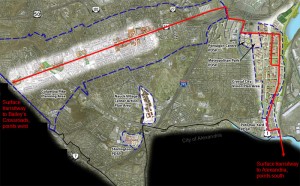
As many of you know, two streetcar lines are proposed for Arlington County: one along Columbia Pike and one through Crystal City.

Many of the benefits of the transit system are laid out in the planning vision for Columbia Pike & Crystal City, including:

  • Encouraging smart development;
  • Providing attractive, comfortable, affordable transit,
  • Encouraging revitalization, preservation, and affordability, and
  • Spurring investment.

 Arlington Streetcar Map

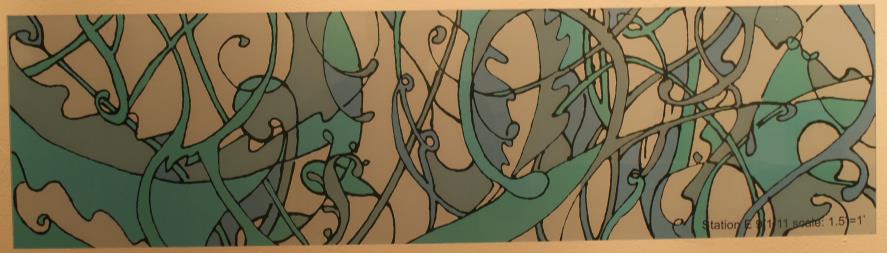
Another aspect of the project, however, is a commitment to integrate public art.  In this case, Barbara Bernstein has been commissioned to create works for several bus shelters along the Crystal City line.  Prototypes, renderings, and sample designs were on view until recently at the Arlington Arts Center, but information can still be found on their website.

bernstein plan view

The proposed artworks are large glass panels that will provide windscreens in addition to enhancing the beauty and interest of each stop.  The designs themselves are swirling, waving, looping, interconnected lines meant to serve as a metaphor for the interconnected layout of the system and the lives of the passengers.  As the lines randomly intersect they create shapes – some of which are filled with color, while others create a background of negative space.  Each station will have a distinct color palette that will provide a visual means of identification for each stop.

berstein panel 01

berstein panel 02

berstein panel 03

The panels are pretty, well-composed, and eye-catching but also serve a functional purpose as wayfinding guides.  Like many transit-oriented artworks, the identification of a site with a motif or specific installation is an important piece of a well-integrated and designed transit system.

Of course, Montgomery County is in the midst of planning a wide-ranging rapid transit system.  We would be wise to encourage public art integration in our system for many reasons, some of which were discussed in a recent panel discussion at the National Building Museum on Cultural Investments: Economic Impact of the Arts.  This discussion was part of a three-part series, Culture as Catalyst: Past, Present, Future.  (The third program, Industry to Art: Revitalizing Cities through Culture will be held on April 10, 2013.)

Robert Lynch, President and CEO of Americans for the Arts, summarized the basic economic impact of the arts industry at the discussion and also in an article at Huffington Post last June:

“Of the $135.2 billion of economic activity generated by America’s arts industry, $61.1 billion comes from the nation’s nonprofit arts and culture organizations and $74.1 billion from event-related expenditures by their audiences. This economic activity supports 4.1 million full-time jobs and produces $22.3 billion in revenue to local, state, and federal governments every year — a yield well beyond their collective $4 billion in arts allocations.”

See the Arts and Economic Prosperity IV website for more information on national and specific local findings.

There are, however, numerous other reasons why the integration of public art is important to vital transit systems; for example:

  • Establishing “brand” and community identity;
  • Making use of and beautifying infrastructure;
  • Creating vibrancy and interest;
  • Provoking emotional investment;
  • Enhancing pedestrian and user comfort; and
  • Telling stories of culture, history, process, or environment.

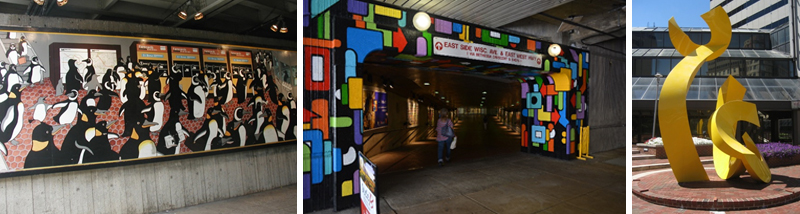
If we ever get the Silver Spring Transit Station finished, maybe another icon of transit-related public art, “Penguin Rush Hour” by Sally Callmer, can be renovated and reinstalled.  Let’s start the fund-raising now!

penguins 01

penguins 02

Dec 6 12

Curating Public Art

by valerie berton

Over the past few decades, Montgomery County has seen a steady rise in the number of public art pieces, bringing artistry and creativity to spaces large and small. We see sculptures, art-enhanced plazas, benches and more in schools, libraries, parks, retail centers and office buildings. The collection provides a set of assets that contribute an extra appeal to the look and feel of our communities.

The Planning Department helps build the collection by encouraging developers to contribute public art in exchange for density.

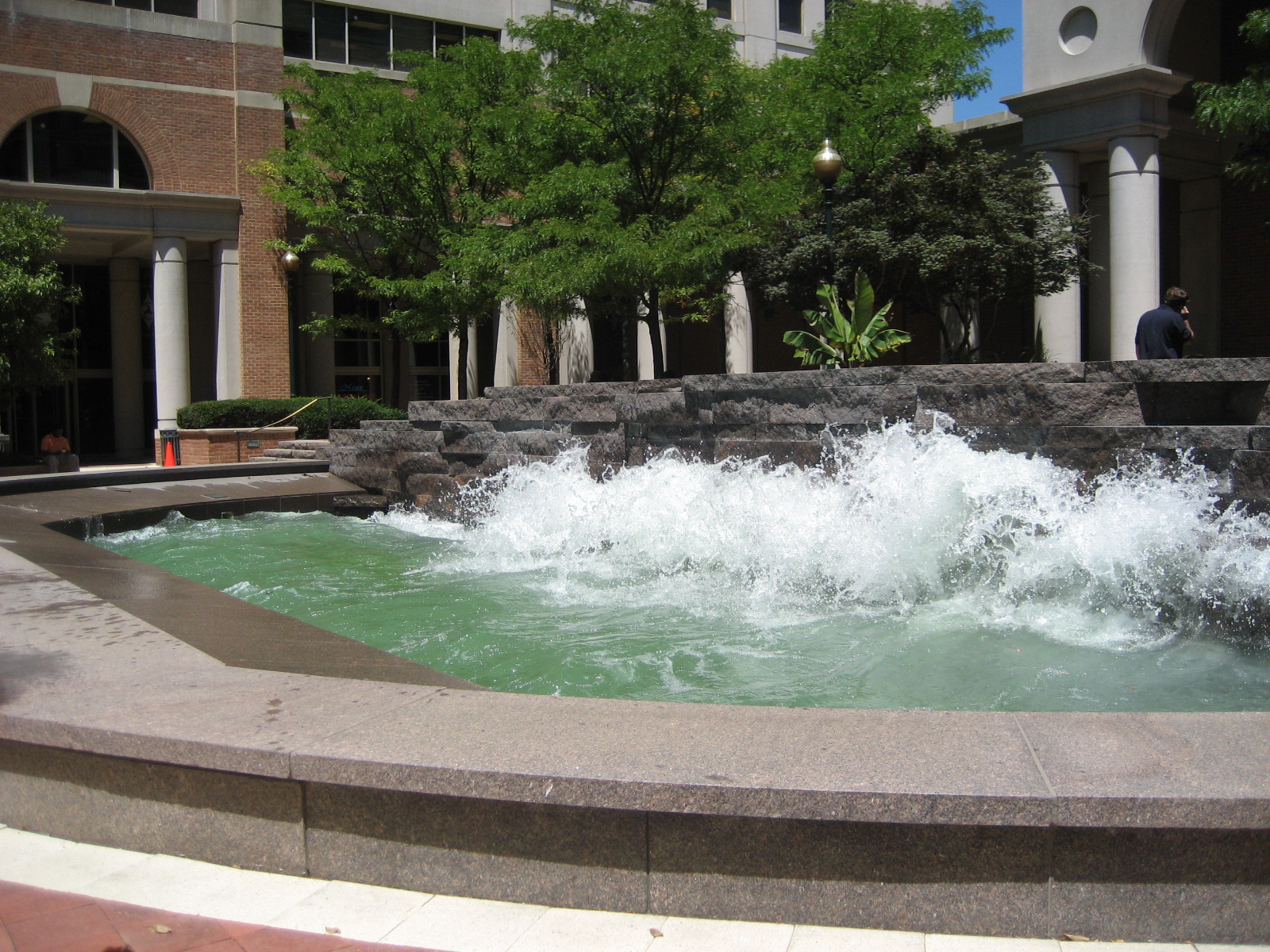
Thus, we have an outdoor pool with real waves correlated to the tides outside the National Oceanic and Atmospheric Administration building in Silver Spring.

Pool outside the National Oceanic and Atmospheric Administration building in Silver Spring

An outstretched palm with birds at a busy Silver Spring intersection.

Catching the eye of motorists and pedestrians at East-West Highway and Colesville Road, Silver Spring

And a set of three oversized granite block chairs that are both eye-catching and a respite for pedestrians on a well-traveled avenue in Bethesda.

Solid granite seats on Old Georgetown Road, Bethesda

Just how art commissioned through private development should work, and how it fits in with the broader public art agenda will be the subject of Planning Board review next week of a public arts policy drafted by The Montgomery County Arts and Humanities Council.

The public arts policy aims to manage, maintain and add value to the full collection. Council members say a more systematic approach to managing and maintaining the artworks will add value to the collection as a whole.

Planners work with professional artists on a review panel that looks for pieces that help build a sense of place. They analyze art and placement with an eye toward access, lighting, durability and other factors. Where pieces are located and how they connect to their surroundings and engage viewers, they say, can be as important as the design of the artwork itself.

The policy has several goals, among them:

  • Promoting culture, community identity and civic pride
  • Celebrating Montgomery County heritage and ethnicity
  • Integrating art into architecture and the landscape
  • Enhancing the image of the county locally as well as nationally
  • Encouraging federal, state and private support for public art


Above all, it’s intended to help place art where it will be enjoyed by many rather than just a few by placing art throughout the county. A consistent approach would help develop art as a true county asset, rather than a sporadic set of pieces.

The Board will review and adopt the document as the standard for managing public art pieces for private development. Other county agencies and organizations, such as Montgomery College and the County’s Executive Branch, also will weigh in.

It is no accident that the developer-placed art appears mainly in down-County locations like Silver Spring and Bethesda. Since 1974, when the optional method of development was created, property owners in high-density zones have been able to apply for additional density if they create more attractive urban environments. Among their options is installing art.

Last year, the County Council approved the Commercial Residential Zone, which provides a list of public amenities for developers opting to earn bonus density. Among the amenities is supplying public art or pay a fee in lieu of providing a new piece.

Also on tap is creation of a Public Art Road Map, intended to provide a big picture look at existing art in the county and point out gaps.


Art has more of an economic impact than most people realize. Statewide, the nonprofit arts sector has a $1 billion impact on the economy, supporting more than 11,000 jobs, according to a just-released report by the Maryland State Arts Council. The report analyzed the impact of performing arts, visual arts, and multidisciplinary arts by region and found that the Capital Region, which includes Frederick, Montgomery and Prince George’s counties, was second to the Central Region (Baltimore, Anne Arundel and surrounding counties) in contributing revenue ($431.2 million) and arts-related jobs (4,865) compared to $495 million and 5,745 jobs.

One might conclude that Montgomery County could do a better job in supporting the arts. Art makes communities distinct, but needs curation and care. The public art policy is one step toward making that happen.

Oct 6 11

Beauty and the Eye of the Beholder

by claudia kousoulas

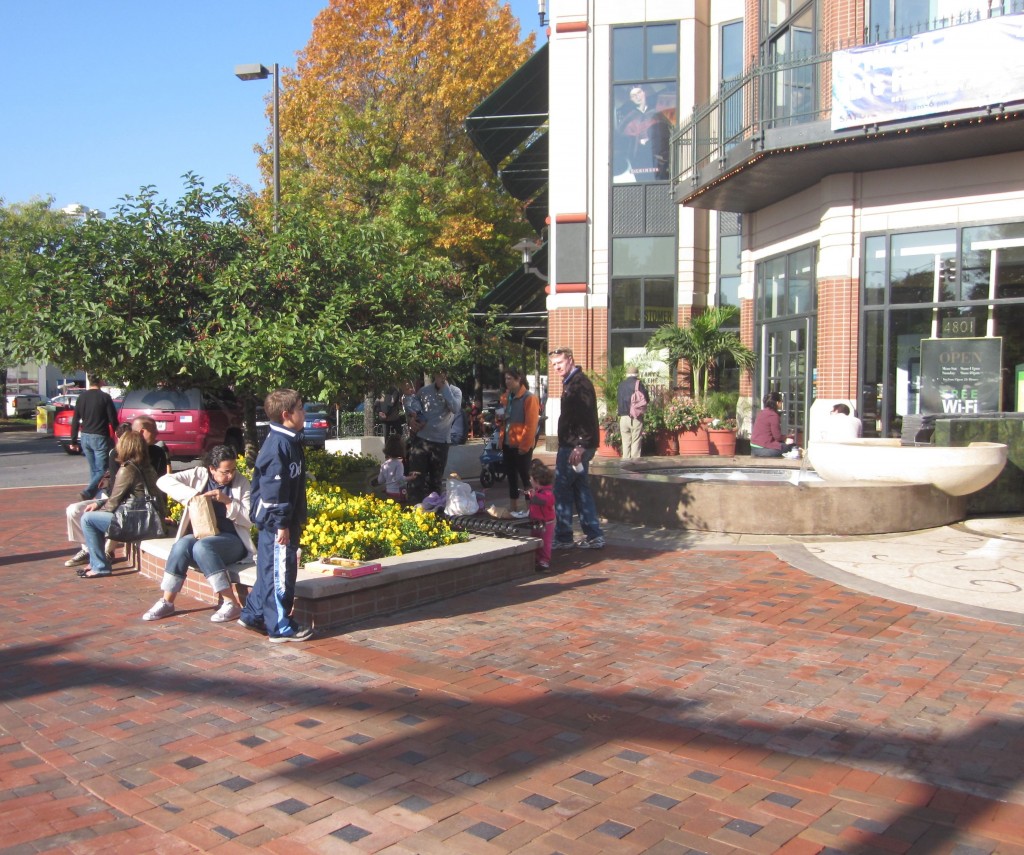
Everyone has an opinion about the new fountain at what people consider the “town square” of Bethesda–the plaza in front of Barnes & Noble Bookstore.  

latte anyone?

As reported online in the Bethesda Patch most of the commenters think it was at best unecessary and at worst, a scheme to keep people from sitting out in front of the store. You can chime in as well by voting online. Unfortunately, out of 209 votes so far, 121 people (57%) don’t like it.

are there enough places to sit?

This is not a Bethesda phenomenon. In fact, just last week, the New York Times reported that Portland, Maine has removed a sculpture called Tracing the Fore. The article quotes Shawn McCarthy, who owns the bar across the street from where the artwork stood.

“In one way it was a conversation piece, but the conversation just was never positive.”

But what are we talking about these days? In earlier eras, we shared a language of methaphor and images, as well as a way of looking at public space and events. Today, victory columns and story-telling pediments are irrelevant media. Even our view of history has changed; the great men are gone. And the lines between public and private space haveblurred. Streets and spaces that are designed to appear public may  be adjunct commercial space.

The interesting thing is that this Bethesda space hardly needs public art, let alone a contentious scultpure. As one Patch commenter noted, this is percieved as Bethesda’s town square, an active intersection of streets, bikes routes, sidewalks, and shops. It already had almost everything that urbanist William H. Whyte claimed you needed for a good urban space–sun, touchable water, food–just needed some movable chairs.

William H. Whyte: The Social Life of Small Urban Spaces – The Street Corner from MAS on Vimeo.

May 9 11

art: empowering youth and teaching sustainability

by joshua sloan

Passing along an article and video from LA on a precious resource: Cuidela.

Oct 15 10

Cool Commuting

by claudia kousoulas

Sure, part of the reason we don’t use Metro is because it’s a long walk from home or you’ve got to pick up the kids after school or you’re just not that interested in the cell phone social life of your seatmate. But wouldn’t mass transit be a little more appealing if it felt like your commute was a scene from a very cool Japanese spy movie?

And Maryland made the New York Times this week as a community that has taken interesting steps toward being green. I can’t believe that DC beat us to taxing shopping bags, this seems like a natural for Montgomery County and isn’t everyone in the habit of traveling with a folded up bag anyway?

Sep 14 10

Place-making art; art-making place

by joshua sloan

Seattle’s Downtown Transit Tunnel was designed as a collaborative project between the project consultant (Parson Brinckerhoff Quade and Douglas Inc.), the architecture subconsultant (TRA), and 25 artists.  The team created what they have termed a distinct “art-itecture” for each station representative of the neighborhood it serves.

The result is a fantastic model for the stations along the proposed Purple Line and the Corridor Cities Transitway.

Even after just a couple days riding the light-rail or buses through Seattle’s stations, a quick glance out the window provides a distinct impression that tells, or shows, where you are. The collaboration is obvious in the integration of artistic details and the creation of a place. You feel that the design process was a conversation – between the place informing the design of the art and the art and architecture reinforcing the sense of place.

Signage and practical information is kept consistent; station logos are modified, but from the same graphic language; and safety is served through varied applications (such as paving, bollards, etc) of similar techniques.

One of my favorite artworks is in the International District Tunnel Station by Sonya Ishii — a grand gesture spanning almost 150 feet along the eastern wall.

This work is a set of nine, 14-foot by 14-foot aluminum panels at various folded stages in the creation of two origami figures. The panels begin virtually flat and end up 2 feet deep to accommodate the folds. One reads from left to center, the other from right to center (as pictured, the top photo is the left).

The heaviness and size of the steel is appropriate for the size of the station and, in this context, actually feels as light as traditional washi origami paper. The colors are simple and bold (not unlike the totem figures of the northwest Native American works that dominate the Seattle art scene).

In all, the work is derived from the place – an international art form in the international district, while helping create a sense of place – “get off the bus at the station with the huge origami figures” (and I bet a first time visitor could pick the station from a random list of all the stations…). This place-making art draws from the uniqueness of the place. It wouldn’t be a stretch to call this an aesthetic example of the dialectic synthesis, as the philosopher would call it, and a model for civic art.

Communities invest in places that reflect and reinforce their sense of self; the artist and design team can bring new perspective and form to that sense. We would be wise to learn from examples such as this before our plans for the Purple Line and the CCT get too far down the, ahem, line.

May 18 10

A Few Links Found While Cleaning Out My Inbox

by joshua sloan

On communities having more input. Not sure I’m down with the program advocated in all – or even most – cases.  But important for particularly important locations and projects, e.g., civic buildings and open spaces.

An example of the grassroots process advocated above that did work:  Paint Your Faith.

Paint Your Faith Video

On artists taking to the streets. But what isn’t more fun in Rome?

Share something in your local park. This is what the right to assembly is all about – knowledge pursued in public spaces.

Last, as if Rybczynski didn’t explain why our cities aren’t like Europe’s well enough – we’re still experimenting with ways to integrate bike transportation.

May 17 10

Elemental Art at United Therapeutics

by joshua sloan

Several sculptural seating elements were created in the plaza space at the new United Therapeutics campus in Silver Spring (corner of Cameron and Spring) and I’ve only begun investigating their interactive potential. Scattered throughout the space and into the sidewalk, these 17- 23-inch poly-resin pieces are shaped like inverted cones stuck into the ground. Several have the symbols of elements, others have designs, most are undecorated.

ut plaza 02

Although fun and functional during the day, their real impact is seen – and heard – at night. The translucent poly-resin material houses LED lights that change color in random patterns based on pedestrian motion or according to a program. Whether this feature is “on” yet, I can’t tell – the colors intensified and faded while I was there, but I wasn’t sure if I was “causing” anything to happen.

Also when I was there, I had forgotten that the installation was also tied into sound system that broadcasts original compositions into the plaza. The music I heard was new-agey and calm and fitting. This may be tied into displays on a future “Bio-Wall” feature that will show visual images and programs run by United Therapeutics and the AFI Silver Theatre. Something to look forward to!

In all, the entire space, including well-integrated plantings, water feature, seating, artworks, and architecture, is an exemplar of design excellence that we – as a county – should emulate. This open space will come to life when the adjacent residential buildings and retail shops start filling as the economic market begins its slow, steady rise back up.

Apr 29 10

Plop, plop, fizz, fizz ….

by joshua sloan

The debate over “plop art” continues – especially when art seems to provide more fizz than substance. Four sculptures by Niki de Saint Phalle, which now sit outside the National Museum of Women in the Arts on New York Avenue, have some wondering if our exterior public spaces are given the same respect as our hallowed museum walls.

Despite their rotund nature, our local Post critic thinks they lack “weight”. Agreed. To a point. His take on it is that such engaging and fun works lack the potency of the subject matter on the canvases and sculptures within the area’s museums; that there is a dichotomy between our expectations of exterior and interior sculptures. As noted, some of de Saint Phalle’s earlier work has been more exuberantly confrontational and provocative, which these certainly aren’t. No one is being asked to engage with their subconscious thoughts on sexuality, femininity, or aggression – or how these ideas trespass on each other.

Serpent Tree

I agree that the most interesting of the four is “Serpent Tree” – there are plenty of myths and metaphors regarding trees and snakes to keep the mind occupied. And the execution in such colors, textures, and finishes keeps the eye equally occupied. Except for “Basketball Player”, which should only be permanently installed at the MJ Hall of Fame, I disagree with the assessment that the others will simply provoke a glimpse and a smile because of a lack of fizz beneath the surface – like fading effervescence that goes flat with time. Well, maybe I agree, but maybe that’s all that can be asked. This is because of, and not despite, the location.

Basketball Player

These are “plop art” in the sense that they are not connected to place – the glam is befitting NY or Milan, the hippy sentimentality is befitting San Francisco – neither “fit” DC. But they are temporary installations here and they do fit the space if not the place. They are large, eye-catching, colorful, and “pretty”. This contrasts with the asphalt and stone and concrete around them. They are set in a median between several lanes of traffic – they have to compete with a lot of noise and space. They compete relatively well; I did see someone actually cross the road to get close and take a video of one piece.

The Three Graces

Nana on a Dolphin

This leaves me wondering whether a more “thoughtful” piece could work in such a space. I doubt it. Large, brash eye-candy is okay in some places. Something that does both would be wonderful, but in such a space would be exceedingly difficult – my vote would be for four trees – real or otherwise … “I think that I shall never see, a [sculpture] as lovely as a tree”….

Graft by Roxy Paine (National Gallery of Art Sculpture Garden)

Apr 23 10

Metalheads: 3 Recent Public Artworks

by joshua sloan

Funny thing, the number of project plan applications in Silver Spring peaked right before the requirement for workforce housing became effective. The now voluntary program would have required affordable housing for any projects over a certain residential density threshold. The fact that we had a rush of applications to beat that deadline was bad news for those of us in the “workforce” that need affordable housing, but it turned out to be good news for those of us who love art in public places.

Three examples, originally approved in 2005, have recently been installed around the Silver Spring area. Each uses various metals in significantly different ways and achieves distinct effects. Generally, they add a touch of contemporary style to otherwise traditional buildings and public spaces. Likewise, they are each engaging and visually interactive in their own right. But I’ll let the photos speak for the artworks and only add a couple personal notes regarding each one.

Wendy M. Ross, Sisyphus

Three metal spheres set on a raised and mounded lawn; built of conical elements that point towards the hollow center. Originally conceived as three spheres with distinct patterns – short, straight metal elements, curved lines in a lattice, and conical elements – the artist revised the concept and built them all from the conical elements. Personally, I think this unifies them and creates more of a sense of gravity between the pieces; whereas the different patterns could have made them seem more autonomous and the overall work less cohesive. And, to be very theoretical, the repetition of forms is more analogous to the theme of repetition in the myth of Sisyphus.

Sisyphus 2

Unlike Camus’ take on that myth, however, there is nothing absurd about our relation to these works; they are clear and structured.  The simplicity of the pattern, the contrasting softness of the grass, the variation in color and movement seen through the cones makes this a distinct and welcome addition to our streetscape.  Located on Cameron Street near the intersection of Cameron and Spring Street.

Ray King, Beacon

Beacon 1

Reflection and refraction are key to catching the eye and differentiating King’s sculpture from the grays of the background. Using glass facets laminated with silver holographic film and a web-like tensile structure the overall form is similar to those used by early futurists, but the technique and application of new materials create a distinct and contemporary landmark.

Beacon 2

Like Ross’s piece, the open framework allows color and light to be seen through the piece, so the interstitial spaces constantly reframe the background. But in this work, the dynamism of the ever-changing refractive facets creates a more immediate sense of color and interaction.  Located at the intersection of Blair Mill Road And East West Highway.

Mary Ann Mears, Lotus

The name is a guess – as it wasn’t titled in the application documents – but references the Egyptian lotus columns that inspired the artist’s work. The intent with these pieces was to bring a sense of scale and to frame movement through the open space.

Unlike the previous two works, these pieces are distinctly solid and much less rigidly geometric. In fact, there is nothing rigid about them. Like something from a surrealist’s melting canvas made 3-dimensional, the sense of movement in this work is more subtle and organic. Seaweed in an undercurrent, hot and lazy dancers, swaying trees…. Each three-sided piece is done in a brushed finish that only slightly reflects the colors of the landscape, similar to a hue seen through a fog. They are large, but intimate and beautifully frame entrances in space as well as the building, and – quite happily – artworks on other sites.  Located at the point where Newell Street and Blair Mill Road hit East West Highway.

(Looks like her website is still a work in progress; if anyone has a good link to her stuff, rather than piece-by-piece, please post.)

Switch to our mobile site