Mixed-Use
Strides in Twinbrook
Good things are happening in Twinbrook, the small community sandwiched between White Flint and the city of Rockville, and planners can take some credit. Three years after the Twinbrook Sector Plan was approved, the area has seen a number of positive changes:
- More housing in an area that lacked housing
- Service-oriented retail, also previously scarce
- Green features, like a bike-share program
- Office construction
The Twinbrook Metro Station makes the community a natural place for growth, particularly residential growth. The Sector Plan calls for more residential units, and they have come.
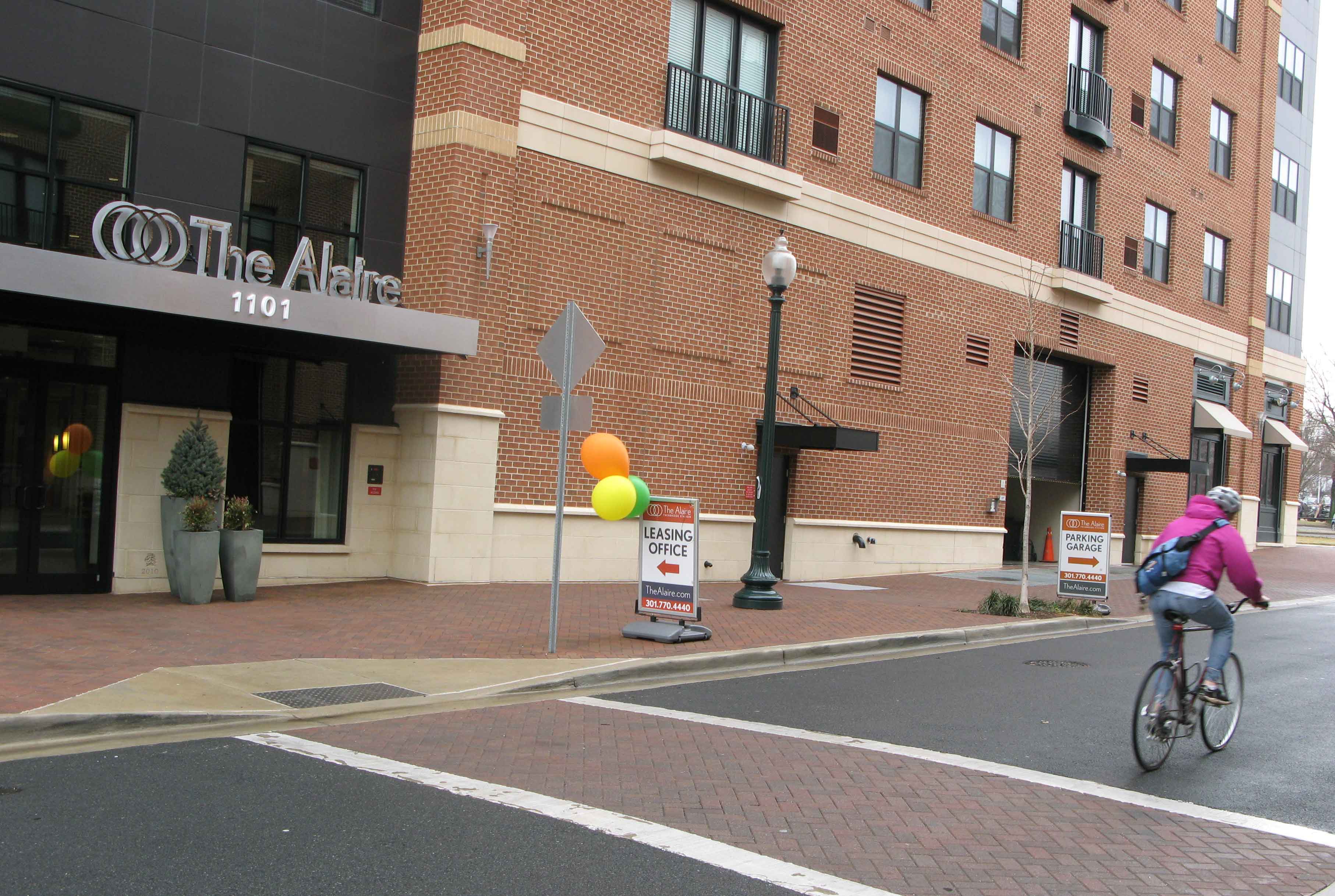
Residents of the new Twinbrook Commons, in the city of Rockville, are just steps from the Twinbrook Metro Station, making it a green development even without the bike share program and solar-powered trash compactor. Planners set the stage for Twinbrook Commons, a medium-density, mixed-use development, before Rockville annexed the area.
Beyond residential development, the 18-story landmark Parklawn Building has been a catalyst for spin-off office development. In 2011, the U.S. Department of Health and Human Services decided to relocate to the Parklawn Building. The HHS decision provided Twinbrook with a serious jobs boost. Across the street, a mixed office and retail building is under construction, and an agency within the National Institutes of Health is building on the large HHS surface parking lot.
Home to one of Montgomery County’s few light industrial areas, Twinbrook’s service industry includes a bevy of practical uses, from kitchen counter fabricators to automotive repair.
We were out in Twinbrook recently to film a Montgomery Plans cable show walking tour. Take the tour, with details provided by planner Fred Boyd, to see Twinbrook’s progress.
MP39- Around Town:Twinbrook from M-NCPPC on Vimeo.
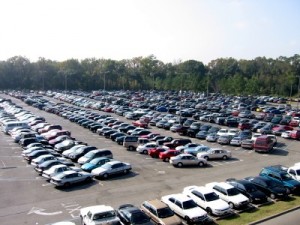
Parking is one of the single-most controversial aspects of development splitting generally along the lines of “we don’t require enough” versus “we require too much”. Parking management is an issue that affects congestion, pollution, pedestrian comfort & safety, potential for open space and green areas, business revitalization feasibility, and many other topics. With so many factors being effected, it’s probable that no model we develop will make everyone (or maybe anyone) completely happy. But it is our task to try.
As many know, the parking ratios we apply to commercial uses have not been updated for decades. And our shared-use model is still based on maximum demand. With this in mind, the County’s DOT and MNCPPC were directed to work with a consultant to examine our existing practices and develop new ideas for establishing parking ratios in our mixed-use/commercial zones. Their report was developed over several months and presented to the Planning Board, County Council committees, the Zoning Advisory Panel (which advises the Planning Department on the ongoing zoning ordinance rewrite), and numerous stakeholder groups of citizens, property owners, developers, bike/transit advocates, and agencies.
The study was focused on Division 59-E (parking requirements) and Chapter 60 (parking lot district [PLD] regulations) of the County Code and our consultant, Nelson/Nygaard, was tasked with several objectives including to:
- Update the PLD program;
- Assess current PLD performance;
- Identify opportunities for PLD improvement;
- Assess interaction between 59-E and 60;
- Update current 59-E requirements;
- Promote shared parking;
- Support local business;
- Increase flexibility; and
- Make standards clearer and more predictable.
A large amount of the initial phase of the study was focused on analysis of our code, best practices in other jurisdictions, and professional models. Some of the more innovative practices included:
- No minimum parking requirements such as Ann Arbor, MI (Public Parking & TDM Strategies Plan);
- Flexible parking pricing such as in San Francisco (SF Park);
- Broad use of employee transit benefits and assurance that parking revenues target local transportation-related investments such as Boulder, CO (Parking Best Practices Review);
- Targeting parking revenues to streetscape improvements to increase pedestrian comfort and safety such as Pasadena, CA (summary at walkablestreets.com); and
- Obtaining shared parking in private development such as Arlington, VA (Columbia Pike Parking Strategy).
Also, the latest industry models from the Urban Land Institute and Institute of Transportation Engineers were studied and compared side-by-side with the benchmark peers, best practice codes, policy-based models, and density-based models. (See the Appendices of the Report for more details.)
After a thorough analysis of the existing code, data on local usage and revenue, and the practices outlined above, a model was drafted. Part 2 will lay out the basics of this model.
Post Script: My vote is for public art integrated into every garage….
Via Fast Company
Portland has long been one of the most celebrated cities in terms of planning and sustainability. Peter Calthorpe is one of the original pioneers of transit-oriented development. In this video, Calthorpe does a nice job of succinctly laying out the principles of transit-oriented development, namely walkability and diversity of population and land use.
Project Profile: The Burnside Rocket
Tacking onto Elza’s post on Silver Spring’s future form, I came across this building a few weeks ago and couldn’t help but think of Fenton Village. It’s cheerful, gritty, and almost certainly would feel at home in a neighborhood that already boasts an array of colors, from the similarly red Pyramid Atlantic to the tastefully pink Jackie’s Restaurant.
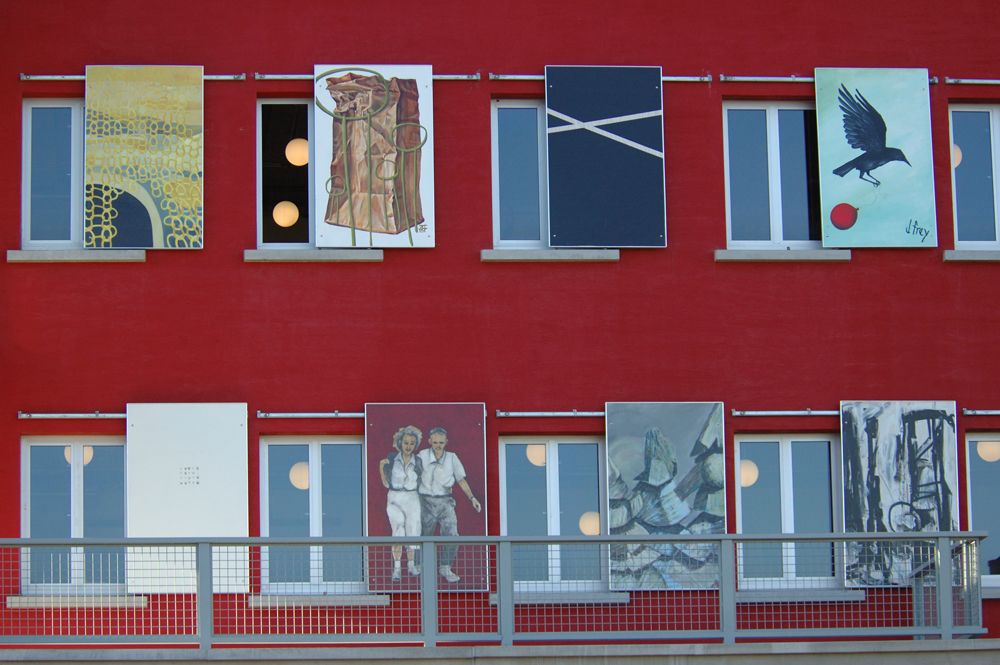
And while the Burnside Rocket may seem to offer little in the way of architectural distinction other than a few eccentric shutters painted by local artists (which I think are quite neat), between its crimson painted walls is a powerhouse at work. The LEED-Platinum certified structure is built both to last, approximately 300 years according to the project’s website, and operate efficiently. Hollow-core concrete slabs distribute conditioned air in lieu of metal ductwork. The raw, industrial aesthetic reduces the need for finishing materials and interior partitions. And a ground source heat pump provides efficient indoor air conditioning while desuperheaters recover “waste heat” for domestic water heating. It is also the first building outside Portland’s downtown to not provide parking.
Even more interesting, the roof features an edible garden that is harvested by the restaurant tenant on the top floor. No, the garden is not as photogenic as say, Chicago’s City Hall. In fact it only about half of the green roof is built into the building. But the Burnisde Rocket maximizes its roof space by providing harvestable roof space in the form of “kiddie” pools planted with vegetables, and a planter-lined parapets.
The Burnside Rocket is also an excellent case study on the economic benefits of “going green.” Because of the massive energy savings, estimated at about a 50% reduction from traditional construction, the property owner can offer tenants a full-service lease. Unlike conventional triple-net leases (NNN) where lessee’s pay for all taxes, maintenance, and insurance associated with their tenancy, the property manager assumes these costs and leaves tenants only to account for rent. The result? Property owners can charge more for rent while offering savings when compared with a triple-net lease, and achieve higher profit margins from the reduced operating costs.
Additional Information:
The Greenroof
Green Renter