A Walk to the Grocery Store
Since moving to Silver Spring, my wife and I have almost always walked to the grocery store. Downtown Silver Spring has several groceries within a short walk of the condo we rented. Now that we live in a house just inside the Beltway, our local grocery store is Sniders. As I have learned, it’s an institution.
While we enjoy shopping there, the 300-yard walk is not pleasant. Unfortunately, that walk resembles pedestrian-challenged spaces so common in auto-oriented environments. Our challenge: we have to cross six-lane Georgia Avenue and several surfaced parking areas for gas stations, dry cleaners and walk in the roadway because there is no sidewalk, to get there.
Georgia Avenue is super busy, terrifying both to walk along or cross. Stand at the bus stop at Seminary Place and Georgia and try to feel safe. Motorists attempting to rapidly change lanes as they get closer to the Beltway on-ramps are traveling fast. Meanwhile it’s also a busy pedestrian space with many commuters waiting to catch the bus. Keep in mind that for a motorist to make eye contact with a pedestrian, they need to be driving less than 24 mph.
While we like our house and neighborhood, do we have to accept such a shoddy, unsafe pedestrian infrastructure? Can better pedestrian routes co-exist with high levels of car traffic?
This sped- up video shows the walk we take to reach the grocery store. We make this trip about four times a week, and we are not alone. More folks would walk if it were not for feeling so unsafe in crossing Georgia Avenue.
This situation is not unique to Montgomery Hills. Exhibit A: Rockville Pike. Exhibit B: Route 198 in Burtonsville. Or even Georgia Avenue farther north in Wheaton. There are so many places where the pedestrian is at risk. Is this the best we can do?
The answer is, of course, no. But before we consider how to improve, it is important to consider a number of constraints.
- Anyone driving through Montgomery Hills or the other routes mentioned above, is in a hurry. They cannot get to where they are going fast enough (or drive close enough to the car in front to prevent someone from cutting in to get onto the I-495 on ramp).
- Georgia Avenue is not a special or favored route. Next time you are driving east on I-495 past Connecticut Avenue, read the exit sign prohibiting trucks from exiting to go south. Hmmm, why is that? Georgia Avenue which has a much higher amount of pedestrian traffic gets all the truck traffic.
- Georgia Avenue is a state road.
That part of Montgomery Hills is zoned commercial-only, perpetuating gas stations, curb cuts, and surface parking lots, all creating points for vehicle and pedestrian conflicts. Is it really necessary for the corner gas stations to have three points of vehicle access? And there are five gas stations within two blocks on a very busy road.
Not every intersection is the same. Different improvements should be considered to fit the needs of each situation.
Believe it or not, the Colesville Road-Fenton Street intersection in Silver Spring was a scramble intersection back in the early 1980s. We have investigated reversing back to that design. I wrote about this in a post last year. This is a place where such an investment could really make a difference to the pedestrian and bring motorists back to reality about driving through more urban places. This design also could work where Colesville crosses Georgia Avenue.
The big reaction against this type of design or many traffic calming measures comes from those who are sure it will slow them down behind the wheel.
The intersection I use at Seminary Place to cross Georgia Avenue does not warrant a scramble intersection because there are too few pedestrians. But the intersection could benefit from some simple fixes.
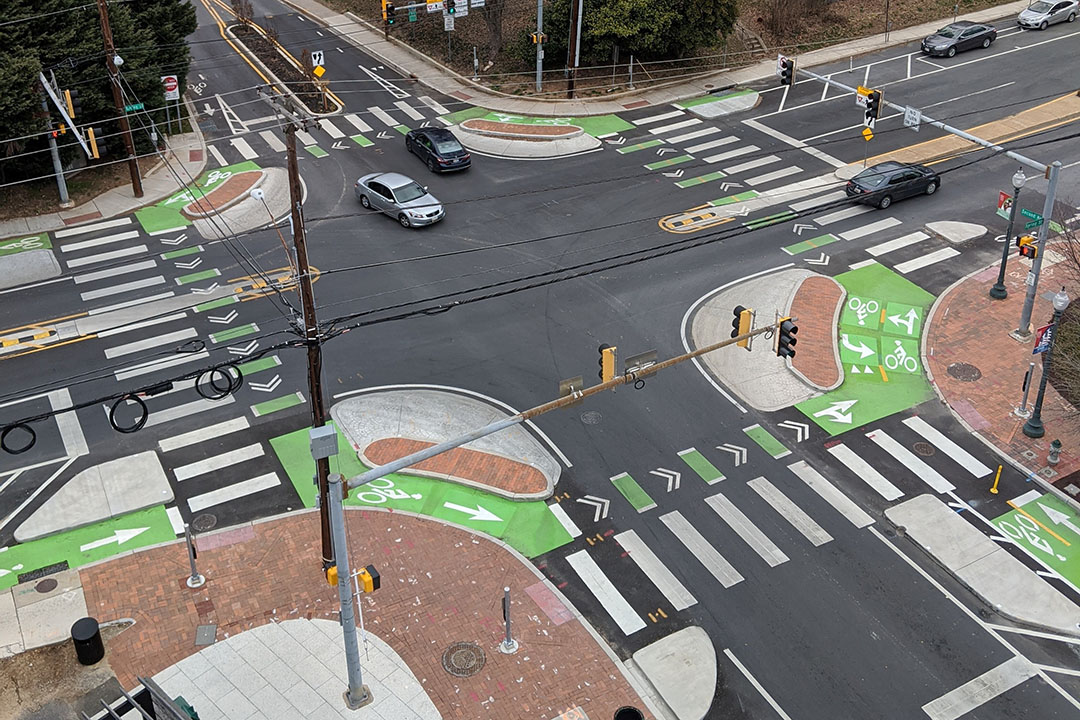
- Striping. Enhance the pedestrian crossings with highly visible crosswalk markings, possibly even texture changes. I realize the snow plows have a small issue, but how often do they plow Georgia Avenue? Where I come from, the City of Toronto uses texture changes for crosswalks and it snows a whole lot more. And striping is just a few thousand dollars.
- Look at zoning changes that might result in new uses like small buildings with residential uses on top bringing more people to the street frontages. More people on the sidewalk can really help change things by making drivers more aware.
Slow the cars down. People move through this area at well over 40 mph. We’ve got speed cameras a quarter-mile south, and people slow their cars. We should do the same in Montgomery Hills. - Reduce the number of curb cuts and establish right-of-way requirements so that as properties redevelop, wider sidewalks can result.
- Emphasize at the County level that pedestrians matter. I agree that we need to move cars, but if it takes 15 seconds longer to move though three blocks of Georgia Avenue, is this a big impact on motorists?
The State Highway Administration is starting to look at this stretch of Georgia Avenue and maybe some of these suggestions should be considered. Let’s hope that by working with SHA we can find ways to improve this busy stretch of road that could serve as a model in other parts of the County. This is especially important as we advance the idea of bus rapid transit, which will bring more folks onto the sidewalks to await their buses. Many of those stops may be in a center median, requiring pedestrians to cross, then stand with cars passing on both sides.
Let’s use the Georgia Avenue-Montgomery Hills intersection rethink as a precedent for how to create safe and functional pedestrian infrastructure in harmony with motor vehicle traffic. I welcome hearing from residents where they think we can do better in their neighborhoods.
Comments are closed.


I well remember the intersections in downtown Silver Spring because I grew up there right after The War. What you term a “scramble” intersection was then called informally a “Barnes dance” after Harry Barnes. He was also credited with popularizing one-way streets. I believe he was head of the traffic department in Flint, MI, and then moved on to Baltimore—which explains why so many streets in Charm City are still one-way.
Colesville Road from around Franklin Ave. north was one-lane each way until around the 1960′s as was University Blvd. As I kid I always wondered why the houses on Univ. Blvd. were set back so far from the road (then called Old Bladensburg Road), but when Univ. Blvd. was widened, it became obvious.
And thanks for your extremely interesting presentation last night to the Taxpayers League. Our youngest son, Eric, has just begun a master’s program in real estate development at Univ. of Md., and I wish he could have been present last night. But he has class every Thursday night.
—Richard
Bradley “Boulevard.” Decent bus service (30 minute headways anyway), but no sidewalks anywhere.
I was going to post this on your Louisville write up, but comments were closed. Your assessment of one ways in urban areas is spot on. We have a plethora of them in Baltimore, and I’ve long suspected (through my experience as a bicyclist/pedestrian and anecdotal evidence) that they starve and divide neighborhoods and reduce business patronage.
Great work on this blog.
Rollin,
Thank you for writing an insightful post on the state of walking in SS. My family lives in DTSS and we hate (knowing that is a strong word) crossing Colesville, Georgia, and/or Wayne. All of these roads seem to be hardened arteries for commuters who traverse from north of DTSS to DC. The obvious problem is that DTSS is developing into a neighborhood / urban center and these wide roads are incompatible with a pedestrian-based community. Also, where are the bike lanes? It’s a terrible system that pits drivers against pedestrians and bikers and any urban planner worth a dime knows that pedestrians and biking make a safer, more desirable community than anything based on driving.
SS has so much potential (despite the myopic decision to put Metro above ground), but the misguided decision-making by past and current County leaders just won’t let it bloom. We have much hope that things will change, but I’m not holding my breath …
As a Silver Spring resident who uses a mobility scooter, I believe that a walkable Silver Spring, wisely planned, makes it far easier for handicapped people to get about. I have enjoyed doing my daily errands in wheelchair accessible downtown but find I cannot use the area around Snyder’s at all for the reasons outlined above.
Before i reverted to a mobility scooter, however, I walked with a cane and crutch and was virtually housebound. On behalf of all the people with bad hearts, arthritis, asthma, obesity, or an armful of kids, I maintain that the best way to make a neighborhood walkable is to provide benches… a cheap, delightful way to lure people out of their cars and to nudge them into giving walking a try.
Americans marvel at how Europeans have developed such walkable cities but they neglect to notice how those cities are filled with benches for people to take rests and enjoy the passing scene as they move from point A to point B. Walking black after a block without a place to rest
can seem too daunting for people who might be willing to give shorter intervals, alleviated by short rests, a try.
Every day in Silver Spring, children are endangered by the lack of sidewalks, proper crosswalks and the general speed of the drivers. I walked around East Silver Spring with a lovely gentleman from the County early last year and he was appalled at the walking situation. Sidewalks that end in nothing, badly patched roads and an absence of proper street markings. And if the kids can make it past all of these obstacles, they must then cross Piney Branch Road to get to school. Numbers of children dash across Piney Branch Road every day. The County provides a crossing guard at one intersection. This guard is routinely late, often absent and the kids must cross without her. And every day there is a near-hit. Even though the county has installed speed cameras, drivers are still speeding on Piney. Yesterday a woman talking on a cell phone almost took out two sixth-graders.
For heaven’s sake, Rollin – don’t you know your supposed to drive – it’s much easier in a car. not.
Thanks for the great video – glad you survived.
Ralph