Skip to content

Wheaton

May 23 12

MontgomeryModern: discover Mid-Century Modern buildings during Preservation Month

by scott whipple

Montgomery Modern


MontgomeryModern explores mid-century modern buildings and communities that reflect the optimistic spirit of the post-war era in Montgomery County, Maryland. From International Style office towers to Googie style stores and contemporary tract houses, MontgomeryModern celebrates the buildings, technology, and materials of the Atomic Age, from the late 1940s through the 1960s. A half century later, we now have perspective to appreciate these resources as a product of their time.


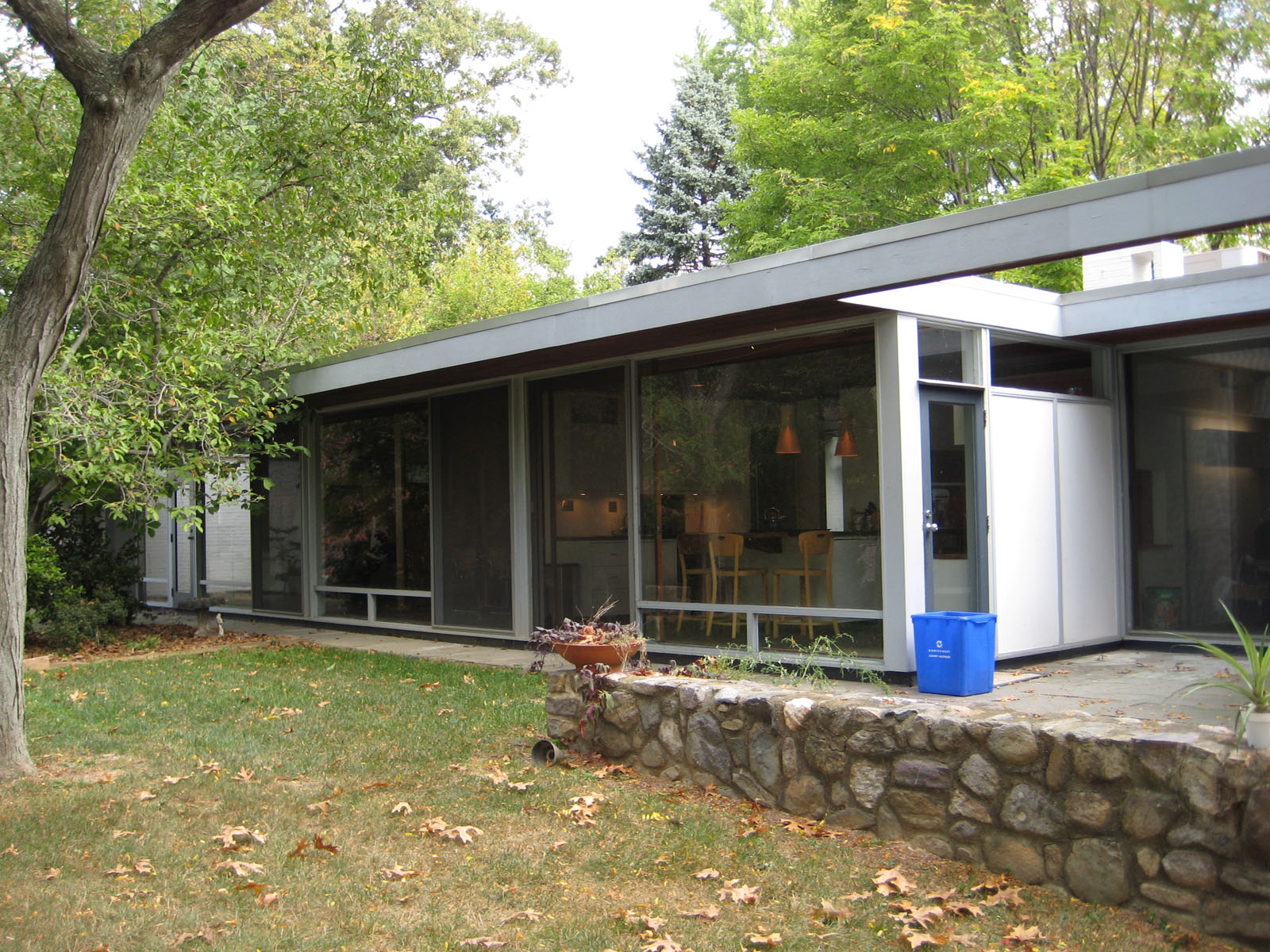
The Seymour Kreiger House

The Seymour Kreiger House

If you read my previous post for Historic Preservation Month, you know that in picking a theme for this year’s Preservation Month, the National Trust for Historic Preservation issued a challenge to people in communities across the country to discover hidden gems and celebrate local historic resources.  Montgomery County historic preservation planners responded by preparing a list of historic resources we hope you will discover.

While Preservation Month has become a fun annual event to raise awareness and celebrate historic preservation nation-wide, our exploration of the county’s historic resources will continue long after we turn the page on May. Our efforts have led us to look beyond what many people recognize as historic, and to start thinking about buildings and places from a period of our history that historic preservationists have only recently begun to consider.  Not long ago Montgomery County historic preservation planners launched a new initiative to study local mid-20th century modern buildings and communities, part of an effort we call MontgomeryModern. The historic value and design significance of the mid-century era — the 1940s through the 1960s — has, until recently, been largely overlooked. But as more than 50 years has passed since these buildings and communities were constructed, we have begun to investigate their historical, cultural and architectural importance.  As a result of a more complete understanding of these mid-century resources, property owners and decision-makers may find more of these resources appropriate for historic preservation.

Carderock Springs

Carderock Springs

MontgomeryModern is exploring mid-century modern buildings and communities that reflect the optimistic spirit of the post-war era in Montgomery County, Maryland. Preservation planners want to help raise the public’s understanding of – and appreciation for – these buildings and communities developed during a time of tremendous growth in Montgomery County. To encourage your discovery of mid-century architecture we included four Modernist buildings or communities in our Preservation Month list of Montgomery County gems. Carderock Springs, a community of 275 houses designed by Keyes, Lethbridge, and Condon and developed by Edmund J. Bennett between 1962-1966, is listed in the National Register of Historic Places.

Rock Creek Woods

Rock Creek Woods

Also listed in the National Register is Rock Creek Woods, a 76-house development that is one of several in Montgomery County by regionally prominent architect Charles Goodman.  World-renowned architect Marcel Breuer designed the International-style Seymour Kreiger House in Bethesda.  The Kreiger House, built in 1958, is listed in the National Register and is designated in the Montgomery County Master Plan for Historic Preservation.  The WTOP Transmitter Building, built in 1939 in Wheaton, is also a landmark modernist building that has been designated in the Master Plan for Historic Preservation.

The intent of including in our list these four historic resources is to give you a taste of the remarkable mid-century modern buildings and communities we have in Montgomery County, and to encourage you to investigate our MontgomeryModern initiative as we learn more about hidden gems from the mid-century.

Feb 23 10

What Walkscore Reveals about Montgomery County

by anthony pins

Earlier this winter, the New York Times ran an article on a CEO’s for Cities study revealing a substantial premium on home sale prices in areas with an above average Walkscore, the informative, if simplistic online measurement tool that ranks neighborhood “walkability” based on proximity to community services and amenities. According to the study, for every additional Walkscore point a neighborhood earns, home prices increase by $700 and $3,000. On average, highly walkable homes sold for $4,000 to $38,000 more than their auto-centric competition.

This past weekend, I attempted to use Walkscore in conjunction with Zillow.com to (at least loosely) confirm the study’s findings for Montgomery County. While zip-code data gave a soft nod in the affirmative, I couldn’t find data fine-grained enough without searching individual listings. I did, however, spend some time seeing how different areas in the County fared on the walkability test.

Not surprisingly, the County’s results range from laudable to loathsome. At the positive end of the spectrum, Bethesda (97), Wheaton (97), and Silver Spring (94), all rank in the top 10% nationwide. They succeed in large part because of their concentration of diverse retail and abundant transportation options. Less exemplary are the Beltway-adjacent areas of Forest Glen (51) and Grosvenor (48) which, despite Metro accessibility, are both physically constrained and poorly served by neighborhood services.

What was most notable about the County is the discontinuity of our walkable fabric. If you own a home three-quarters of a mile west of the Bethesda Metro Station, your Walkscore is probably about 38. Travel the same distance in the opposite direction and you’re likely to earn a score of 55. This trend is pretty consistent throughout the MD-355/Red Line corridor. Worse, though, are the number of pockets in between Metro stations that have diminished Walkscore. This trend suggests that residents and office workers are unlikely to walk to services or use transit without driving to the station (which is still much better than driving to work). Pooks Hill, for example, located just south of the Beltway between the Medical Center and Grosvenor stations barely ekes out a score of 30. As distance between stations increases, this trend becomes increasingly common.

Downtown DC, by contrast, is consistently walkable. According to the CEO for Cities study, DC has a median score 71. A quarter of District neighborhoods score better than 82 on the Walkscore scale, ranking seventh among US cities. Where in Montgomery County the walkable street network extends only a limited distance from Metro, in the District the street network ties together neighborhoods creating a continuous pedestrian environment. As a result, it is just as easy to walk from Adams Morgan to Georgetown where there is no Metro service, as it is to Dupont Circle or Penn Quarter where there is.

Walkscore is also a valuable indicator of a site’s inherently sustainable characteristics. The LEED for Neighborhood Development rating system addresses these considerations in two full sections dedicated to Smart Location and Linkages, and Neighborhood Pattern and Design sections. LEED for New Construction, however, allots only a four points related to walkable site selection (SS 1:Site Selection, SS 2:Development Density & Community Connectivity, SS 4.1: Public Transportation Access and SS 4.4 Parking). Why is this important?

Consider the following buildings in Montgomery County. The first is a LEED-Platinum rated office building just off I-270 with almost non-existent transit service, no proximal services or amenities, and no real concentration of nearby housing. To construct the building, a swath of forest was cleared not only to accommodate the building footprint, but also the parking structure, which incidentally has twice the footprint of the building itself. Its Walkscore is 35.

The second project is the Silver Spring Library, which is scheduled break ground on a site that will eventually serve as a station for the Purple Line light rail system. The library building accommodates ground floor retail, an arts center, additional office space, and a 60,000 square foot library. It sits on a previously developed site, requires no additional parking, will eventually also accommodate 140 residential units, and is located adjacent to the Silver Spring CBD. Its walkscore is 97. The library, however, is projected to only earn a LEED-Silver rating.

According to one study, 30% more energy is expended by workers commuting to a traditional office building than the building itself uses. For an average office building built to modern energy codes, more than twice as much energy is used by commuters than by the building itself. This highlights the importance of building within a walkable framework. You can argue that a “green” auto-dependence is better than the traditional form of auto-dependence, and in the case of Tower Oaks, attractive auto-dependence is better than your run-of-the-mill schlock. But this misses the point. Ultimately, sustainability comes back to a few basic principles. Walkability, and automobile independence, is one.

Other areas in Montgomery County: Olney: 91; Friendship Heights: 89; White Flint: 80; The Kentlands: 78; Germantown: 63; White Oak: 60; Gaithersburg Life Sciences: 55.

Switch to our mobile site