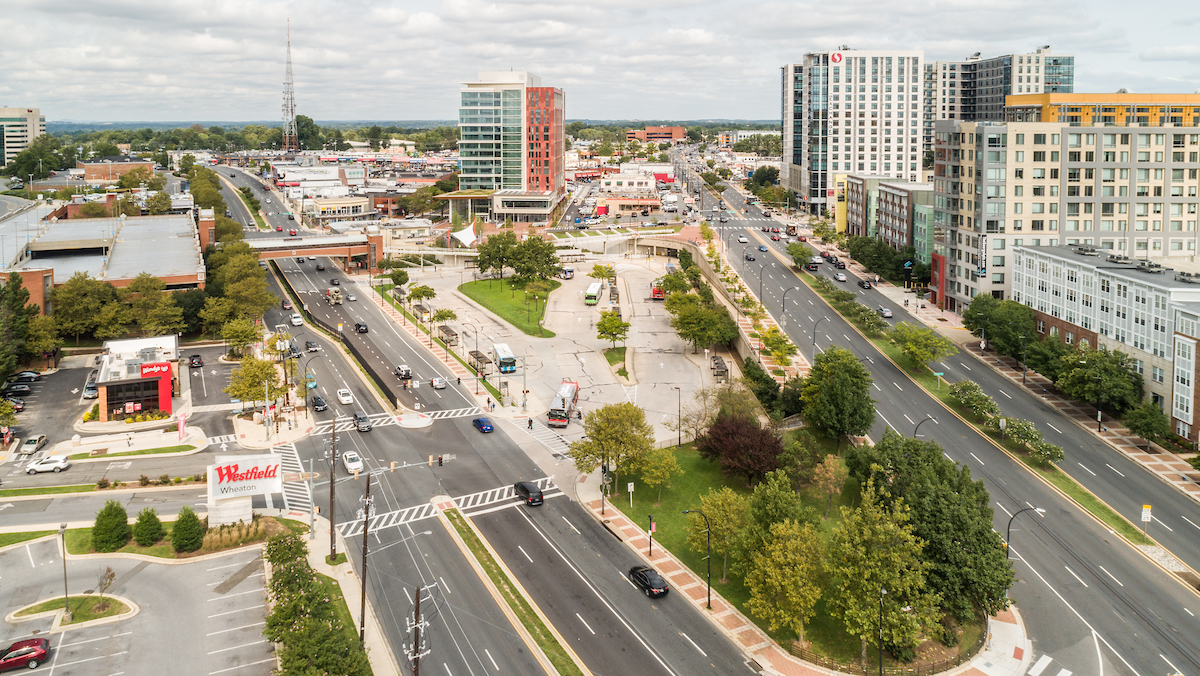


Wheaton sits at the crossroads of Georgia Avenue, University Boulevard, and Veirs Mill Road—a vibrant, diverse community of nearly 36,000 residents with locally owned restaurants, shops, and businesses that reflect its unique character. Recent initiatives, including the 2012 Wheaton Central Business District and Vicinity Sector Plan, the 2022 Wheaton Downtown Study, and 2023 Streetscape Standards, and the 2025 Wheels in Wheaton Placemaking project, have shaped a vision for the future founded in community participation.
The Wheaton Plan builds on this momentum to better connect Wheaton multimodally, economically, and culturally to deliver lasting solutions to create a thriving activity center and a key link to nearby communities like Silver Spring, Glenmont, Kensington, and Rockville.
Guided by Thrive Montgomery 2050, the plan will explore new housing types to support incremental growth, enhance transportation choices, and sustain Wheaton’s unique small business community. Montgomery Planning is committed to working with residents to create a safe, resilient, and vibrant Wheaton.
Plan Goals
The Goals will be refined during the community visioning phase of the Plan. Goals include:
- Advancing Wheaton’s potential by identifying actionable strategies and recommendations for multimodal transportation, environmental resilience, housing affordability, and economic competitiveness
- Responding to community calls for improved walkability, safety, and connectivity
- Supporting and enhancing Wheaton’s unique identity and sense of place
Why now?
Wheaton is ready for its next chapter. Despite strong assets, like a Metrorail station, civic institutions, and diverse businesses, development has lagged behind expectations, and economic challenges persist, including disparities in income, education, and housing affordability. Since the last plan in 2012, much has changed—and more is coming in the next 20 years: climate impacts, market shifts, affordability pressures, and technological advances.
The Wheaton Plan responds to these realities and community priorities for walkability, safety, and connectivity. This is an opportunity to realize Wheaton’s full potential, leveraging public investment and zoning to deliver new housing, infrastructure upgrades, and support for small businesses.
Timeline
-
Winter 2025Pre-planning
-
Winter 2026Plan kickoff
-
Spring 2026Scope of Work approved by Planning Board
-
Summer 2026-Summer 2027Community visioning
-
Winter 2026Existing conditions analysis
-
Summer 2027Share preliminary recommendations with community and Planning Board
-
Fall 2027Working Draft presented to Planning Board
-
Winter-Summer 2028Planning Board public hearing, work sessions and draft
-
Fall 2028-Winter 2028County Executive review, Council public hearing, work sessions and approval