This blog post is also published as a Greater Greater Washington guest column.
As Montgomery County eagerly awaits next year’s anticipated opening of the Purple Line, we know few communities stand to gain as much from the massive light-rail investment as those located south of the Capital Beltway between Sligo Creek and the Prince George’s County line.
That area will have three Purple Line stations: Manchester Place, Long Branch, and Piney Branch Road. At the same time, the county has plans to add fast, frequent bus service, known as bus rapid transit (BRT), to University Boulevard and New Hampshire Avenue, complementing today’s BRT line on Colesville Road.
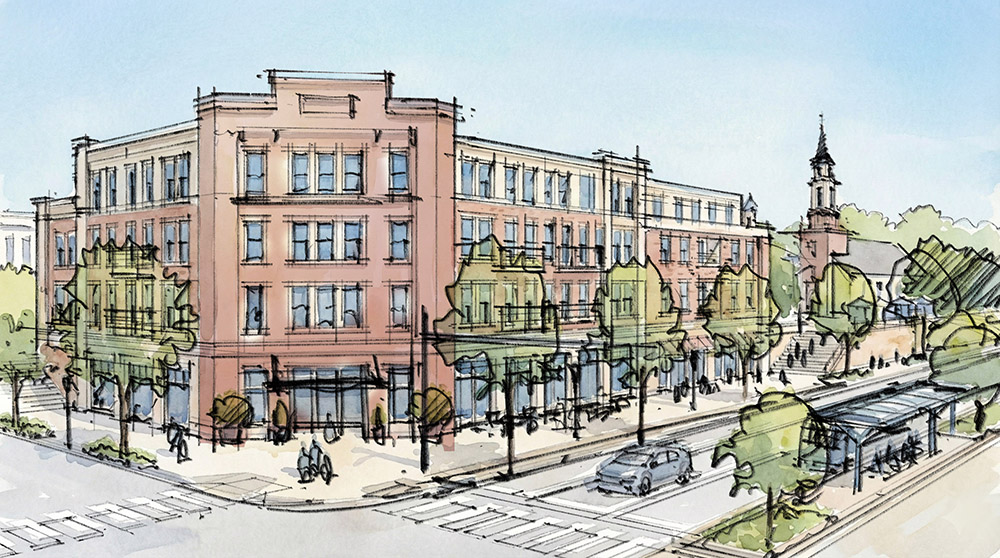
Rendering of the future Oakview Drive BRT station on New Hampshire Avenue visualized through the Eastern Silver Spring Communities Plan.
When built, many of the area’s 37,000 residents will live within a half-mile walk – about 10 minutes – of a bus rapid transit or Purple Line station, providing a once-in-a-generation opportunity to support more compact, walkable, and livable communities.
That’s why we’ve been working since late 2023 on the Eastern Silver Spring Communities Plan to guide the area’s growth, land use, housing, transportation, schools, and environment over the next 20 or so years.
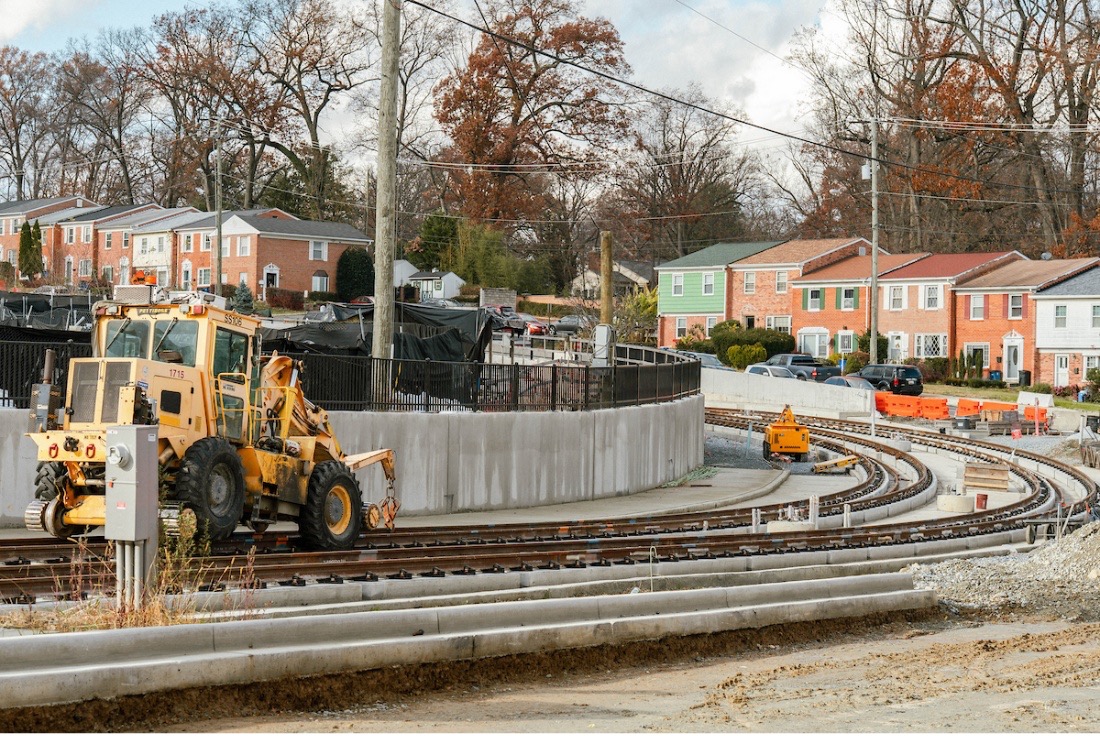
Construction of the Purple Line Piney Branch Station.
By allowing growth around transit stations, more people can be less dependent on their cars for transportation, and will be within a short walk, ride, or roll of more shops, restaurants, and amenities. Along with economic investment, creating opportunities for more homes and jobs by transit also could bring more walkable streets, more sidewalks and trails, brighter street lighting, and more shade trees.
As excited as many residents and business owners are about the potential benefits of transit-oriented development, we’ve also heard concerns about what these changes could mean for their neighborhood. Throughout this process, we’ve heard from more than 1,200 community members.
One overarching challenge that we’ve heard is something that is top of mind for many county residents: housing affordability. Household incomes in the plan area average about $115,500, far below the county average of $172,866, and more residents rent than own their homes. Renters and homeowners agree that they want to ensure that their neighborhoods, which are some of the most affordable in Montgomery County, remain within reach.
Rising property values – and, in turn, rents – around new transit stations could price out the very residents and local businesses that public transportation is intended to benefit. In response, the Eastern Silver Spring Communities Plan’s preliminary recommendations focus on protecting existing residents by calling for no net loss of affordability with redevelopment, deeper affordability in new housing, and specific strategies to prevent displacement. These initial recommendations also promote a wider mix of housing types near transit to create more affordable options and housing choices.
Housing quality was also a concern stated by residents and businesses. The recommendations seek to improve housing quality without raising rents by exploring the use of incentives to fix older buildings while keeping rents stable.
Many have told us how much they cherish the area’s beautiful stream valley parks, wide variety of locally owned restaurants and markets, and vibrant diversity, including a large immigrant population. But they also see room for improvement. They’re asking for safer routes for pedestrians and cyclists, more public spaces, and support for small businesses, such as in the Long Branch commercial district.
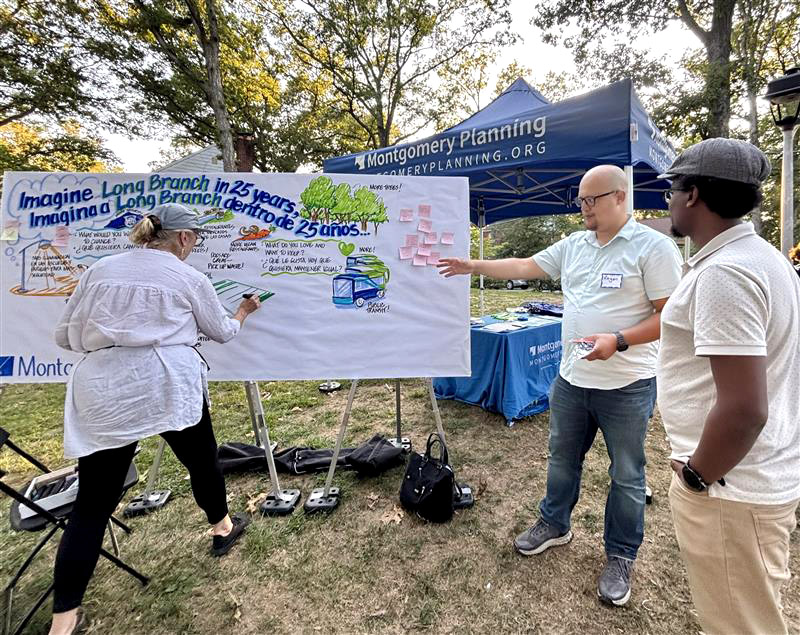
Community members interacting with a graphic recording artist for the plan during Long Branch Festival in 2025.
Our recommendations
The Eastern Silver Spring Communities Plan’s preliminary recommendations seek to maximize the immense potential of transit-oriented development while minimizing its downsides.
Help more people of all incomes live near transit stations
- Allow more homes of all types near transit stations to provide options for residents of different income levels, household sizes and stages of life.
- Make it easier for community institutions, such as churches, to build housing.
Preserve and expand safe, subsidized, and affordable housing
- Require that at least 15% of new residential units be preserved as “moderately priced.” Incentivize deeply affordable units in new development or redevelopment.
- Explore tax breaks and other incentives for property owners willing to keep rents stable in exchange for financial aid to make improvements.
Expand and improve local parks
- Add picnic shelters, sports fields, and other amenities.
- Make them easier and safer to reach via trails, sidewalks, and pedestrian crossings.
- Plant more shade trees to protect people from the summer heat.
Make it safer to walk, ride, and roll
- Add wider sidewalks and more frequent protected pedestrian crossings to major roads.
- Add sidewalks to neighborhood streets, particularly near transit stations, parks, and schools.
Protect local businesses, help them grow, and attract new ones
- Incentivize redevelopment in Long Branch to include affordable retail spaces and preserve existing locally-owned businesses.
Protect the environment
- Provide incentives for new buildings to be energy-efficient.
- Ensure new construction has plenty of tree canopy, grass, and other greenery to provide shade, control flooding, and improve water quality.
Encourage infill development and attractive building designs
- Support development on vacant land, parking lots, and other underused areas.
- Ensure that the design and scale of such infill development fit with surrounding context.
- Encourage building designs with appealing facades and off-street driveways to protect pedestrians.
Going forward
As we develop a first draft of the plan to present to the Montgomery County Planning Board in the fall of 2026, we are continuing to listen to the community. We hope you’ll share your ideas and opinions. Together we can ensure that the coming Purple Line and BRT are big wins for the communities around the Manchester Place, Long Branch, and Piney Branch Road Purple Line stations–and for everyone.
You can visit montgomeryplanning.org/esscp to share your thoughts about the preliminary recommendations by completing our online questionnaire or contact the Planning Team at easternsilverspring@montgomeryplanning.org.
 About the author
Carrie Sanders is the Division Chief for East County Planning in the Montgomery County Planning Department, responsible for development review and master planning in the east county. Carrie joined the Planning Department as a Planning Chief in 2017 and has overseen regulatory and master planning in many communities in Montgomery County, including North Bethesda, Grosvenor-Strathmore, Great Seneca, Kensington, Wheaton, and White Oak. Carrie is a graduate of the Leadership Montgomery CORE Program (Connecting Our Region’s Executives) and of the Urban Land Institute’s Washington’s Regional Land Use Leadership Institute. Prior to joining M-NCPPC, Sanders served as Deputy Director of Transportation for the City of Alexandria, where she oversaw transportation planning, transportation engineering, and mobility services. She holds a bachelor’s degree from Indiana University and a master’s degree in urban planning from the University of Maryland, College Park.
Leave a Reply