
Etching of the Vitruvian primitive hut, made from wood, by Charles Eisen in 1755 exploring the origins of architecture and its practice, in the essay on architecture by Marc-Antoine Laugier.
Perhaps because I am an architect, I love looking at landscapes, and I love looking at the grain detail of large wood beams, siding and furniture within a building. The natural flow of the grain can be mesmerizing and just looking at and touching wood, is calming.
Throughout history, human societies have used wood to construct structures ranging from modest dwellings to highly sophisticated religious and civic buildings. When wood is used within buildings, it nurtures a relationship between the tenants who use a space, and nature which created the wood. This relationship is called biophilic design, and with the use of wood in the structure of buildings, this relationship not only enhances our health and wellbeing, but the use of wood also is tremendous for the environment because it is renewable and it sequesters carbon, a primary element of greenhouse gases.
Using wood for the structure of a building, which includes the beams, columns, and structural floor/wall panels, is known as “Mass Timber” Type III construction. This is not to be confused with Type V wood light framed construction where 2 x 4s and 2 x 12s are generally used for framing a house or smaller-sized apartment building. Mass Timber is an energy efficient, sustainable alternative to other forms of building construction with a much lighter carbon footprint than the typical materials of steel and concrete. Mass timber construction has one-third of the carbon footprint of a similarly sized steel and concrete building. It is structurally strong and meets the same performance and fire safety requirements as concrete or steel structures.
Mass timber is also sustainable and renewable as trees are selectively harvested from certified commercial forests, and continuously replenished through a cycle of growing, harvesting, and replanting. Prominent mid-Atlantic states for harvesting include Pennsylvania, West Virginia, Virginia, and North Carolina. The structural members and panels are created by binding wood pieces together by nails or glue and then compressing layers with glue to create structural strength that can withstand high winds and earthquakes.
Mass timber is also fire rated up to three hours or more to withstand catastrophic fires and to meet all building safety codes. The exterior of the wood member can char which ultimately protects the middle of the member to allow it to maintain its structural capacity.
Mass timber columns, beams, and panels weigh about one-fifth of the weight of steel and concrete, so there is an added advantage of reducing shipping costs to a site. Because the mass timber members are put together like a Lincoln Log toy set where each piece fits into the other, construction time can be reduced by over 25%, which saves owners a great deal of time and money.
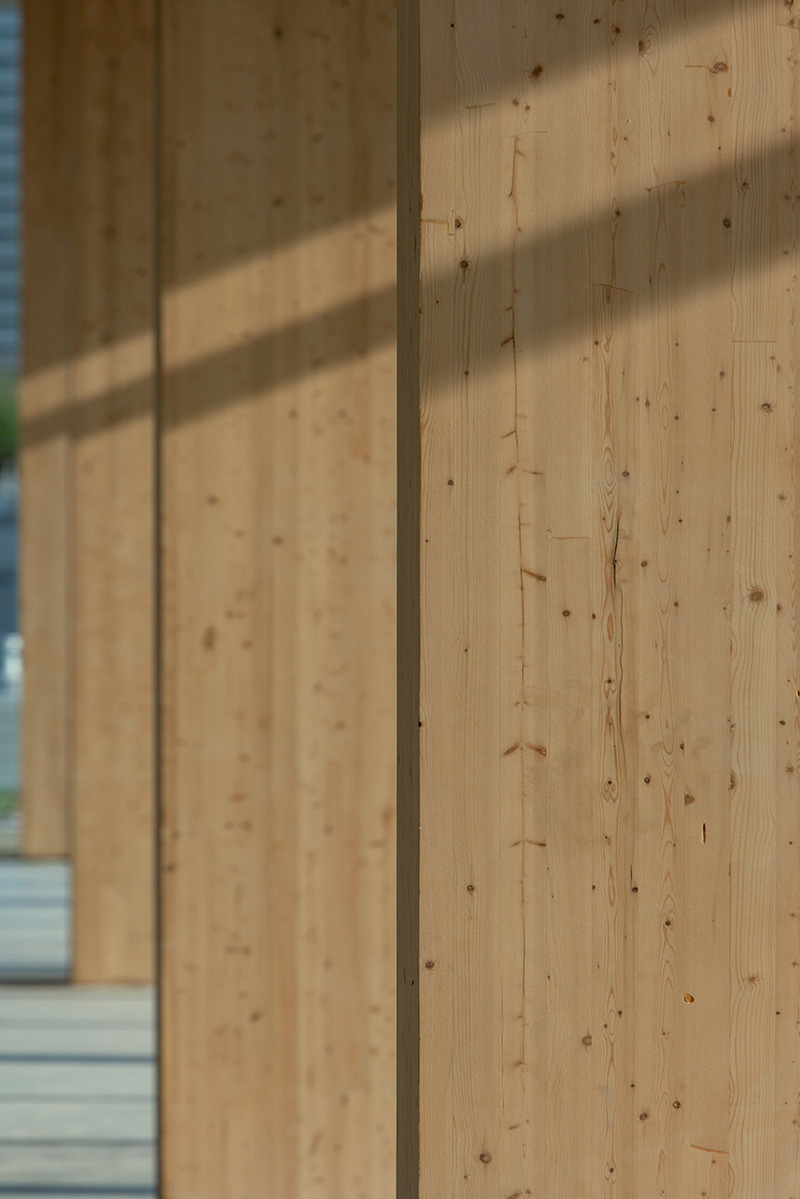
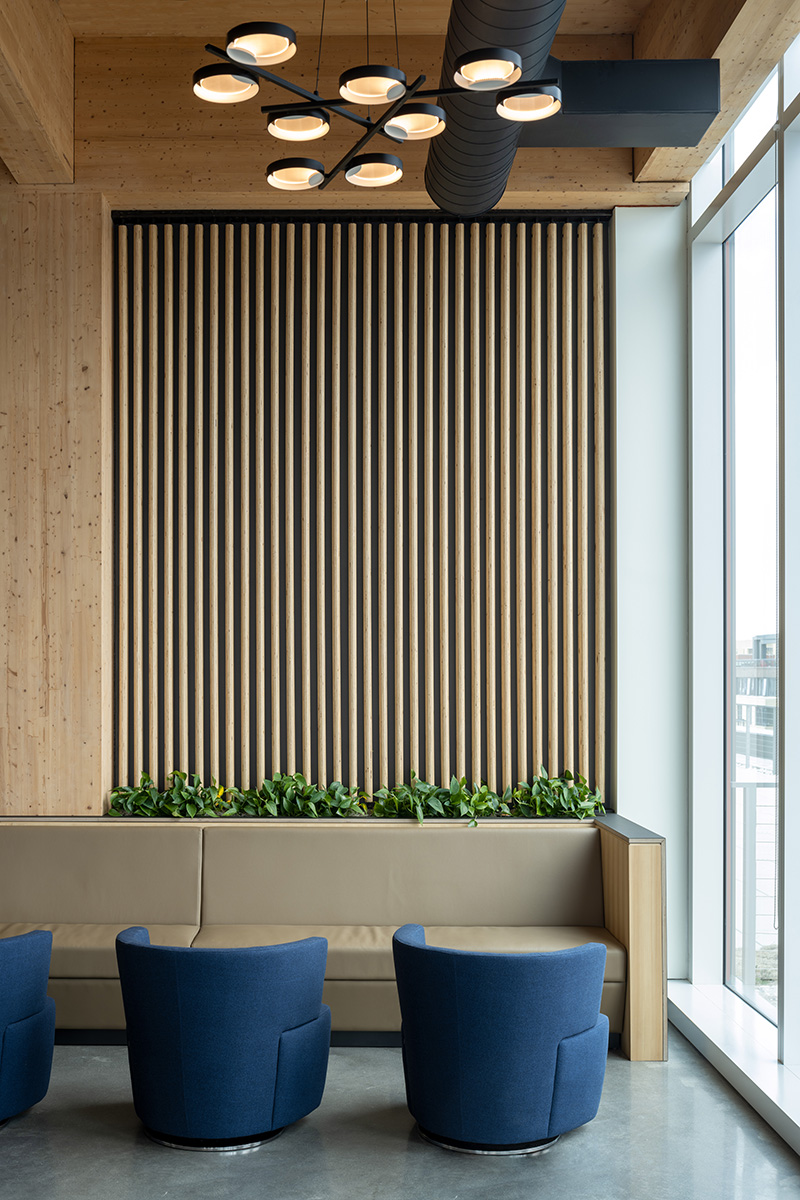
 The beauty of the natural grain and color of wood has a calming effect on building tenants. Photo courtesy Bob Blunt and Hickok Cole Architects.
To date, most mass timber buildings in the United States are shorter commercial buildings at two to three stories including schools, retail buildings, museums, and sports complexes. However, taller office and residential buildings of five or more stories are slowly becoming more common as Type III heavy timber building code standards become more inclusive of this building type. The tallest mass timber building in the world is the 25-story Ascent tower in Milwaukee. It is 284 feet tall and houses six floors of retail and amenities and 19 floors of 259 luxury apartment units. In these types of buildings, elevator and stair cores and exterior materials are mostly created out of masonry and concrete with the structural columns and beams and floor and wall panels all being built out of wood.
To make mass timber construction more standard with broad adoption in the U.S., several barriers need to be overcome. The first barrier is initial cost. The initial cost of mass timber is currently more expensive than standard steel or concrete construction. This is primarily due to the lack of suppliers and factories/mills that create the finished materials throughout the country. There is also a lack of contractors who are experienced and/or comfortable with the construction type and process. Once more timber wood suppliers and mills come online, especially in our more forested regions, and more contractors become comfortable with building mass timber buildings, the cost and construction time will come down significantly, making this much more competitive.
Another impediment includes current state- and local-government fire safety policies and regulations based on current International Building Code (IBC) requirements. Those rules may begin to change as the new IBC now allows Type III heavy timber construction for projects that are up to 270 feet in height. Some jurisdictions, like Washington, DC, are already shifting to more timber wood construction. Through review and acceptance of project-specific solutions that meet safety standards, DC is allowing buildings, such as the 3-story addition to the previously 7-story 80 M Street SE building, to be constructed to great success. This cooperation between developers, architects, engineers, and jurisdictions will need to continue to allow mass timber to leverage its benefits and be used in taller buildings.
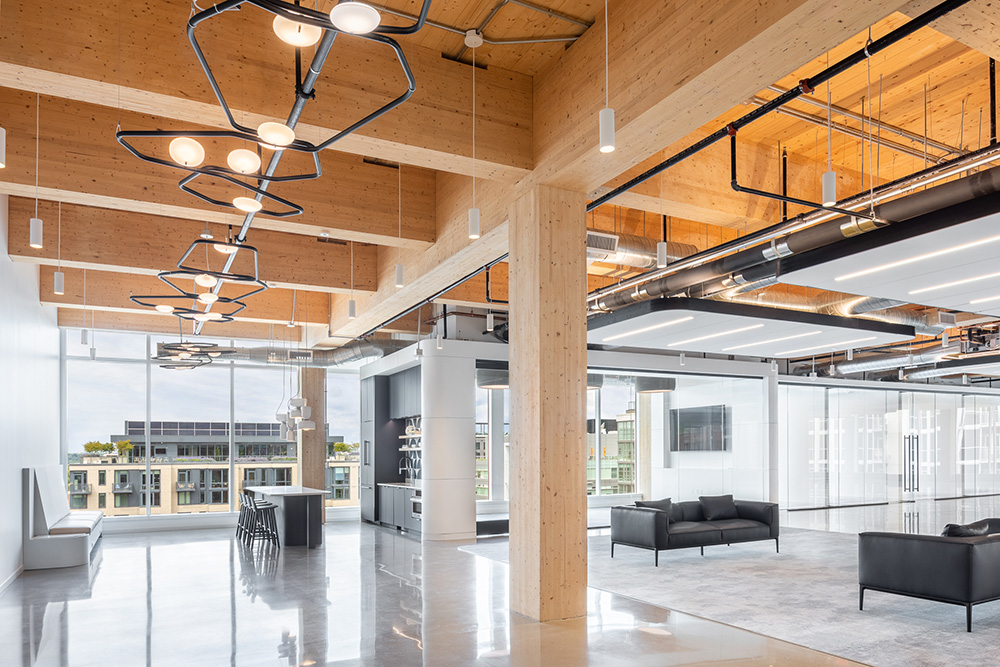
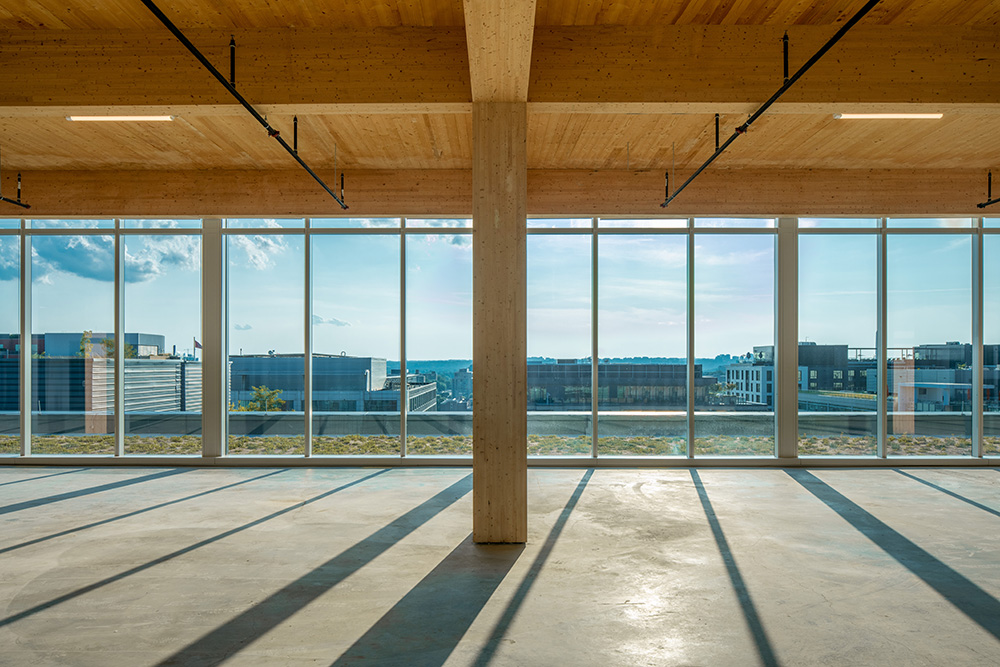
 Mass Timber construction in buildings is not only environmentally sustainable, but it adds beauty, light, color and value to this office interior at 80 M Street in Washington, DC. Photo courtesy Bob Blunt and Hickok Cole Architects.
If Maryland and Montgomery County are serious about implementing mass timber construction to help protect the environment, decision makers, investors, and building practitioners will all need to join together to remove cost and modernize regulations.

About the author
Paul Mortensen is the Senior Urban Designer in the Director’s Office at the Montgomery County Planning Department and leads the Design Excellence program. He is a registered architect in California, Washington, and Maryland, is a LEED-Accredited Professional, and is a member of the Congress for New Urbanism. Prior to joining Montgomery Planning, Paul was the lead designer and master planner for several nationally recognized firms on AIA and CNU award winning developments throughout the country.
Peter Varley
Interesting article! I had heard of 80 M St in DC but assumed it was in NW. In fact, it is SE (Navy Yard) near my office and I had seen the building from the outside and thought it looked interesting but didn’t realize its significance.
In the photo near the bottom, are those hydronic cooling panels mounted on the ceiling above the two sofas? I’ve never seen one in real life and wonder how effective they would be in DC with humid summers.
Paul Mortensen
Thank you for the response. Your question is an interesting one. I do not know if those panels above the sofas are cooling panels. Hickok/Cole was the architects for this work. They are not only leaders in mass timber construction, but also leaders in sustainable designs. It is possible, but they would have that answer. Thanks again.
Paul