Skip to content

Streetscape

Aug 8 12

Small Pieces of Big Streets

by claudia kousoulas

The District’s plan for eco-friendly redevelopment in Southwest Washington is a big one, but M-NCPPC environmental planner Tina Schneider points out that one of the plan’s small elements could apply in Montgomery County.

Alternating tree panels with stormwater panels is a way to slow and filter run-off while enhancing streetscape. The County requires stormwater management treatment, but it’s often easiest to use methods that have already recieved approval than to try something new. And, let’s admit it, there’s a lot of competition for the limited right-of way space. We want to make room for bicycles, streetscaped sidewalks, and–oh yeah–cars. It can also be a challenge to thread a new drainage path among existing underground infrastructure.

But other places have managed it–you can see lots of pictures of the Indianapolis Cutlural Trail here, happy bike riders, cars, and planted panels.

It really speaks to what a complex environment a street is, one made more complex by competing interests vieing for a limited resource–space. But that’s what planning is all about. And don’t forget that roads and streets are our most prevalent and visible public spaces; they deserve coordinated design attention.

PS–one of my first questions was about mosquitos. Stormwater panels are designed to drain within 24 hours, less time than it takes mosquitos to get–ahem–comfortable.


Jul 27 10

Streetscape Challenges for Planners and Users

by claudia kousoulas

This Thursday, the Planning Board will review the County’s DHCA plans to upgrade the 25-year old streetscaping along Georgia Avenue between Selim Street and Silver Spring Avenue. The goals are to meet ADA standards  and to install new soil panels that will help street trees reach full maturity.

But it’s more than a matter of setting in a few bricks and new trees. The design of the sidewalk space and its elements has to mediate among the needs of all users. Business owners want trees that don’t obscure their storefronts and signs. Curb edges and varied paving materials can hold up wheelchair users but can help blind pedestrians navigate. Agencies undertaking the work, trying to make the most out of taxpayers’ money, are looking for effective project coordination and maintenance.

The staff report’s recommendations address these sometimes conflicting needs. The proposed brick pavers will be set on a concrete base, “glued” in place with asphalt and finished with sand between the joints to create a surface with a minimal amount of heaves. It’s a technique that has worked well in the Bethesda CBD. The brick itself is has been updated by the manufacturer with a slightly rough surface that is less slippery for pedestrians but still smooth for wheels.

The new trees, American  and Lacebark Elms have proven to be hardy street trees. Their high branching pattern will keep storefronts visible and the proposed amended soil panel will give them a fighting chance to develop a full canopy.

Coordination has been extensive on this project. DHCA has worked with Silver Spring citizens, property owners and Planning staff.   The Planning Board’s review will give citizens another chance to be heard.

Apr 23 10

Metalheads: 3 Recent Public Artworks

by joshua sloan

Funny thing, the number of project plan applications in Silver Spring peaked right before the requirement for workforce housing became effective. The now voluntary program would have required affordable housing for any projects over a certain residential density threshold. The fact that we had a rush of applications to beat that deadline was bad news for those of us in the “workforce” that need affordable housing, but it turned out to be good news for those of us who love art in public places.

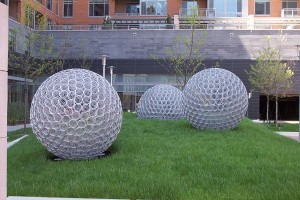
Three examples, originally approved in 2005, have recently been installed around the Silver Spring area. Each uses various metals in significantly different ways and achieves distinct effects. Generally, they add a touch of contemporary style to otherwise traditional buildings and public spaces. Likewise, they are each engaging and visually interactive in their own right. But I’ll let the photos speak for the artworks and only add a couple personal notes regarding each one.

Wendy M. Ross, Sisyphus

Three metal spheres set on a raised and mounded lawn; built of conical elements that point towards the hollow center. Originally conceived as three spheres with distinct patterns – short, straight metal elements, curved lines in a lattice, and conical elements – the artist revised the concept and built them all from the conical elements. Personally, I think this unifies them and creates more of a sense of gravity between the pieces; whereas the different patterns could have made them seem more autonomous and the overall work less cohesive. And, to be very theoretical, the repetition of forms is more analogous to the theme of repetition in the myth of Sisyphus.

Sisyphus 2

Unlike Camus’ take on that myth, however, there is nothing absurd about our relation to these works; they are clear and structured.  The simplicity of the pattern, the contrasting softness of the grass, the variation in color and movement seen through the cones makes this a distinct and welcome addition to our streetscape.  Located on Cameron Street near the intersection of Cameron and Spring Street.

Ray King, Beacon

Beacon 1

Reflection and refraction are key to catching the eye and differentiating King’s sculpture from the grays of the background. Using glass facets laminated with silver holographic film and a web-like tensile structure the overall form is similar to those used by early futurists, but the technique and application of new materials create a distinct and contemporary landmark.

Beacon 2

Like Ross’s piece, the open framework allows color and light to be seen through the piece, so the interstitial spaces constantly reframe the background. But in this work, the dynamism of the ever-changing refractive facets creates a more immediate sense of color and interaction.  Located at the intersection of Blair Mill Road And East West Highway.

Mary Ann Mears, Lotus

The name is a guess – as it wasn’t titled in the application documents – but references the Egyptian lotus columns that inspired the artist’s work. The intent with these pieces was to bring a sense of scale and to frame movement through the open space.

Unlike the previous two works, these pieces are distinctly solid and much less rigidly geometric. In fact, there is nothing rigid about them. Like something from a surrealist’s melting canvas made 3-dimensional, the sense of movement in this work is more subtle and organic. Seaweed in an undercurrent, hot and lazy dancers, swaying trees…. Each three-sided piece is done in a brushed finish that only slightly reflects the colors of the landscape, similar to a hue seen through a fog. They are large, but intimate and beautifully frame entrances in space as well as the building, and – quite happily – artworks on other sites.  Located at the point where Newell Street and Blair Mill Road hit East West Highway.

(Looks like her website is still a work in progress; if anyone has a good link to her stuff, rather than piece-by-piece, please post.)

Feb 16 10

Broadway Pedestrian Boulevard Made Permanent

by anthony pins

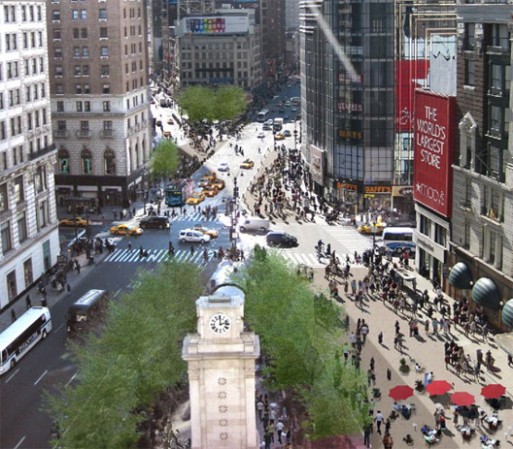
After months of study and deliberation, New York City has decided to make its pedestrian-priority spaces a permanent fixture on sections of Broadway around Times and Herald Squares. The decision to keep the revised street plan, which had been operating under trial review since last summer, came despite vehicle travel times falling short of projected improvements. The plan was originally sold on the basis that it would improve vehicle flow by 17%. It improved 7%.

More importantly, the roadway enhancements vastly improved pedestrian and motorist safety. According the City’s Department of Transportation, pedestrian injuries are down 35% while motorist and passenger injuries decreased 63%. And 80% fewer pedestrians are walking in the streets despite increased usage of Times and Herald Squares, ostensibly due to less crowded sidewalks.

Sometimes seen as a glorified tourist trap, the experiment was also a hit with locals and business owners. A survey conducted by the Times Square Alliance noted that 74% of residents and office workers were “satisfied with their experience.” They did, however, want to see improvements to the design of the pedestrian areas, which the City has vowed to implement now that the trial phase is over.

While this is good news for New Yorkers, what can Montgomery County take from this policy? For one, projects such as this reiterate the importance of discussing pedestrian and cyclist safety in the same breath as automobile mobility. Had this simply been an exercise in traffic management, the results would be underwhelming. However, factoring in pedestrian safety and quality-of-place considerations, the decision represents a well-reasoned response that successfully enhances the urban environment.

It’s also a lesson in the simplicity of open space. What I found striking about Times Square when I visited recently (albeit in warmer weather) is how automobiles, bikes, pedestrians and the inert all come together in close proximity with remarkable harmony. Lawn chairs and traffic lanes separated by mere feet! What brought all this together? A few buckets of paints, a few signs, and some planters. Not exactly high-tech, but effective.

Switch to our mobile site