cities
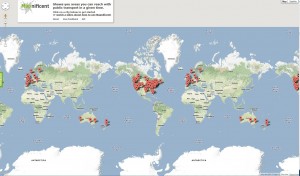
What a fun toy! Mapnificent shows you how far you can travel on transit from any address for several cities around the world.
You can choose the travel time along a sliding bar and choose specific addresses or drag a pin on the map around. Here’s the blob from the Planning Department’s address set at 30 minutes:
I was able to quickly look at Chicago and Philadelphia, two cities I’ll be visiting soon, and the times looked about like I’ve experienced before (as does Silver Spring’s). Nothing for Providence, another city I’ll be visiting this summer, although I know RIPTA has a decent system.
Maybe more soon.
More info and examples were posted on The Atlantic Cities site.
Some Recent Articles & Links
On Housing
- A report from the Brookings Institution: restrictive (read, “exclusionary”) zoning may lead to lower test scores for kids.
“As the nation grapples with the growing gap between rich and poor and an economy increasingly reliant on formal education, public policies should address housing market regulations that prohibit all but the very affluent from enrolling their children in high-scoring public schools in order to promote individual social mobility and broader economic security.”
- An analysis by US Today shows the recession accelerated trends towards urbanization.
“The shift to more urban housing development has been growing slowly during the past couple of decades and thanks to the recession and housing crash, this trend has accelerated. It is probable that the trends that the USA Today analysis points to are the precursors to a long-term shift in suburban development resulting in more in-fill, close-in development and far less growth on the outer edges of metropolitan areas.”
- Downtown Cleveland is growing while suburban/exurban growth slows or reverses course.
“Take the latest population figures in the 5 county metropolitan area [around Cleveland]. From 1990 to 2010, the City of Cleveland shrank, as did many of the suburban areas of Cuyahoga County. The growth mostly occurred in the increasingly exurban fringes of the metro, as well as on the edges of Cuyahoga County. Except there is one outlier: downtown Cleveland. Over the last two decades, the neighborhood’s population grew 96%, with residential totals increasing from 4,651 to 9,098. It was the single largest spike of any neighborhood, suburb, or county measured for the two decades under study.”
Defining Neighborhoods through Data Tracking
“…a research project called Livehoods, from Carnegie Mellon University’s School of Computer Science, aims to shed some light on how people really inhabit their cities—and how this changes over time—by mapping data collected from 18 million Foursquare check-ins that have been sent out via Twitter.”
ITDP Mexico Takes on Traffic
Rethinking the National Mall
“Many of the world’s top landscape architects and architects presented their designs for three grand projects on the National Mall: Constitution Gardens, Union Square, and the Washington Monument Grounds at Sylvan Theatre. The competition is fierce because all the design proposals offer elegant, exciting, innovative ideas for solving sticky ecological, security, and public space design challenges.”
Blog.
Creativity & Cities
Jonah Lehrer’s ambitious new book, Imagine: How Creativity Works, takes a fascinating dive into the world of creativity and how it all works, not to mention devoting a chapter entirely to cities.
Lehrer recently took some time to chat with Atlantic Cities and expand on his ideas concerning the nexus of creativity and cities.
Urban Agriculture
Urban agriculture has a number of advantages for communities, including:
- improving the quality of the urban environment through the introduction of green space and, thus, a reduction in pollution and global warming;
- supporting the reduction of energy use through local production of food, including savings in transportation costs and food storage. Purchasing produce from farmers within a 100-mile (160-km) radius reduces automobile emissions and eliminates packaging waste;
- helping close the urban loop system characterized by importation of food from rural zones and exportation of waste to regions outside the city or town;
- incorporating use of wastewater for irrigation and organic solid waste for fertilizer;
- promoting alternative development options, such as cultivation of vacant urban land for agricultural production;
- helping build equitable responses to food needs by providing local food sources for low-income communities to improve access to fresh foods;
- invigorating the community by incorporating local ideas and engagement; and
- incorporating a cross-sector approach to look at long-term, systemic solutions to problems in cities with the goal of improved health and wellness.
Transit Score
Guess who’s ahead of Portland? And who’s right behind?!
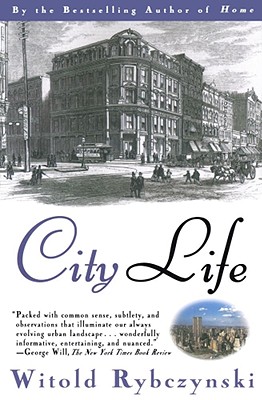
Book(s) of the Month: City Life
In my last post, I began reviewing two of my favorite books from Witold Rybczynski, someone I consider one of the best authors in architecture and urban studies. The first post covered Last Harvest (2007) . Contrast that to City Life (1995), where Rybczynski theorizes:
“…the American city has been a stage for the ideas of ordinary people: the small business man on Main Street, the franchisee along the commercial strip, the family in the suburbs. It all adds up to a disparate vision of the city. Perhaps the American urban stage is best described as cinematic rather than theatrical. A jumbled back lot with cheek-by-jowl assortment of different sets for different productions….”
Like Last Harvest, there are many digressions along the way. In this case into:
- Etymology
- Overviews of works by Lynch, Mumford, Sitte, and others
- Design impacts of Burnham and Olmsted
- Paradigmatic urban forms
- Expansion of Fernand Braudel’s theory of stages in city development to include industrial, post-industrial, and information-age cities
- The Laws of the Indies
- De Tocqueville’s visit to the States
- The Land Ordinance of 1785
- Immigration
- Real estate speculation
- The Columbian Exposition and the Civic Art (City Beautiful) movement
The interesting contrasts Rybczynski describes between North American and European cities have a lot to do with the fact that the New World was basically (to the colonists) a blank slate. But there were important differences between Hispanic, French, and English colonial urbanization that resulted in patterns that last into the 21st century.
Wonderful brief histories and analysis are provided on cities as diverse as Saint Augustine, Quebec, Montreal, New Orleans, New York, Boston, New Haven, Charleston, Annapolis (a high-point in early planning thanks to our early governor, Francis Nicholson), Williamsburg, Philadelphia, Savannah, Woodstock, and Chicago. From these precedents, Rybczynski draws several generalities that distinguish North American cities dating back to their roots. Because land was cheap, “empty” and populations were sparse, people spread out. Open space was treasured, resulting in broad streets and public squares – the desire for spaciousness was built into our psyche in the infancy of our republic. Also, grids established an easy form of real estate development and the commodification of land. The imprint of religious tolerance and democratic governance can be found in the patterns of open spaces, relationships of civic and institutional buildings, and the focus on individual lots for houses.
A large impact on the form of our cities is, of course, functional zoning that separates uses and robs places of variety and vitality. Thus, a good many pages are devoted to early zoning ordinances (Los Angeles – 1907 and New York – 1916), building heights, and uses. In large part, as a reaction to the Civic Art ideals, the First National Conference on City Planning in 1909 deemed attempts to beautify cities “as exercises in ‘civic vanity’ and ‘external adornment.’ The bureaucrats and engineers felt that city planning should be concerned with engineering, economic efficiency, and social reform, not aesthetics. They asserted that whatever functioned well would automatically produce a beautiful, or at least acceptable, urban environment.” Sigh, we still suffer from the results of such thinking.
A large portion of the second half of the book details the tensions between competing theories, governmental policies, and the flight of the population to the suburbs. All of these intertwined ideas are told, of course, through a wandering history with anecdotes, observations, and citations from numerous practitioners, government acts, and examples. These ideas are fleshed out in more detail in Rybczynski’s latest book, Makeshift Metropolis.
The final two chapters address the revitalization of downtowns and an approach Rybczynski calls “The Best of Both Worlds.” His paradigm is his home in Chestnut Hill in northwest Philadelphia. Chestnut Hill has several attributes:
- A diverse housing stock including multi-family, townhouse, and detached houses
- A population of about 10,000 people within less than 3 square miles (about 5 people per acre)
- A commercial main street
- Strong connections to Philadelphia’s cultural and business core and the greater metropolitan area
These attributes point to a networked system of mid-size centers within greater regions, but will require connections – electronic and physical – to each other with multi-modal transit, smart power grids, and numerous other more sustainable infrastructure upgrades that we need to begin planning for now.
A Scientific Look at Cities
Scientific American’s special issue on cities covers nearly every urban topic you can think of, from the not so lost aromas of New York’s Fulton Fish Market to the history of the toilet and its influence on the growth of cities. From China to Saudi Arabia, from street markets to solar energy, the issue examines technological and social aspects of urban settlements.
Closer to home, one article asks “Can Suburbs be Designed to Do Away with the Car,” using King Farm in Rockville as an example of the challenges inmaking suburbs and suburbanites transit-friendly. There are plenty of reader comments with the usual claims of elitism and happiness; see where your ideas fall.