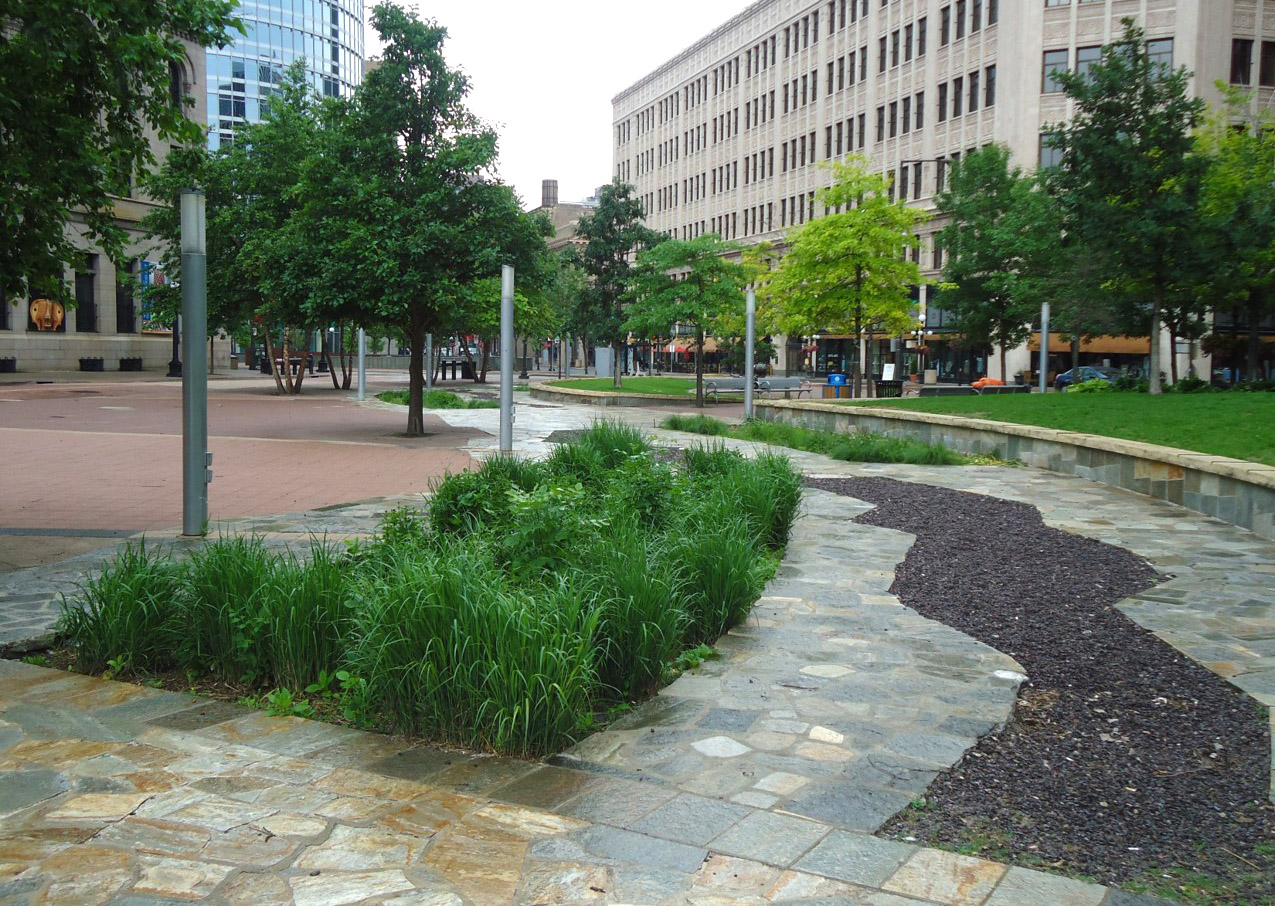
If you live or work in Montgomery County, you’ve probably heard about the ambitious plans to build Bus Rapid Transit (BRT) here. You can learn more about the proposal at a panel discussion in Silver Spring this Wednesday.
Bus Rapid Transit is a type of transit using buses, which can include many of the aspects normally associated with light rail. Attributes like reserved lanes, all-door boarding, traffic signal priority, and off-board fare collection speed up buses, and allow transit riders to get where they’re going faster.
The county has announced plans to build as much as 160 miles worth of BRT in Montgomery, to bring quick transit to as many residents as possible.
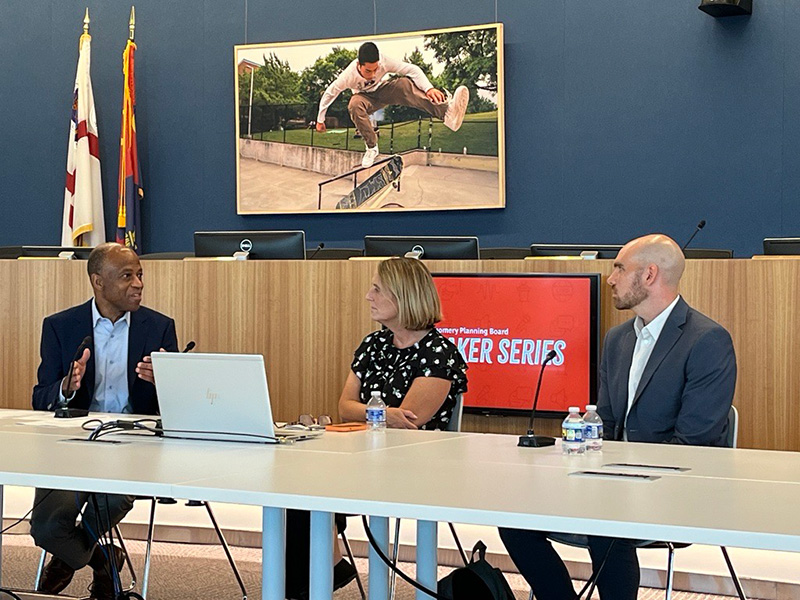
The Coalition for Smarter Growth is organizing the panel, and its Executive Director, Stewart Schwartz will be moderating. Panelists are members of the Transit Task Force, and will discuss where the lines will go, how it will work, and where the funding will come from.
If you’d like to learn more or be a part of the discussion, the free panel will be held at the Silver Spring Civic Building at 1 Veterans Place in Downtown Silver Spring. The panel, on Wednesday, August 8, will start at 7:00 p.m., and doors will open at 6:30.
If you plan to attend, please RSVP.
And I hardly know what to make of this. Did someone redefine cool or cities or Bethesda? And as one commenter on Bethesda Patch noted, Baltimore ranked 14, just beating Bethesda at 17.
Cool is subjective, and (she says snarkily) is the measure of cool the number of hipster pickle makers per loft? By the way, Brooklyn, which seems to be the epicenter of cool hipster pickle-makers, did not make the list. Though I suppose it was subsumed into the NYC-White Plains-Wayne (NJ) census mess.
And moving on from snark to bureaucratic nerdiness, Bethesda is not a city or even a town. It’s an unicorporated place that can leap perceptual boundaries whenever a realtor needs to gin up another suburban tract colonial. And that’s what it did here. The measure is of Bethesda-Gaithersburg-Frederick.
Ah well, nothing tremendously venal here, Forbes and other magazines love these types of articles–they get bloggers and everyone else typing and talking. Just another reason to take lists and rankings with a grain of salt. And to remember what’s really cool is not to care!
We grew up as planners learning that shopping malls sapped downtown of its energy–whether it was small town retailers wiped out by the mall just over the county line or urban retail boulevards gutted of life as suburbanites left the city to follow jobs and the shopping followed them.
Over time, downtowns began to reimage themselves as malls. Beginning in 1980, The National Trust for Historic Preservation’s Main Street program was based on that very premise, organizing disparate retailers to work together on signage, opening hours, seasonal sales, and marketing.
Federal Realty took it one step further, simply buying up retail streets in places like Westport, Connecticut and Bethesda, Maryland to create a single, curated retail environment from brick pavers to street trees.
As main streets became newly invigorated environments drawing people to hang out, stroll, and by-the-way, spend money, shopping malls emptied out. Now, malls are again tracking downtown, as this New York Times article notes, by becoming more experiential places.
Though the article focuses on online competition for mall retail, one executive is quoted, “It’s not just about shopping — it’s multidimensional; it’s a place you can just hang out and go for a stroll,” he said. “You’re not doing that in a mall.”
Sounds like main street to me!
A new(ish) Park in DC
The Yards Park has already won a list of awards, but I’ve just discovered it.
I can see why it’s won awards–there are so many things I love about it–the variety of spaces, the classic Holly Whyte bits of urbanism (movable chairs, touchable water, something to eat, people to watch), and its connections, running from Diamond Teague Park at National’s Stadium and through the Navy Yard, with a few bikeshare docks along the way.

Along with a great lawn, there are also intimate spaces, emphasized with the use of residential planning materials like hosta, boxwood, and birch

Is this not the ultimate in "touchable water"? It is also my idea of heaven, Sunday morning, newspaper, pastry, a shady seat, and a place for the kids to have safe fun

The detailing is thoughtful too; what a nice way to signal that you won't be able to sleep here, while echoing the river's ripples

from initimate spaces to dramatic walkways (underneath it, in the shade, are lots of movable chairs)

from drama, to lots of drama; the park was able to coordinate with the Navy Yard to make a continuous path
Walkable Communities vs a Walk-in Closet
Suburbs have always been an indicator of economic status. If you lived in them, you were wealthy enough to take on a mortgage, maintain a house and yard, and eventually own and maintain one or even two cars.
At some point, that shifted. Living in the city and maintaining a middle class lifestyle took an upper class income. Limited attractive neighborhoods and buildings cost a premium. And if local schools and services were not up to par you needed to pay tuition and fees.
Now, according to Christopher Leinberger and Mariela Alfonzo in the New York Times, a larger number of city neighborhoods are outstripping the suburbs in desirability and thus in per square foot value. Their recent report finds that walkable places have “become more gentrified over the past decade,” with wealthier and more educated residents. And from a list of the walkable communities examined, you won’t be surprised by that finding–Bethesda, Penn Quarter, Logan Circle, Chevy Chase Lake.
But what are the quantifaible elements of a walkable community? He and his co-author found that “the absence of a clear classification of the mix of residential, office, and retail elements that comprise walkable urban places…has been one of the most significant barriers to addressing their demand.” But demand is there–he found that in Atlanta only 35 percent of people who wanted to live in a walkable community actually did.
The characteristics the authors used to define a walkable place are somewhat Lynchian (with my comments in parens):
- aesthetics (some subjective judgement of decoration, but also views and outdoor dining)
- connectivity (in the sense of barriers)
- density
- form (does the place feel like a place)
- pedestrian amenities (both practical and decorative)
- personal safety (judged by indicators like graffiti and litter)
- physical activity
- proximity of uses (mixed uses)
- public spaces and parks (a la Holly White–movable chairs, touchable water)
- traffic measures (not car throughput, but slowing measures–signals and calming)
(The not easily quanitifiable measure I use for a walkable place is the ice cream cone factor. Can I get a cone, and then have a nice and interesting walk while I eat it, and will there be a place to toss my napkin when I’m done. Extra points if I can ride my bike there and burn off some of those calories ! I wouldn’t last a day at Brookings.)
Once you can describe these places, their economic impact can be measured, and Leinberger finds that impact to be considerable. Even controlling for household incomes, walkable places show a higher economic performance, with premiums in office and residential rents as well as in retail sales and housing values.
From the report: “Federal, state, and local policy makers should conduct a systematic review of existing public policies that are biased against walkable development, and adopt new measures aimed at facilitating (or at least removing roadblocks to) this type of development.”
As a suburb within walking, biking, and transit distance of downtown, and one that has its own urban centers, Montgomery is advantagously postioned to add value by creating car alternatives to getting downtown (I’m looking at you bikeshare) and by building up its own urban areas.
The White Flint Plan, the BRT study, the zoning rewrite, even the Parks Department’s community garden program are all moves that will redfine how and were we live by adding more choices. With plenty of suburban single-family communities and the preservation of the Agricultural Reserve, Montgomery will become a layered place, one with options and interest that all add value.
Planning for Access to Parks
Yesterday the Planning Board discussed a draft Park, Recreation and Open Space Plan (PROS Plan) that lays out a strategy to ensure access to open space for County residents:
The purpose of the 2012 PROS Plan is to estimate the future needs for park and
recreation facilities and natural, historic and agricultural resource preservation
and to develop specific service delivery strategies to meet future needs through
the year 2022 and beyond.
This broad-ranging Plan covers traditional park and trail facilities on public and private land, but also delves into preservation and enhancement of historic, cultural, and agricultural resources.
Like the recently created Parkscore system established by the Trust for Public Land, important parts of the PROS Plan are establishing:
- a methodology to determine where open space is lacking,
- strategies to rectify identified problem areas, and
- guidelines to implement the creation of new open space.
A quick overview of our urban areas shows that significant green spaces are lacking in our densest areas.
Parkscore has rated Washington, DC 5th among the 40 largest cities ranked.
And with the metrics used, the County should rank quite well. Many of the County’s parks, however, are right outside our metro station areas. For example, I regularly visit Wheaton Regional Park, which is only a 1.7 mile walk from my home in the southern part of the Wheaton CBD.
Still, opportunities exist within the central core to provide green space and respite for residents, employees, and visitors. How these open spaces are created is, of course, the question. And it is one that the PROS Plan begins to answer.
The record remains open until June 1st, so please contact the project manager at MCP-PROSPlan2012@Montgomeryparks.org.
MontgomeryModern explores mid-century modern buildings and communities that reflect the optimistic spirit of the post-war era in Montgomery County, Maryland. From International Style office towers to Googie style stores and contemporary tract houses, MontgomeryModern celebrates the buildings, technology, and materials of the Atomic Age, from the late 1940s through the 1960s. A half century later, we now have perspective to appreciate these resources as a product of their time.
If you read my previous post for Historic Preservation Month, you know that in picking a theme for this year’s Preservation Month, the National Trust for Historic Preservation issued a challenge to people in communities across the country to discover hidden gems and celebrate local historic resources. Montgomery County historic preservation planners responded by preparing a list of historic resources we hope you will discover.
While Preservation Month has become a fun annual event to raise awareness and celebrate historic preservation nation-wide, our exploration of the county’s historic resources will continue long after we turn the page on May. Our efforts have led us to look beyond what many people recognize as historic, and to start thinking about buildings and places from a period of our history that historic preservationists have only recently begun to consider.  Not long ago Montgomery County historic preservation planners launched a new initiative to study local mid-20th century modern buildings and communities, part of an effort we call MontgomeryModern. The historic value and design significance of the mid-century era — the 1940s through the 1960s — has, until recently, been largely overlooked. But as more than 50 years has passed since these buildings and communities were constructed, we have begun to investigate their historical, cultural and architectural importance.  As a result of a more complete understanding of these mid-century resources, property owners and decision-makers may find more of these resources appropriate for historic preservation.
MontgomeryModern is exploring mid-century modern buildings and communities that reflect the optimistic spirit of the post-war era in Montgomery County, Maryland. Preservation planners want to help raise the public’s understanding of – and appreciation for – these buildings and communities developed during a time of tremendous growth in Montgomery County. To encourage your discovery of mid-century architecture we included four Modernist buildings or communities in our Preservation Month list of Montgomery County gems. Carderock Springs, a community of 275 houses designed by Keyes, Lethbridge, and Condon and developed by Edmund J. Bennett between 1962-1966, is listed in the National Register of Historic Places.
Also listed in the National Register is Rock Creek Woods, a 76-house development that is one of several in Montgomery County by regionally prominent architect Charles Goodman. World-renowned architect Marcel Breuer designed the International-style Seymour Kreiger House in Bethesda. The Kreiger House, built in 1958, is listed in the National Register and is designated in the Montgomery County Master Plan for Historic Preservation. The WTOP Transmitter Building, built in 1939 in Wheaton, is also a landmark modernist building that has been designated in the Master Plan for Historic Preservation.
The intent of including in our list these four historic resources is to give you a taste of the remarkable mid-century modern buildings and communities we have in Montgomery County, and to encourage you to investigate our MontgomeryModern initiative as we learn more about hidden gems from the mid-century.
What a fun toy! Mapnificent shows you how far you can travel on transit from any address for several cities around the world.
You can choose the travel time along a sliding bar and choose specific addresses or drag a pin on the map around. Here’s the blob from the Planning Department’s address set at 30 minutes:
I was able to quickly look at Chicago and Philadelphia, two cities I’ll be visiting soon, and the times looked about like I’ve experienced before (as does Silver Spring’s). Nothing for Providence, another city I’ll be visiting this summer, although I know RIPTA has a decent system.
Maybe more soon.
More info and examples were posted on The Atlantic Cities site.
What Does the Future Look Like?
According to a report on NPR, population worldwide is moving to cities. This is not a new trend; cities have always been centers of opportunity, but now that population threatens to overwhelm capacity it is more important than ever to build them right.
While some countries are building new cities from scratch, places that will “win” are those that already have infrastructure and are making best use of it. As Harriet Tregoning, D.C.’s planning chief pointed out at a panel discussion at the National Building Museum, even in this recent recession, communities that did best were those that are “dense, mixed-use places.”
As part of the Washington metropolitan area, Montgomery County has long recognized that it faces a growing population, but only recently have we thought about new ways to handle that growth.
We’ve already made some good decisions that will serve us in the future. Setting aside the Agricultural Reserve as inviolable has left it to develop emerging value for local farming. Focusing growth at Metro stations has stanched sprawl, created job and housing choices, and built the local economy.
Current planning efforts–Bus Rapid Transit, the Purple Line, the Corridor Cities Transitway, community-specific design guidelines, urban park standards, even moving our record keeping to computers–will help County residents get where they want to go, define their communities, and get the information they need.
These are not greenfield planning efforts, but a thrifty use of infrastructure, information, and systems we already have. It’s an approach other cities are using as well. In New York, the wildly successful High Line park is layered on top of an old elevated rail line, turning an eyesore into an asset. The Digital City initiative is using technology to deploy existing data in ways that improve New York’s functioning and communication with its residents. Cities around the world are establishing bike share programs and thereby creating a new transportation system.
It’s squeezing stuff in–local parks above ground, a corner of sidewalk turned over to a bike dock, threading new cable through existing channels–that ironically, doesn’t feel like constriction, but feels like opportunity.
Bikeshare Coming to Silver Spring, etc.
I have a confession: i don’t own a bike. The bus and metro are a bit too convenient for me. And with DC’s Bikeshare program and the soon to come Silver Spring program, why would I need one? (And we’re beginning to reserve spaces on land in White Flint.)
With a grant in place and plans under way, the first project to propose a bikeshare station with integrated public art, Fenwick Station (on the corner of Second Avenue and Spring Street), was reviewed by the Planning Board on April 26.
This is just in time for national bike month!
So maybe we can give DC, named the 6th most bikeable city by walkscore.com, a run (ride?) for their money.
And to make our pedestrian realm a bit more fun, here’s a thought for more interesting bike racks: Louisville’s public art/bike rack solution:
Coincidentally, they happened to be having a biking event one of the days we visited.