landscape
This Thursday, the Planning Board will review the County’s DHCA plans to upgrade the 25-year old streetscaping along Georgia Avenue between Selim Street and Silver Spring Avenue. The goals are to meet ADA standards and to install new soil panels that will help street trees reach full maturity.
But it’s more than a matter of setting in a few bricks and new trees. The design of the sidewalk space and its elements has to mediate among the needs of all users. Business owners want trees that don’t obscure their storefronts and signs. Curb edges and varied paving materials can hold up wheelchair users but can help blind pedestrians navigate. Agencies undertaking the work, trying to make the most out of taxpayers’ money, are looking for effective project coordination and maintenance.
The staff report’s recommendations address these sometimes conflicting needs. The proposed brick pavers will be set on a concrete base, “glued” in place with asphalt and finished with sand between the joints to create a surface with a minimal amount of heaves. It’s a technique that has worked well in the Bethesda CBD. The brick itself is has been updated by the manufacturer with a slightly rough surface that is less slippery for pedestrians but still smooth for wheels.
The new trees, American and Lacebark Elms have proven to be hardy street trees. Their high branching pattern will keep storefronts visible and the proposed amended soil panel will give them a fighting chance to develop a full canopy.
Coordination has been extensive on this project. DHCA has worked with Silver Spring citizens, property owners and Planning staff.   The Planning Board’s review will give citizens another chance to be heard.
On a recent trip for my aunt’s wedding, I had a chance to stop by my grandparent’s place in a small town in CT. One of the first things I noticed, being who I am, is that the community open space was either play space or community garden space. My grandmother, of course, has a small plot where she can grow flowers and some veggies and generally keep active in a town where there isn’t much else to do – especially for seniors (or kids, for that matter). I don’t think we can overstate how important connections to nature and food are and how community gardens, playgrounds, and open space bring people together and promote health, well-being, happiness, etc. The American Community Gardening Association has summarized the benefits well:
Benefits of Community Gardens:
- Improves the quality of life for people in the garden
- Provides a catalyst for neighborhood and community development
- Stimulates Social Interaction
- Encourages Self-Reliance
- Beautifies Neighborhoods
- Produces Nutritious Food
- Reduces Family Food Budgets
- Conserves Resources
- Creates opportunity for recreation, exercise, therapy, and education
- Reduces Crime
- Preserves Green Space
- Creates income opportunities and economic development
- Reduces city heat from streets and parking lots
- Provides opportunities for intergenerational and cross-cultural connections
But, even without space for community gardens (as with most infill, gray-field projects), we can still benefit from creating our own little Edenic plots. A number of urban gardening stories have come across my desk/mailbox/computer recently; two that I’ll pontificate on here.
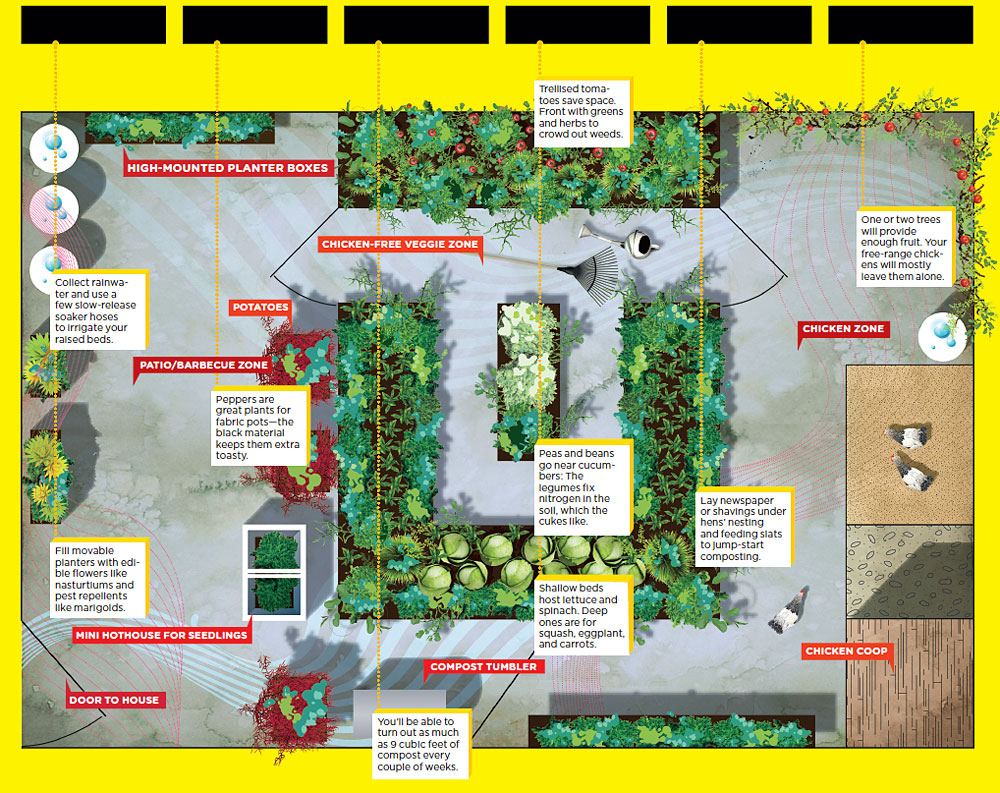
Wired magazine had an interesting story on creating gardens at various scales – from balcony to suburban lot. What was key to each of the scales was maximizing productivity (and luring nerds into the green-geek world of botanical names, grafting techniques, soil science, etc. of gardening). One aspect that didn’t escape my attention was the fact that virtually all the scenarios involved keeping animals of one kind or another, which is generally verboten in most of our denser residential and mixed-use zones. Is there tolerance to change this? Maybe step by step: bees, chickens, rabbits, goats……
Which brings me to a video I came across on an intensive farm created on an abandoned lot in Oakland, CA. In this case, the admitted state of anarchy in the area has allowed the gardener to be left to her own devices – the cops have better things to do. But, as the example shows, if the garden is technically illegal, doesn’t the fact that it co-exists peaceably, and may even be fostering some community bonds tell us something about our squeamishness regarding farming in urban areas? Many cultures live in and around their food sources. We generally don’t – our landscapes are aesthetically focused. It’s a shame we haven’t yet integrated the productive values of landscapes (ecologically, socially, nutritionally, economically) with our typically English pleasure garden aesthetic. Again, step by step: corn in the front yard, espaliered trees along fences rather than evergreen hedges, strawberries in our container plantings…..
I’m looking forward to keeping this conversation going during our zoning rewrite process and I’ll be interested to know what our tolerance really is. Can we put our farms where our mouth is?
One of the most fascinating pieces of public art in Silver Spring is “Coastline,” a sculpted water feature by Jim Sanborn, which is tucked into the plaza near the National Oceanic and Atmospheric Administration at 1301 East-West Highway. For those who know it is there – mostly office workers from the surrounding complex – it is a wonderful place to relax during lunch or coffee breaks. And the lucky kids who come across the piece are transfixed by the threat and prospect of being hit by the spray of the surf.
The sculpture: A large, pneumatically activated pool that sends waves crashing into stacked, sculpted red granite, creating an intense sound and sense of dynamism to which most water features – fountains that flow from one level to another or spray uniformly into the air – pale in comparison. Another fascinating aspect of the piece is that it is tied to actual wave height data being instantly transmitted from the Wood’s Hole, Massachusetts monitoring station. Imagine being at the edge of the Atlantic hearing the surf booming against the beach and rocks. Pause. You’re actually in downtown Silver Spring.
The problem: A great, interactive piece of art that appeals to our sense of play and intellect sits above sidewalk grade, away from typical pedestrian routes, screened by plantings and benches. This functions more like a private amenity, although it is supposed to benefit the larger public. (Density was awarded to the surrounding development above what would typically be allowed in exchange for this sculpture and other public amenities.)
Lessons learned: Public amenities need to be convenient and reachable, not just legally accessible. They need to be located on pedestrian routes; visible from adjacent properties, open spaces, and sidewalks; and supported by synergistic uses and activities (retail, information kiosks, restaurants, events). In sum, the landscape, the artwork, and the architectural environment need to be integrated into how space – the immediate and contextual space – is traversed and activated. This is our charge and our responsibility for projects that provide public art as an amenity.
Visit Jim Sandborn’s website to learn more about the artist and Downtown Silver Spring’s website to learn more about the project.