
This blog is part of a series that highlights the winners of the 2025 Design Excellence Awards.
Placemaking is the act of improving a common space to make it welcoming and attractive, so it better serves the needs of the people who use it. It is both a process and an outcome. As a process, it is a collaborative effort to plan, design, and manage public spaces in ways that enhance community health, happiness, and well-being. It relies on active participation from community members to create a shared vision: transforming ordinary spaces into vibrant destinations that strengthen connections between people and their environment.
As an outcome, placemaking results in spaces that foster social interaction, environmental stewardship, economic vitality, and health. It transforms common areas into welcoming, attractive places that serve the needs of those who use them. Placemaking invites people into shared spaces, strengthens the bond between communities and their environments, and maximizes value by shaping the public realm. It goes beyond good urban design, it leverages existing and future community assets to promote health, happiness, and well-being.
Within each Design Excellence Award program, an independent jury of architects, landscape architects, and developers selects winners for outstanding design. They also have the discretion to recognize special, unique projects with an award of merit. This year, the jury honored one development with a Merit Award for Placemaking:
7200 Wisconsin Avenue Plaza at Bethesda Avenue, designed by LandDesign, Inc.
From Obsolete Courtyard to Vibrant Plaza
The plaza at 7200 Wisconsin Avenue was once a cloistered courtyard, open to the street but inwardly focused on restaurants that activated the space. When those ground-floor uses moved out, the courtyard became obsolete: underutilized, disconnected, and more barrier than destination. Architectural elements like a clock tower and trellis, once symbolic of the exterior vision, now obscured views and failed to invite public use. Entrances were hard to find, and steep grade changes made navigation difficult, especially for those with mobility challenges.
Recognizing the need for reinvention, JBG Smith Properties, owners of the space and adjacent buildings, and their design team set out to transform this prominent end of Bethesda Avenue into an active, inclusive, accessible, and high-performing public plaza at the heart of Downtown Bethesda.
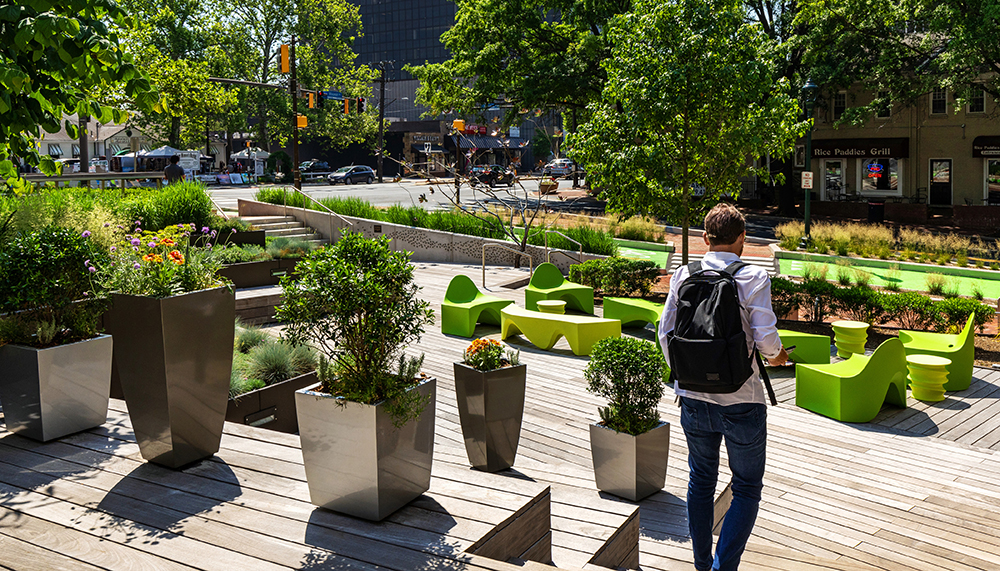
The landscape features native, drought-tolerant species for resilient, seasonally colored interest.
A Strategic Transformation
The redesign began by removing visual and physical barriers: dismantling outdated architectural elements to open sightlines and reconnect the site to its urban context. The team faced significant challenges such as steep topography, an active underground parking garage, and aging stormwater infrastructure. These constraints became opportunities for innovation, inspiring a design aligned with Montgomery County’s Energized Public Spaces Functional Master Plan, which emphasizes sociable, comfortable spaces and multimodal access.
The new plaza unfolds as a series of terraced platforms that accommodate grade changes while preserving the structural slab of the garage below. Each terrace offers inviting spaces—seating nooks, amphitheater-style steps, lush planting zones, and universally accessible routes—designed for flexibility and intuitive wayfinding. The layout encourages movement and pause, creating moments for gathering, working, and reflection. The result is a space that is both functional and delightful.
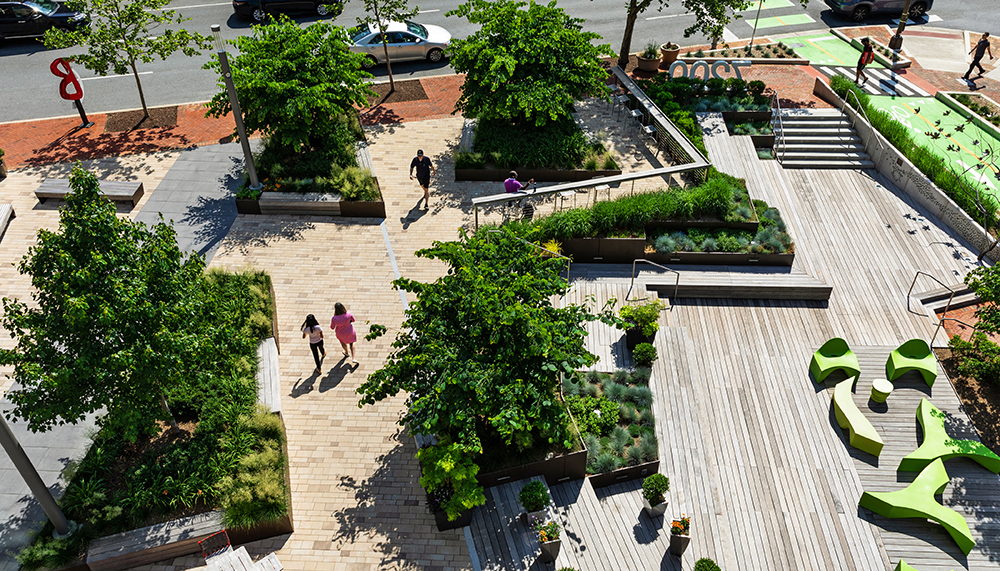
The new plaza unfolds as a series of terraced platforms that accommodate existing grade changes. The layout encourages movement and pause, creating moments for gathering, working, and reflection.
Reconnecting to the Urban Fabric
To re-engage the streetscape, the design reorients views and circulation both inward toward adjacent retail and outward to bike and pedestrian networks, fostering multimodal movement. Improvements to lighting, paving, furnishings, and signage reinforce the plaza as a dynamic, legible part of Downtown Bethesda.
Warm materials, native plantings, and custom, brightly colored furnishings create a refined yet durable palette that enhances the sensory experience. Public art adds an extra layer of discovery, including a new sculpture by artist Alma Selimovic, whose intricate metalwork animates the streetscape with pattern, shadow, and texture. The jury praised the art as “beautifully integrated into the design—subtle and intriguing, inviting a second and third look.”

The redesigned plaza now serves as an inviting gateway from Wisconsin Avenue to the plaza and the Bethesda Avenue retail spine.
A Collaborative Success
This transformation was made possible through close collaboration among designers, engineers, artists, stakeholders, and the client team. Together, they delivered a site-responsive, constructible, and enduring solution within significant technical and logistical constraints. The result is more than a public space—it is a gateway. The reimagined plaza improves visibility, enhances tenant access, and restores vitality to a once-forgotten corner. It reflects a commitment to design excellence, balancing vision and feasibility to create a vibrant, inclusive destination for Downtown Bethesda.
As the jury concluded: “If we brought this standard of care to all of our public spaces, we would be living in paradise.”

About the author
Paul Mortensen is the Senior Urban Designer in the Director’s Office at the Montgomery County Planning Department and leads the Design Excellence program. He is a registered architect in California, Washington, and Maryland, is a LEED-Accredited Professional, and is a member of the Congress for New Urbanism.
Leave a Reply