Skip to content

purple line

Jan 11 13

Transit improvements Should Not Be Considered Anything Paved

by joshua sloan

In response to the article, “The year ahead: A top 10 list of transportation projects to watch“, I have to say I’m quite disappointed. Not by the content per se, but the title.

Of the 10 projects listed, only 4 are truly “transit” projects; the other 6 are highway projects/roadway improvements (all 10 of which are “transportation” projects). The problem that drives some of us in the design and planning business crazy is that it is precisely because these two concepts are conflated, that we miss the opportunity to truly assess progress for more sustainable, congestion-reducing transportation solutions. Words matter because there is so much baggage attached to them.

While, broadly speaking, “transit” is the movement of something from one place to another, it should be understood more narrowly in these conversations. And transit is not just “mass-transit”, it should cover bikes, buses, light rail, heavy rail, bus-rapid-transit, or any tool to decrease travel by one driver in one car; so maybe we add HOV, or car/van-pooling. Transportation, then, should cover these, plus improvements for the average driver. And a separate argument should be pointed out that roadway improvements – adding lanes, widening roads, installing interchanges – rarely actually improve traffic flow; they typically just fill up with more cars: if you pave it, they will drive.

We fight for hard-earned victories when we can persuade policy makers to think more like transit planners rather than traffic engineers and require transportation departments to focus more on the transit side of the equation. Given the 4/6 ratio of the projects you’ve mentioned, we still have a lot to do. Thus, I think the article – in pointing out the pending projects that will impact our daily commute – you could have been more aggressive in showing that the projects that really could positively influence the environmental impacts and congestion issues are not getting the attention they deserve. For example, in our jurisdiction, the Corridor Cities Transitway, the Purple Line, and the Bus Rapid Transit Amendment to the Master Plan of Highways. These plans, and similar ones in surrounding jurisdictions need more attention and a more critical eye from journalists; we can’t pave our way out of our congestion problem and we need everyone to look at the issues more carefully and analytically.

Apparently, however, the print edition was corrected for the online version; but I think my argument is still valid.  But to prove I wasn’t going nuts:

May 21 12

What Does the Future Look Like?

by claudia kousoulas

According to a report on NPR, population worldwide is moving to cities. This is not a new trend; cities have always been centers of opportunity, but now that population threatens to overwhelm capacity it is more important than ever to build them right.

While some countries are building new cities from scratch, places that will “win” are those that already have infrastructure and are making best use of it. As Harriet Tregoning, D.C.’s planning chief pointed out at a panel discussion at the National Building Museum, even in this recent recession, communities that did best were those that are “dense, mixed-use places.”

Not Boca Raton, but the romantically named, King Abdullah Economic City

As part of the Washington metropolitan area, Montgomery County has long recognized that it faces a growing population, but only recently have we thought about new ways to handle that growth.

We’ve already made some good decisions that will serve us in the future. Setting aside the Agricultural Reserve as inviolable has left it to develop emerging value for local farming. Focusing growth at Metro stations has stanched sprawl, created job and housing choices, and built the local economy.

Current planning efforts–Bus Rapid Transit, the Purple Line, the Corridor Cities Transitway, community-specific design guidelines, urban park standards, even moving our record keeping to computers–will help County residents get where they want to go, define their communities, and get the information they need.

These are not greenfield planning efforts, but a thrifty use of infrastructure, information, and systems we already have. It’s an approach other cities are using as well. In New York, the wildly successful High Line park is layered on top of an old elevated rail line, turning an eyesore into an asset. The Digital City initiative is using technology to deploy existing data in ways that improve New York’s functioning and communication with its residents. Cities around the world are establishing bike share programs and thereby creating a new transportation system.

It’s squeezing stuff in–local parks above ground, a corner of sidewalk turned over to a bike dock, threading new cable through existing channels–that ironically, doesn’t feel like constriction, but feels like opportunity.

May 14 12

Connecting our “Life Sciences Triangle”

by joshua sloan

On a recent trip to Savannah, we not only had a wonderful time – we learned a few unexpected things. There’s more to the city than the beautiful downtown (with omnipresent SCAD buildings), there’s the economy built on an infrastructure that allows Savannah to be the fourth busiest port in the country (according to our boat tour guide) linked to an extensive heavy rail system. And evidence was obvious on the river – even from the window of the restaurant where we had lunch one day. Transit, however, is generally absent; the free Downtown Transportation (DOT) bus is fine, but it covers an area that’s easy enough to walk.

Freighter Heading up the Savannah River

MoCo’s economy seems more diverse than Savannah’s, but is becoming focused on the life sciences, especially in the fields of health and biotech research. Our own Life Sciences Triangle is beginning to take form – between Bethesda, the Great Seneca Science Corridor, and the White Oak Science Gateway. Two keys ensuring the success of this vision will be linking these areas together and ensuring that there is a robust, mixed use, 24/7 economy around these key nodes. Generally, the latter is a matter of zoning and these areas are developing (or have the potential to develop) with housing, retail service, and employment opportunities. The former, however, is more difficult. Luckily, the early stages of creating transit links are completed and schedules are moving forward.

In the recently published ULI report, Infrastructure 2012, Montgomery County’s Intercounty Connector (ICC) is highlighted as an example of link connecting parts of our suburbs. Unfortunately, the examples of transit systems implementing visions similar to our Life Sciences Triangle are New England’s Knowledge Corridor and North Carolina’s Research Triangle.

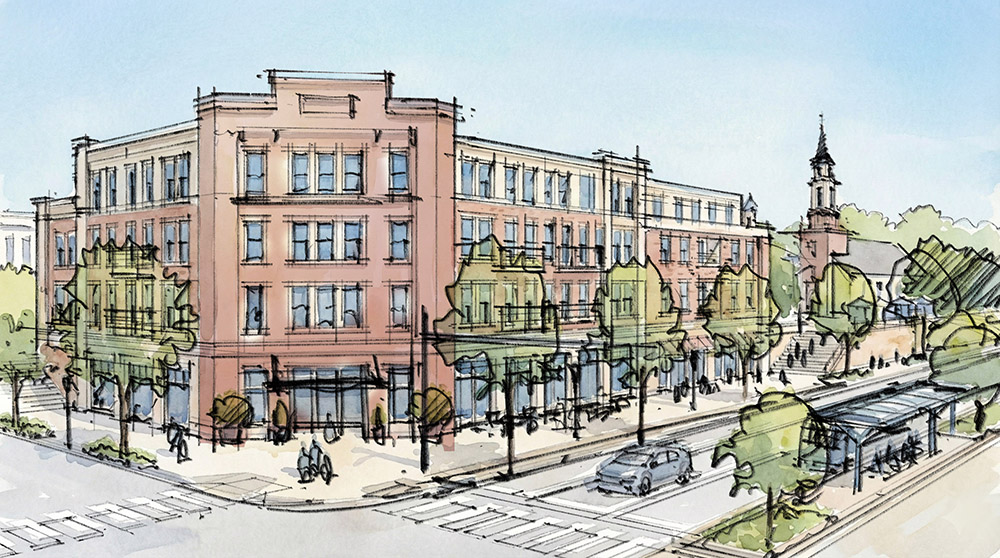
But there is hope. The general alignment for the Purple Line transit link between the Bethesda and New Carollton Metro stations has been set since 2009 and several planning studies are being done for areas around key nodes along the line: Takoma Langley Crossroads, Chevy Chase Lake, Long Branch, and Lyttonsville-Rosemary Hills. Another study is ongoing: the Countywide Transit Corridors Functional Master Plan, which will be followed up by a BRT – Land Use Plan. Of course, the Zoning Ordinance Rewrite is also ongoing and being coordinated so that we will have the zoning implementation tools necessary to help these new opportunities succeed.

BRT Proposed Network

And now, the Corridor Cities Transitway (CCT) locally preferred alternative was announced by the Governor’s office on May 11th (press release not online yet) and the schedule has been laid out to implement phase 1 – from Shady Grove Metro station to the Metropolitan Grove MARC station, with service to begin in 2020.

CCT Phase 1

Funding is, of course, a huge issue. But, as Infrastructure 2012 points out, that there are numerous options as budgets and federal funding become constricted, such as:

  • Fuel taxes
  • Vehicle taxes and fees
  • Sales and use taxes
  • Public/private partnerships
  • Tolls
  • Vehicle mileage fees; and
  • Tax Increment Financing/Special Assessment Districts

There also will remain some Transportation Infrastructure Finance & Innovation Act funds designed to leverage these more local alternatives, and a combination of various sources is likely.

Each of these funding sources have been used by various municipalities and the pros/cons and a few examples are laid out well in the report. It’s time to look carefully at the next steps to implement these links and build on the vision that is just beginning to take shape around our evolving, focused economy.

Nov 16 11

Planning Board to hear recommendations about Capital Crescent Trail

by Matt Johnson
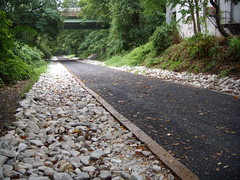
Georgetown Branch Trail

Interim Georgetown Branch Trail. Photo by thecourtyard on Flickr.

As a part of the Purple Line, Montgomery County will fund upgrades to the Capital Crescent Trail between Bethesda and Silver Spring. Tomorrow, the Planning Board will hear recommendations from its transportation planning staff about several issues facing the trail. After hearing testimony, the Planning Board will send recommendations to the Montgomery County Council.

The current design from the Maryland Transit Administration includes a number of improvements to the trail. The upgraded trail will be expanded to 12 feet wide, where  feasible, and paved. Additionally, the trail will be extended from its current terminus at Lyttonsville 1.5 miles farther east to Downtown Silver Spring. New overpasses or underpasses will be provided over Connecticut Avenue, Jones Mill Road, 16th Street, and Colesville Road.

This is good news for trail users.

Planning staff is calling for the installation of lighting along the new trail from Bethesda to Silver Spring. The trail would be lit during the hours the Purple Line is open, and would allow the trail to be used safely during commuting hours. The recommendation is to design lighting so that it does not disturb neighboring properties.

Staff is also calling for emergency call boxes to be placed at intervals along the trail. This will help to promote security and reduce crime. New landscaping will help to create a pleasing trail experience and will screen trail users and neighbors from the Purple Line.

Bethesda tunnel

The Bethesda tunnel. Photo by thisisbossi on Flickr.

The most costly decision that will have to be made is whether to put the trail above the train in the tunnel under Wisconsin Avenue.  Right now, estimates place the cost of keeping the trail in the tunnel at $40.5 million, which is 43% of the cost of the entire trail. Planning staff have recommended against putting the trail in the tunnel if the price remains so high. For a fraction of that cost, the surface alignment could be significantly improved. The Planning Department is calling for more study before making a final decision.

Not having the trail in the tunnel would mean that trail users would need to cross Wisconsin Avenue at grade. If a surface alignment is chosen, the staff recommends prioritizing pedestrians and cyclists crossing Wisconsin Avenue. They recommend a working group be convened to hammer out the design details.

A surface alignment is clearly not as nice for pedestrians and cyclists because of the Wisconsin Avenue crossing. But there are plenty of ways to make the crossing of Wisconsin safe and efficient for trail users.

The Planning Department recommends that if the surface alignment is used through Bethesda, that the trail will be made as user-friendly and safe as possible. While the exact design solutions have not been determined, many solutions will be considered, including creating a bicycle/pedestrian only signal phase for crossing Wisconsin Avenue, a separated “cycle track”, raised crosswalks, and more.

Hornby Street cycle track

Above: a separated cycle track in Vancouver. Image from Paul Krueger on Flickr.

And let’s not forget that even if the tunnel under Wisconsin is lost to the Purple Line, the trail will still be vastly improved. It will be paved, bridge several major arterials where people have to cross at grade now, and extend 1.5 miles farther to downtown Silver Spring.

Apr 23 10

A Vision for Long Branch

by claudia kousoulas

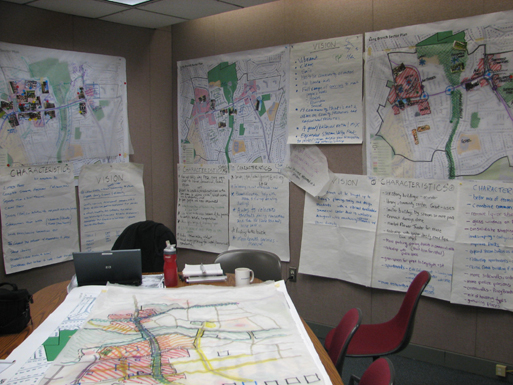
Wednesday night, planners held a community workshop and guided about 25 residents in using visual building blocks to express the characteristics they’d like to see in their community. The future Purple Line stations will change the neighborhood’s character and opportunities. This workshop and upcoming workshops are a chance for the community to define its future.

They began with maps, markers, and photos—the visual building blocks—and after talking about what they want their community to be—a place where you can walk to a hardware store or ride your bike to the park, they started to put their ideas on paper.

Planners Kathy Reilly and John Marcolin said the people here know their community and all its issues, an even though there was some skepticism, by the end of the night, everyone had their hands all over the maps.

The workshop was an effort to ensure that community views shape the plan’s recommendations. The maps and pictures they created are just the physical expression of their knowledge and ideas.

Next Wednesday, April 28, at the Long Branch Library, planners will bring back the ideas, which they will have distilled into possible development scenarios and areas of common vision. From tracing paper to pavement, this is where the plan begins.

Switch to our mobile site