Skip to content

parks

May 25 12

Planning for Access to Parks

by joshua sloan

Yesterday the Planning Board discussed a draft Park, Recreation and Open Space Plan (PROS Plan) that lays out a strategy to ensure access to open space for County residents:

The purpose of the 2012 PROS Plan is to estimate the future needs for park and
recreation facilities and natural, historic and agricultural resource preservation
and to develop specific service delivery strategies to meet future needs through
the year 2022 and beyond.

This broad-ranging Plan covers traditional park and trail facilities on public and private land, but also delves into preservation and enhancement of historic, cultural, and agricultural resources.

Like the recently created Parkscore system established by the Trust for Public Land, important parts of the PROS Plan are establishing:

  • a methodology to determine where open space is lacking,
  • strategies to rectify identified problem areas, and
  • guidelines to implement the creation of new open space.

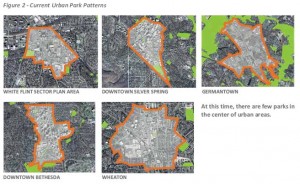
A quick overview of our urban areas shows that significant green spaces are lacking in our densest areas.

Parkscore has rated Washington, DC 5th among the 40 largest cities ranked.

And with the metrics used, the County should rank quite well.  Many of the County’s parks, however, are right outside our metro station areas.  For example, I regularly visit Wheaton Regional Park, which is only a 1.7 mile walk from my home in the southern part of the Wheaton CBD.

Brookside Garden on an Evening Winter Walk

Still, opportunities exist within the central core to provide green space and respite for residents, employees, and visitors.  How these open spaces are created is, of course, the question.  And it is one that the PROS Plan begins to answer.

The record remains open until June 1st, so please contact the project manager at MCP-PROSPlan2012@Montgomeryparks.org.


May 7 12

Some Recent Articles & Links

by joshua sloan

On Housing

  • A report from the Brookings Institution: restrictive (read, “exclusionary”) zoning may lead to lower test scores for kids.

“As the nation grapples with the growing gap between rich and poor and an economy increasingly reliant on formal education, public policies should address housing market regulations that prohibit all but the very affluent from enrolling their children in high-scoring public schools in order to promote individual social mobility and broader economic security.”

Report.

  • An analysis by US Today shows the recession accelerated trends towards urbanization.

“The shift to more urban housing development has been growing slowly during the past couple of decades and thanks to the recession and housing crash, this trend has accelerated. It is probable that the trends that the USA Today analysis points to are the precursors to a long-term shift in suburban development resulting in more in-fill, close-in development and far less growth on the outer edges of metropolitan areas.”

Assessment.

Story.

  • Downtown Cleveland is growing while suburban/exurban growth slows or reverses course.

“Take the latest population figures in the 5 county metropolitan area [around Cleveland]. From 1990 to 2010, the City of Cleveland shrank, as did many of the suburban areas of Cuyahoga County. The growth mostly occurred in the increasingly exurban fringes of the metro, as well as on the edges of Cuyahoga County. Except there is one outlier: downtown Cleveland. Over the last two decades, the neighborhood’s population grew 96%, with residential totals increasing from 4,651 to 9,098. It was the single largest spike of any neighborhood, suburb, or county measured for the two decades under study.”

Report.


Defining Neighborhoods through Data Tracking

“…a research project called Livehoods, from Carnegie Mellon University’s School of Computer Science, aims to shed some light on how people really inhabit their cities—and how this changes over time—by mapping data collected from 18 million Foursquare check-ins that have been sent out via Twitter.”

Brief.


ITDP Mexico Takes on Traffic

Video.


Rethinking the National Mall

“Many of the world’s top landscape architects and architects presented their designs for three grand projects on the National Mall: Constitution Gardens, Union Square, and the Washington Monument Grounds at Sylvan Theatre. The competition is fierce because all the design proposals offer elegant, exciting, innovative ideas for solving sticky ecological, security, and public space design challenges.”

Blog.


Creativity & Cities

Jonah Lehrer’s ambitious new book, Imagine: How Creativity Works, takes a fascinating dive into the world of creativity and how it all works, not to mention devoting a chapter entirely to cities.
Lehrer recently took some time to chat with Atlantic Cities and expand on his ideas concerning the nexus of creativity and cities.

Website.


Urban Agriculture

Urban agriculture has a number of advantages for communities, including:

  • improving the quality of the urban environment through the introduction of green space and, thus, a reduction in pollution and global warming;
  • supporting the reduction of energy use through local production of food, including savings in transportation costs and food storage. Purchasing produce from farmers within a 100-mile (160-km) radius reduces automobile emissions and eliminates packaging waste;
  • helping close the urban loop system characterized by importation of food from rural zones and exportation of waste to regions outside the city or town;
  • incorporating use of wastewater for irrigation and organic solid waste for fertilizer;
  • promoting alternative development options, such as cultivation of vacant urban land for agricultural production;
  • helping build equitable responses to food needs by providing local food sources for low-income communities to improve access to fresh foods;
  • invigorating the community by incorporating local ideas and engagement; and
  • incorporating a cross-sector approach to look at long-term, systemic solutions to problems in cities with the goal of improved health and wellness.


Video.

Article.


Transit Score

Guess who’s ahead of Portland? And who’s right behind?!

Website.

Aug 9 11

High Line Part Two

by claudia kousoulas

The second half of the High Line opened this summer and even though it’s a one-off, not likely to be funded in these straightened budget times or replicated in less dense environments, it’s still intersting to think about making parks out of places that are not traditionally green.

Enjoy the pictures.

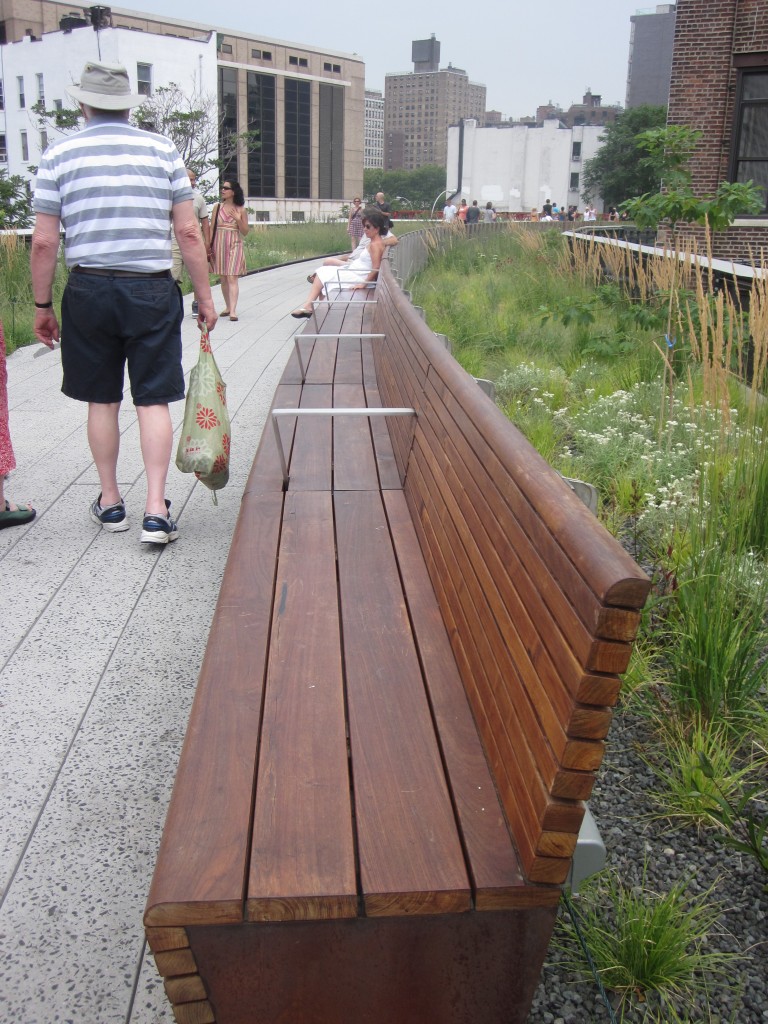
simple seating and lots of it

seating as an environment and an experience

one of the repeated design features on this leg are seating spurs that reference the park's past as a rail line and allows the user to step out of the traffic flow. Another feature is raising the metal grid path above the original surface, saving a bit on landscape materials and maintenance


unlike the first leg, property owners now know the High Line's value added and developed accordingly, even before the park was finished

a simple but charming design effect. The path's jog makes it look like strollers are in the middle of a field

and they have managed to fit in a field--a small one--evlivened by a casual choral performance on the built in bleacher seats

Sep 14 10

New Yards Park is dressed to impress

by Matt Johnson

This past weekend, the Capitol Riverfront area celebrated the grand opening of the Yards Park.

The new park is located along the Anacostia River between 3rd Street SE and the Navy Yard. It was built as a public-private partnership between the developer of the Yards, the government of the District of Columbia, and the General Services Administration. It’s managed by the Capitol Riverfront BID.

A festival marked the opening this weekend. It included bands, artists, vendors, and more. I had the opportunity to stop by, and I snapped some photos. The park is very well designed, and I can only hope it is an example of future waterfront parks in the area.

It has many features which help to make it a great urban park. In addition to passive spaces like lawns and plazas, a pavilion and terraced steps offer places for programmed activities. I imagine that the boardwalk, with its sweeping views of the Anacostia River, will be very popular.

Greeting people walking from M Street and the Metro is a splash fountain. It was very popular with kids on Saturday. A waterfall drops from the level of the splash fountain into a pool at a slightly lower level. A platform allows people to walk behind the waterfall. And the pool into which the waterfall empties is about a foot deep, which allows people to wade in it.

A walkway around the perimeter of the wading pool leads to a boardwalk alongside the Anacostia. The boardwalk is lower than street level, and where it intersects the pool, there appears to be room for retail underneath the overlook plaza at the level above.

That plaza is adjacent to the “Lumber Shed”, which is temporarily being used as a pavilion. Eventually, it will be enclosed for use as retail or dining.

Further east, terraced steps allow gathering for concerts or performances on the boardwalk, where a stage can be set up.

West of the overlook plaza, a unique steel bridge crosses over the wading pool and leads to a green lawn surrounded by wavy wooden benches. Another passive green space is to the east of the Lumber Shed.

This park is a great addition to Washington. The well-thought design is long overdue and the features give Washingtonians new ways to relax and recreate. Hopefully, DC will find a way to extend this park and also replicate its design elements along other parts of the Anacostia and the Potomac.

Crossposted at Greater Greater Washington.

Jun 4 10

Rethink Health: The Power of Play

by claudia kousoulas

Last night, Joan Almon, Executive Director of the Alliance for Childhood, reminded us of the importance of mud puddles.

She began by outlining the importance of play (that is, undirected messing around, preferably outside). It helps children develop negotiation and social skills, and coordination between their brains and hands. They learn to wonder, concentrate, and overcome challenges.

But these days, children 6-8 years old spend only 12 percent of their time outdoors. Children 10-16 spend only 12 minutes a day in vigorous physical activity, but 10 hours a day in sedentary activities (is that an oxymoron?). You won’t be surprised to learn that they spend a whopping 53 hours a week (about 7 hours a day) with media–whether its computers in the classroom or wii at home.

We intuitively know this is a problem–teachers see the wound up kids who don’t get recess and parents wistfully recall the days when they were sent outside and told to be home in time for dinner.

But even though we are more fearful and time-pressed, it is possible to fit play back into children’s (and our own) lives. Almon described playworkers who are present but invisible in playgrounds, lightly supervising to ensure general safety. Royce Hanson mentioned the role of “park aunts” (and uncles), retired folks who volunteer to be the adult who provides formal/informal supervision.

Almon made the point that these types of ideas are simple (certainly no more complicated than setting up a soccer league) but very effective.

Other ideas that came up: Takoma Play days, geo-caching, and the worst mother in America. But instead of clicking those links, how about going outside for a hike? Maybe you’ll see a turtle!

Switch to our mobile site