Skip to content

new york times

Jul 18 12

A New Generation of Malls Track Downtown, Again

by claudia kousoulas

We grew up as planners learning that shopping malls sapped downtown of its energy–whether it was small town retailers wiped out by the mall just over the county line or urban retail boulevards gutted of life as suburbanites left the city to follow jobs and the shopping followed them.

Over time, downtowns began to reimage themselves as malls. Beginning in 1980, The National Trust for Historic Preservation’s Main Street program was based on that very premise, organizing disparate retailers to work together on signage, opening hours, seasonal sales, and marketing.

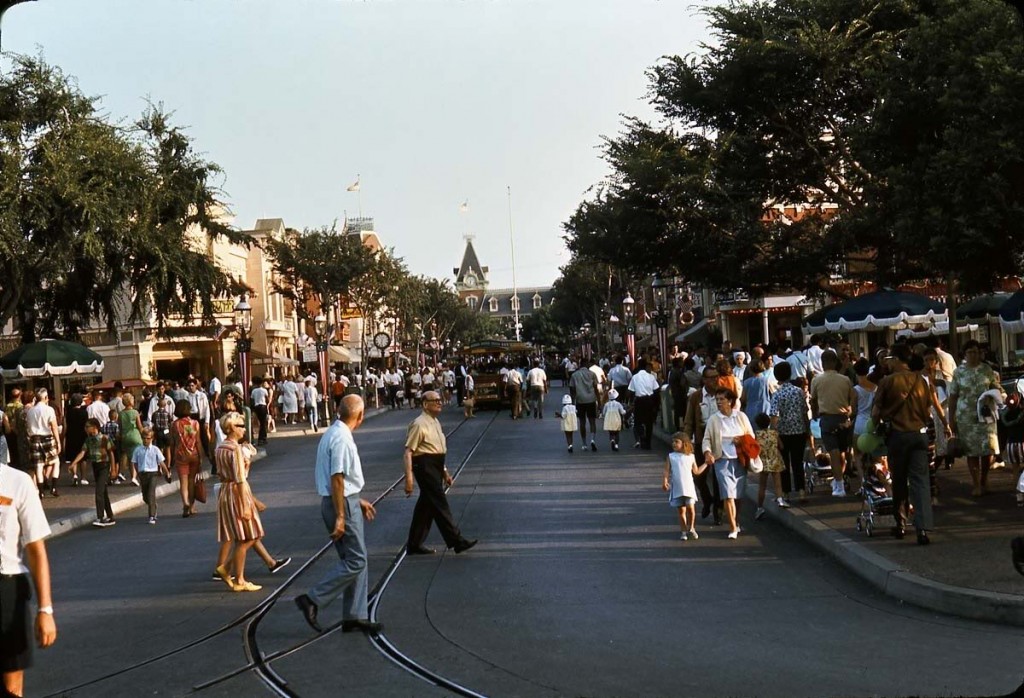
Yes, I know this is Disney. I'm trying to make a snarky point

Federal Realty took it one step further, simply buying up retail streets in places like Westport, Connecticut and Bethesda, Maryland to create a single, curated retail environment from brick pavers to street trees.

More than a place to do errands

As main streets became newly invigorated environments drawing people to hang out, stroll, and by-the-way, spend money, shopping malls emptied out. Now, malls are again tracking downtown, as this New York Times article notes, by becoming more experiential places.

Though the article focuses on online competition for mall retail, one executive is quoted, “It’s not just about shopping — it’s multidimensional; it’s a place you can just hang out and go for a stroll,” he said. “You’re not doing that in a mall.”

Sounds like main street to me!

May 31 12

Walkable Communities vs a Walk-in Closet

by claudia kousoulas

Suburbs have always been an indicator of economic status. If you lived in them, you were wealthy enough to take on a mortgage, maintain a house and yard, and eventually own and maintain one or even two cars.

At some point, that shifted. Living in the city and maintaining a middle class lifestyle took an upper class income. Limited attractive neighborhoods and buildings cost a premium. And if local schools and services were not up to par you needed to pay tuition and fees.

Now, according to Christopher Leinberger and Mariela Alfonzo in the New York Times, a larger number of city neighborhoods are outstripping the suburbs in desirability and thus in per square foot value. Their recent report finds that walkable places have “become more gentrified over the past decade,” with wealthier and more educated residents. And from a list of the walkable communities examined, you won’t be surprised by that finding–Bethesda, Penn Quarter, Logan Circle, Chevy Chase Lake.

But what are the quantifaible elements of a walkable community? He and his co-author found that “the absence of a clear classification of the mix of residential, office, and retail elements that comprise walkable urban places…has been one of the most significant barriers to addressing their demand.” But demand is there–he found that in Atlanta only 35 percent of people who wanted to live in a walkable community actually did.

The characteristics the authors used to define a walkable place are somewhat Lynchian (with my comments in parens):

  • aesthetics (some subjective judgement of decoration, but also views and outdoor dining)
  • connectivity (in the sense of barriers)
  • density
  • form (does the place feel like a place)
  • pedestrian amenities (both practical and decorative)
  • personal safety (judged by indicators like graffiti and litter)
  • physical activity
  • proximity of uses (mixed uses)
  • public spaces and parks (a la Holly White–movable chairs, touchable water)
  • traffic measures (not car throughput, but slowing measures–signals and calming)

(The not easily quanitifiable measure I use for a walkable place is the ice cream cone factor. Can I get a cone, and then have a nice and interesting walk while I eat it, and will there be a place to toss my napkin when I’m done. Extra points if I can ride my bike there and burn off some of those calories ! I wouldn’t last a day at Brookings.)

Once you can describe these places, their economic impact can be measured, and Leinberger finds that impact to be considerable. Even controlling for household incomes, walkable places show a higher economic performance, with premiums in office and residential rents as well as in retail sales and housing values.

From the report: “Federal, state, and local policy makers should conduct a systematic review of existing public policies that are biased against walkable development, and adopt new measures aimed at facilitating (or at least removing roadblocks to) this type of development.”

As a suburb within walking, biking, and transit distance of downtown, and one that has its own urban centers, Montgomery is advantagously postioned to add value by creating car alternatives to getting downtown (I’m looking at you bikeshare) and by building up its own urban areas.

The White Flint Plan, the BRT study, the zoning rewrite, even the Parks Department’s community garden program are all moves that will redfine how and were we live by adding more choices. With plenty of suburban single-family communities and the preservation of the Agricultural Reserve, Montgomery will become a layered place, one with options and interest that all add value.

where's my ice cream cone?!


Mar 2 12

Urban Economics and Where We Live

by claudia kousoulas

American Century types like to complain that this country doesn’t make anything anymore or if we do it’s artisanal cheese and not steel. But as this article points out, that cheese or other basement production is often where the big stuff starts. How can we forget Apple’s garage beginnings.

So if economies are shifting, at least in some small way, to local production and services, are our communities able to accomodate new jobs?

According to Mike Pyatok, interviewed in Better Cities and Towns, “Most planning regulations are based on the Euclidean model that separates cities into zones accommodating a single use, which true live-work is decidedly not.”

While Pyatok is pointing out that the rules of subsidized housing preclude small scale economic ventures, the article’s author, Thomas Dolan, describes a white collar version of live-work. Rather than colonizing a Starbucks, office freelancers could work in the ground floor of a live-work building where they can share services and ideas.

With economies shifting, our notion of what a good commuity is may shift as well. Will it continue to be the suburban ideal of green separation or will connections be more important?

Jan 11 12

Public Space is People Space

by claudia kousoulas

We can extol the New England Common and the midwestern town square, but let’s be honest, America’s real public spaces are parking lots. We have turned our landscape over to the car. In his forthcoming book, “ReThinking a Lot,” MIT urban planning professor Eran Ben-Joseph estimates that there are 500 million parking spaces in the US, covering about 3,500 square miles, about the size of Delaware and Rhode Island combined. Other estimates are higher–up to 2 billion spaces; throw in Connecticut and Vermont.

That comparison is a sad statistic on our willingness to turn over civic life to the car; parking lots are an investment in space that seems to be paying out negative social, environmental, and economic impacts. So what to do with all this pavement?

We’ve been looking into zoning and planning opportunities to recreate crossroads and Metro area lots into livable rather than strictly drivable places. In some case, the CR Zones reduce parking requirements significantlycases and also set maximum limits. The zones’ parking standards vary on a sliding scale  based on proximity to transit services.

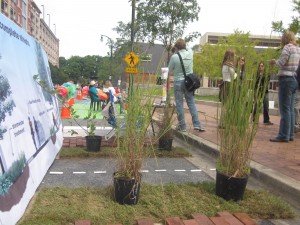
We even participated in Parking Day.

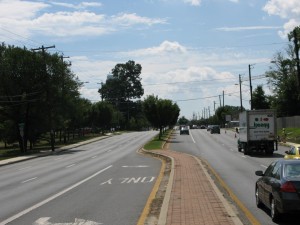
streets are for people as well as cars, and they can be green as well as gray

Parking lots really have to serve us twice–as drivers and as walkers–and they have an aesthetic. Landscaping is the most obvious way to create a more nuanced environment. 

landscaping in the Dia Beacon art museum parking lot in New York's Hudson Valley


Do only art museums warrant landscaped parking lots? Thanks to Elza Hisel-McCoy for the pictures

But this article looks at even looser and more interesting approaches to civic re-use of pavement, including summer theater under the department store port cochere, sports leagues, and the ever-popular food trucks.

To make parking lots more meaningful and attractive public spaces, whether a formal landscaped design or an organic outgrowth of community activity, we have think like people rather than drivers.

Here are more pictures of parking lot re-use, and send us your photos of interesting lots–good and bad.

Dec 7 11

Modernism in Massachusetts

by claudia kousoulas

This article in the New York Times points out the Montgomery County is not alone in recognizing its heritage of modern architecture.

That bastion of Colonialism, New England loves its saltboxes but is moving to preserve, through easements, a legacy of modern residential architecture that includes work by Walter Gropius.


Montgomery Modern explores mid-century modern buildings and communities that reflect the optimistic spirit of the post-war era in Montgomery County, Maryland. From International Style office towers to Googie style stores and contemporary tract houses, Montgomery Modern celebrates the buildings, technology, and materials of the Atomic Age, from the late 1940s through the 1960s. A half century later, we now have perspective to appreciate these resources as a product of their time.

Switch to our mobile site