Infrastructure
Connecting our “Life Sciences Triangle”
On a recent trip to Savannah, we not only had a wonderful time – we learned a few unexpected things. There’s more to the city than the beautiful downtown (with omnipresent SCAD buildings), there’s the economy built on an infrastructure that allows Savannah to be the fourth busiest port in the country (according to our boat tour guide) linked to an extensive heavy rail system. And evidence was obvious on the river – even from the window of the restaurant where we had lunch one day. Transit, however, is generally absent; the free Downtown Transportation (DOT) bus is fine, but it covers an area that’s easy enough to walk.
MoCo’s economy seems more diverse than Savannah’s, but is becoming focused on the life sciences, especially in the fields of health and biotech research. Our own Life Sciences Triangle is beginning to take form – between Bethesda, the Great Seneca Science Corridor, and the White Oak Science Gateway. Two keys ensuring the success of this vision will be linking these areas together and ensuring that there is a robust, mixed use, 24/7 economy around these key nodes. Generally, the latter is a matter of zoning and these areas are developing (or have the potential to develop) with housing, retail service, and employment opportunities. The former, however, is more difficult. Luckily, the early stages of creating transit links are completed and schedules are moving forward.
In the recently published ULI report, Infrastructure 2012, Montgomery County’s Intercounty Connector (ICC) is highlighted as an example of link connecting parts of our suburbs. Unfortunately, the examples of transit systems implementing visions similar to our Life Sciences Triangle are New England’s Knowledge Corridor and North Carolina’s Research Triangle.
But there is hope. The general alignment for the Purple Line transit link between the Bethesda and New Carollton Metro stations has been set since 2009 and several planning studies are being done for areas around key nodes along the line: Takoma Langley Crossroads, Chevy Chase Lake, Long Branch, and Lyttonsville-Rosemary Hills. Another study is ongoing: the Countywide Transit Corridors Functional Master Plan, which will be followed up by a BRT – Land Use Plan. Of course, the Zoning Ordinance Rewrite is also ongoing and being coordinated so that we will have the zoning implementation tools necessary to help these new opportunities succeed.
And now, the Corridor Cities Transitway (CCT) locally preferred alternative was announced by the Governor’s office on May 11th (press release not online yet) and the schedule has been laid out to implement phase 1 – from Shady Grove Metro station to the Metropolitan Grove MARC station, with service to begin in 2020.
Funding is, of course, a huge issue. But, as Infrastructure 2012 points out, that there are numerous options as budgets and federal funding become constricted, such as:
- Fuel taxes
- Vehicle taxes and fees
- Sales and use taxes
- Public/private partnerships
- Tolls
- Vehicle mileage fees; and
- Tax Increment Financing/Special Assessment Districts
There also will remain some Transportation Infrastructure Finance & Innovation Act funds designed to leverage these more local alternatives, and a combination of various sources is likely.
Each of these funding sources have been used by various municipalities and the pros/cons and a few examples are laid out well in the report. It’s time to look carefully at the next steps to implement these links and build on the vision that is just beginning to take shape around our evolving, focused economy.
Building a successful and attractive transit system takes more than drawing lines on a map and buying snazzy vehicles. In addition to the many technical issues, one of the most important factors is values. Who is the system for, and why will they use it?
International transportation consultant Jarrett Walker, who writes the blog Human Transit, has a new book by the same title about the values behind transit, transit’s limits and opportunities, and why people do and don’t ride.
On Tuesday, February 7, the Planning Commission is hosting Jarrett as a part of our speaker series. The talk will start at 7:30 pm in the Planning Board auditorium at 8787 Georgia Avenue in Silver Spring.
If you can’t make it to Silver Spring on the 7th, there are other chances to see Jarrett.
Several local organizations are cosponsoring an informal chat and question/answer session with Jarrett next Thursday, February 9th, at 6:30 pm.
That event will be at the American Public Transportation Association (APTA) offices at 1666 K Street NW, Suite 1100, starting at 6:30. Young Professionals in Transportation, Women’s Transportation Seminar, the American Planning Association, APTA, and Greater Greater Washington are cosponsoring the event.
To go to the evening event at APTA, you do need to RSVP. Additionally, there are a limited number of books available at a discounted rate. You can reserve one when you RSVP.
Also on the 9th, Jarrett will speak at the National Building Museum from 12:30 to 1:30 pm. The National Building Museum is located downtown at 401 F Street NW. It may fill up so RSVP to reserve your space.
For those of you who live or work in the Baltimore area, Jarrett has also announced a lunchtime talk at Penn Station. It will run from noon until 1 pm on Tuesday the 7th.
All of the events are free.
Jarrett’s book, like his blog, is full of insightful commentary. I was particularly interested in his discussion of the relationship between connections and frequency in enabling transit to be a more feasible mode. It was especially poignant for me, since the Metrobus and Prince George’s County bus routes in Greenbelt were restructured around these principles just last year.
Prior to the change, we basically had a “direct service everywhere” design, which meant either long waits for the right bus or long rides on the wrong bus. Jarrett talks about how good design (both frequency and connections between routes) can mean that transferring might get you there more quickly and more reliably at the same cost to the agency. My experience on the ground backs that up, and the book explains why transit works that way.
Anyone who has ridden transit on a regular basis will appreciate the points Jarrett makes. Especially his matrix showing the seven demands of useful transit service. Transit designers must take these demands into consideration if they hope to compete for riders.
I won’t get too in depth, here. But I will strongly encourage you to buy Jarrett’s book. And hopefully I’ll see you at one of his events in the area.
The Infrastructure Made Me Do It
Three articles in the New York Times caught my eye this weekend. Bill Cunningham cast his stylish eye on the revelers at reinvented Coney Island, the About New York column did a follow-up on trashed clothing found outside H&M and Walmart, and the City Critic wrote about the potential for water taxis in Hudson and East Rivers.Â
They all come down to infrastructure and how you use it. Places, things, and ideas that we’ve abandoned often deserve a second look; they can have new value as our own values change. We used to think it was great to have a car and drive everywhere. Now, gassing it up, jockeying for lane space, and trying to park it can be an expensive pain. A fresh air and salt spray commute sounds like a great alternative.
Rethinking assets was an underlying idea of the Planning Department’s recent Rethink Montgomery speaker’s series. Bringing in experts on everything from playgrounds to oil consumption, gave us ideas about new ways to think about all our assets and their potential.
The series is over, let the thinking begin!
Rethink Infrastructure
At the second event of the Rethink speaker’s series, Casey Anderson of WABA and Richard Layman of Rebuilding Place in the Urban Space talked about making (or trying to make) the suburbs more bike friendly for cyclists, both commuters and recreational riders.
Anderson has interviewed 10,000 federal employees about their attitudes and experiences and found some not surprising stats—potential riders are afraid of car traffic, and some surprising ones—even those who would never consider riding a bike think it’s worthwhile to invest in bike and pedestrian infrastructure.
Anderson says the take-away for policy-makers and politicians is that this is not flaky, the community will support this investment.
Layman is seeking to make cycling “irresistible,” and emphasized that a bike-friendly cities like Portland or Amsterdam are created by “breakthrough decisions” and “incremental steps,” and that this can take 40 years. So it’s past time to start.
So rather than lamenting lost opportunities, what are the connections we can make in our plans, policies, maintenance and management structures that will build a long-term commitment to making Montgomery safely and enjoyably bike-able?
As the weather has started warming up I’ve been riding my bike more often between home, work, and school. It’s been great for my commute because the County has a number of good trails and off-road routes for getting from place to place. While certain parts of the County are extremely bike-friendly – think Bethesda on a weekend morning – others could use some work. It’d be nice to see the County expand it’s on-street bicycle infrastructure. When it does, here’s one idea I think is pretty effective.
Via Fast Company
Portland has long been one of the most celebrated cities in terms of planning and sustainability. Peter Calthorpe is one of the original pioneers of transit-oriented development. In this video, Calthorpe does a nice job of succinctly laying out the principles of transit-oriented development, namely walkability and diversity of population and land use.
Earlier this winter, the New York Times ran an article on a CEO’s for Cities study revealing a substantial premium on home sale prices in areas with an above average Walkscore, the informative, if simplistic online measurement tool that ranks neighborhood “walkability” based on proximity to community services and amenities. According to the study, for every additional Walkscore point a neighborhood earns, home prices increase by $700 and $3,000. On average, highly walkable homes sold for $4,000 to $38,000 more than their auto-centric competition.
This past weekend, I attempted to use Walkscore in conjunction with Zillow.com to (at least loosely) confirm the study’s findings for Montgomery County. While zip-code data gave a soft nod in the affirmative, I couldn’t find data fine-grained enough without searching individual listings. I did, however, spend some time seeing how different areas in the County fared on the walkability test.
Not surprisingly, the County’s results range from laudable to loathsome. At the positive end of the spectrum, Bethesda (97), Wheaton (97), and Silver Spring (94), all rank in the top 10% nationwide. They succeed in large part because of their concentration of diverse retail and abundant transportation options. Less exemplary are the Beltway-adjacent areas of Forest Glen (51) and Grosvenor (48) which, despite Metro accessibility, are both physically constrained and poorly served by neighborhood services.
What was most notable about the County is the discontinuity of our walkable fabric. If you own a home three-quarters of a mile west of the Bethesda Metro Station, your Walkscore is probably about 38. Travel the same distance in the opposite direction and you’re likely to earn a score of 55. This trend is pretty consistent throughout the MD-355/Red Line corridor. Worse, though, are the number of pockets in between Metro stations that have diminished Walkscore. This trend suggests that residents and office workers are unlikely to walk to services or use transit without driving to the station (which is still much better than driving to work). Pooks Hill, for example, located just south of the Beltway between the Medical Center and Grosvenor stations barely ekes out a score of 30. As distance between stations increases, this trend becomes increasingly common.
Downtown DC, by contrast, is consistently walkable. According to the CEO for Cities study, DC has a median score 71. A quarter of District neighborhoods score better than 82 on the Walkscore scale, ranking seventh among US cities. Where in Montgomery County the walkable street network extends only a limited distance from Metro, in the District the street network ties together neighborhoods creating a continuous pedestrian environment. As a result, it is just as easy to walk from Adams Morgan to Georgetown where there is no Metro service, as it is to Dupont Circle or Penn Quarter where there is.
Walkscore is also a valuable indicator of a site’s inherently sustainable characteristics. The LEED for Neighborhood Development rating system addresses these considerations in two full sections dedicated to Smart Location and Linkages, and Neighborhood Pattern and Design sections. LEED for New Construction, however, allots only a four points related to walkable site selection (SS 1:Site Selection, SS 2:Development Density & Community Connectivity, SS 4.1: Public Transportation Access and SS 4.4 Parking). Why is this important?

Consider the following buildings in Montgomery County. The first is a LEED-Platinum rated office building just off I-270 with almost non-existent transit service, no proximal services or amenities, and no real concentration of nearby housing. To construct the building, a swath of forest was cleared not only to accommodate the building footprint, but also the parking structure, which incidentally has twice the footprint of the building itself. Its Walkscore is 35.
The second project is the Silver Spring Library, which is scheduled break ground on a site that will eventually serve as a station for the Purple Line light rail system. The library building accommodates ground floor retail, an arts center, additional office space, and a 60,000 square foot library. It sits on a previously developed site, requires no additional parking, will eventually also accommodate 140 residential units, and is located adjacent to the Silver Spring CBD. Its walkscore is 97. The library, however, is projected to only earn a LEED-Silver rating.
According to one study, 30% more energy is expended by workers commuting to a traditional office building than the building itself uses. For an average office building built to modern energy codes, more than twice as much energy is used by commuters than by the building itself. This highlights the importance of building within a walkable framework. You can argue that a “green” auto-dependence is better than the traditional form of auto-dependence, and in the case of Tower Oaks, attractive auto-dependence is better than your run-of-the-mill schlock. But this misses the point. Ultimately, sustainability comes back to a few basic principles. Walkability, and automobile independence, is one.
Other areas in Montgomery County: Olney: 91;Â Friendship Heights: 89;Â White Flint: 80;Â The Kentlands: 78;Â Germantown: 63;Â White Oak: 60;Â Gaithersburg Life Sciences: 55.
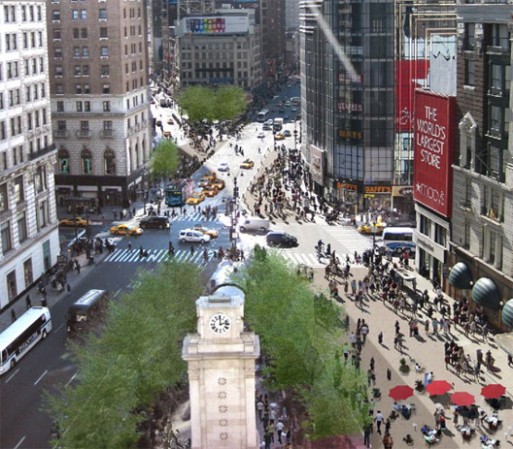
After months of study and deliberation, New York City has decided to make its pedestrian-priority spaces a permanent fixture on sections of Broadway around Times and Herald Squares. The decision to keep the revised street plan, which had been operating under trial review since last summer, came despite vehicle travel times falling short of projected improvements. The plan was originally sold on the basis that it would improve vehicle flow by 17%. It improved 7%.
More importantly, the roadway enhancements vastly improved pedestrian and motorist safety. According the City’s Department of Transportation, pedestrian injuries are down 35% while motorist and passenger injuries decreased 63%. And 80% fewer pedestrians are walking in the streets despite increased usage of Times and Herald Squares, ostensibly due to less crowded sidewalks.
Sometimes seen as a glorified tourist trap, the experiment was also a hit with locals and business owners. A survey conducted by the Times Square Alliance noted that 74% of residents and office workers were “satisfied with their experience.” They did, however, want to see improvements to the design of the pedestrian areas, which the City has vowed to implement now that the trial phase is over.
While this is good news for New Yorkers, what can Montgomery County take from this policy? For one, projects such as this reiterate the importance of discussing pedestrian and cyclist safety in the same breath as automobile mobility. Had this simply been an exercise in traffic management, the results would be underwhelming. However, factoring in pedestrian safety and quality-of-place considerations, the decision represents a well-reasoned response that successfully enhances the urban environment.
It’s also a lesson in the simplicity of open space. What I found striking about Times Square when I visited recently (albeit in warmer weather) is how automobiles, bikes, pedestrians and the inert all come together in close proximity with remarkable harmony. Lawn chairs and traffic lanes separated by mere feet! What brought all this together? A few buckets of paints, a few signs, and some planters. Not exactly high-tech, but effective.