houses
Catherine Mohr: Building Green
Ever feel like you’re being watched by the Green Police? Have a loved-one who thinks that tossing a newspaper in the trash is the equivalent of clubbing a baby seal? Tired of transparent marketing campaigns for products with dubious environmental benefits? You’re certainly not alone.
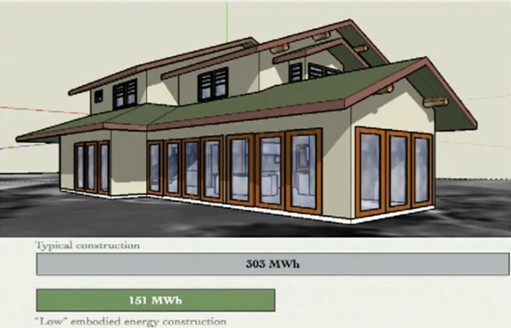
In this video from TED Talks, Catherine Mohr rightly calls out the insanity of nitpicking over every paper towel or coat of paint, and identifies the real elephant in the room: embodied energy. Embodied energy is the total amount of energy necessary for an entire product lifecycle, including everything from transportation to installation to decomposition. When used as a metric to evaluate sustainable construction construction practices, it can reveal the real opportunities for substantial savings over conventional methods. Not surprisingly, off-the-shelf and post-construction products yield little savings. Instead, the real meat and potatoes savings come from floors, doors, windows and insulation.
On her personal house, Ms. Mohr uses some interesting techniques, including straw bale walls which she claims have zero embodied energy. She also resorts to FSC-certified wood not only for the framing of the house, but also for the windows. This represents a significant savings over aluminum framed windows.
In principle, I’m a fan of what Ms. Mohr has done with her house. That she opted to use straw bale techniques endears her to my heart. However, I find the demolition of the existing house a little unsettling. The tear-down was likely required to pour the concrete slab flooring for passive solar heating, however one wonders the original building could have been retained. Most of us are not self-proclaimed “organic food eating, carbon footprint minimizing, robotic surgery geek[s]” and will not spend an exorbitant amount of time, effort, and money calculating the embodied energy trade-offs associated with the construction of our dream home. If it comes time to rip down the old house, I’m going in with a sledgehammer and a crowbar (read: boys with toys), not a material salvage company. You can kiss that embodied energy savings goodbye.
With a break-even point after initial upgrades nearly 20 years out, and additional improvements a near certainty along the way, is new construction necessarily the most efficient way for the average homeowner to go green? Also, wouldn’t Ms. Mohr be better off ditching the house altogether for a downtown condo where she could cut her annual embodied in half by living car-free (ignoring for a second that she seems to fly for a living)?
Perhaps I’m being too critical. It’s easy to deride those that go out on a limb for a cause. What do you think? Is greening a single-family house a futile venture or a way for every household to make a difference? Should they build off of what’s there, or start anew?
See progress on her house at: 301 Monroe
Via Worldchanging
The Rules
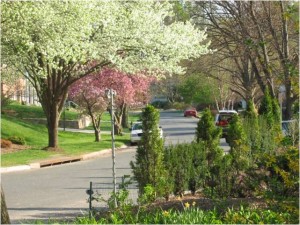
Where do you park your car? Of course, in front of your house. What would your neighbors say if you parked in front of their house?
How quickly do you shovel your sidewalk after it snows? Do you shovel your steps and the elderly lady’s next door?
If there is garbage on your street, do you pick it up, even if it’s not yours, even if it’s not in front of your house?
Remember why the big fat Greek wedding family was embarrassing? Not because they cooked a lamb on a spit (though that’s a little weird), but because they cooked it in the front yard. They broke the unwritten rule of suburbia, cookouts happen in the backyard!
The appeal of suburbia is its rules. Early suburbs weeded out the rule breakers with money—you had to have a chunk of cash and maybe even a car to make suburban living feasible. The rules got really strict in communities with convenants. “Some of your best friends” couldn’t live next door. We laugh. We’re sophisticated now, we would never tolerate such exclusive behavior in our communities in this enlightened era.
But leave your garbage can at the curb all week and see what happens. Paint your house pink and you’ll end up as a community curiosity, maybe even featured in the local newspaper.
The rules of suburbia make it quiet, safe, and—as confirmed in any piece of pop culture—dull.
And people may take pride and possession of their properties, but they don’t necessarily use them, as discussed is this UCLA study. They are too busy working to keep up with the Jones’.
What are the unwritten and written rules in your neighborhood? What is the physical and social infrastructure that keeps you mowing a lawn and driving to the local pool, when you’d really rather be harvesting vegetables or riding your bike?
I’m too Cool for my House
The Building Museum’s current exhibit, Drawing Toward Home, begins with the spidery lines of a Samuel McIntire plan of a Federal style house to be built in Salem, Massachusetts in the late 1700s. The rooms aren’t labeled, but simply marked with their measurements. The single sheet is a design, a contract, and a builder’s directive.
Very quickly, the exhibit’s drawings of houses turn into drawings of home. Along with color and detail, they add emotion.
“The architect must keep his client’s enthusiasm alive and active by sending or submitting bright, jaunty little perspective sketches of his contemplate work,” wrote Benjamin Linfoot in Architectural Picture Making (1884).
The drawings are partially the ploy of an architect to keep his client engaged and committed, but also a reflection of what we mean when we say home.
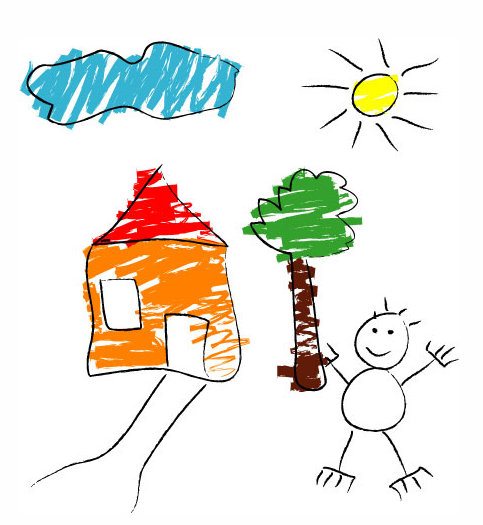
It should be the place where the sun shines, flowers grow, and we hold hands.
Today we interpret such nostalgia two ways. Massive neo-Victorians recall one idealized era of family, but with room for the SUV, microwave, and home theater.
Cool modern houses recall another, equally idealized time, when DDT and cigarettes were good for you.
But life, as well as architectural drawings, are infinitely more complex these days. Where do you want to live—cool or cozy? And will you be happy there?