Skip to content

Food

Sep 23 11

Food Trucks Expand Their Menus

by claudia kousoulas

Food trucks are an urban trend that is hard to keep up with. Do they compete with or complement stationary businesses? Are they sufficiently regulated for health, safety, and welfare? Are they unsightly or exciting?

Well, they’ve morphed again. Real Food Farm trucks in Baltimore are bringing fresh produce to neighborhoods, and sometimes even to your door. On the one hand, it’s a service with a bit of social engineering–bringing good food to people who need it and connecting farmers to new markets.

But it is also an update of a Baltimore tradition of street peddlers, known as A-rabbers. Once again, the new urbanism updates the old urbanism.
May 9 11

Where is the green space for apartment-dwellers?

by joshua sloan

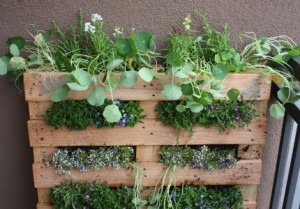
If you don’t have a plot of land, you can still grow flowers, herbs, and vegetables. Fern Richardson writes a great blog on container gardens, Life on the Balcony. And Treehugger has put up a synopsis of her recent designs for using pallets as vertical planters.

from www.lifeonthebalcony.com

Jul 30 10

Food Truck Follow-up

by claudia kousoulas

When we think about urban environments we picture tall buildings, noisy traffic, and hard surfaces. But the real point of urban environments is people, lots of them, bouncing off each other—eating lunch in the square, going to the theater, crowding around a street performer, sharing a sidewalk. Cities bring people together.

Food also brings people together and one could think of urban spaces as giant family tables. After all, Napoleon didn’t describe Venice’s Piazza San Marco as “the finest drawing room in Europe” for nothing. A $15.00 lemonade at one of its cafĂ©s is worth every penny if you make good use of your plaza-side table.

La piazza di tutti piazzi

Community spaces and tables are prevailing in private spaces as well. Metropolis Magazine writes about restaurants across the country that are designing their spaces and menus to become what sociologists call the third place—the place that is not home or work—where you go to hang out.

Local restaurateur Jose Andres recognizes the value of communal celebration and includes a long community table in his restaurants and at Le Pain Quotidien, you may find a fresh baguette and a new friend at the communal table.

Combine food and people and you’re bound to get politics—or at least an interesting discussion around that communal table. In Pittsburgh, Conflict Kitchen serves “food from countries the United States is in conflict with.” Their façade creates a distinct street presence and their menu is as much about sustenance as communication.

Is there a way to use urban design of public space to create “third places” and what are the elements of a successful place? I can picture a communal table in the new Silver Spring Civic Building’s Veteran’s Plaza and imagine the conversations that could take place around it.

instead of a lot of little tables, how about a big table?

May 25 10

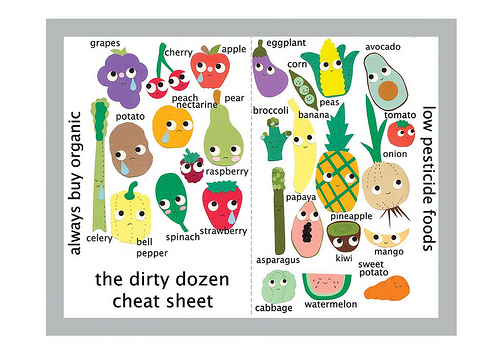
Pocket guide for the pesticide-aware consumer.

by joshua sloan

We can plan for it, you have to live it.

Hierarchy:
1. Buy local.
2. Buy organic.
3. Minimize pesticides.

Artist, Heidi Kenney's Cheat Sheet

Feb 26 10

End of the Week Links: February 26th

by anthony pins

LOCAL

A Visit To Velatis
Silver Spring Singular

SSS samples the caramels from Velatis, which recently opened on Georgia Avenue in a building previously occupied by trees. Mouth watering images included.
 

Lessons from a South American Bus Rapid Transit system
Greater Greater Washington

Councilmember George Leventhal traveled to Curitiba, Brazil to test out their BRT system. He shares his thoughts with GGW.
 

It’s Worse Than You Thought… but maybe better too
Friends of White Flint

An interesting recap of where Montgomery County is strong, and where it needs to improve relative to the Washington region.


How Silver Spring Park could be a good neighbor
Greater Greater Washington / Just Up The Pike

Wednesday Eclectica
Thayer Avenue

Two blogs share their thoughts on Silver Spring Park, the project formerly known as the Moda Vista.

Note: This project goes before the Planning Board on March 4th. The planning staff report can be found here.

NOT SO LOCAL

A Plan to Decarbonize Chicago’s Loop
Inhabitat

Adrian Smith + Gordon Gill, the designers responsible for the Willis (Sears) Tower retrofit, have completed an initial analysis of buildings in the heart of Chicago to reduce carbon emissions by 30% by 2020.
 

Architecture of Healthiness
Next American City

New York City recently came out with their Active Design Guidelines, and is looking at a number of ways to make buildings healthier and more active places to live and work.
 

Green Roofs Are So Last Year; Rooftop Farms Are The Growing Thing
Treehugger

Treehugger runs through a plethora of examples demonstrating the rising popularity of rooftop gardens.

Feb 22 10

Food Truck Update

by claudia kousoulas

Los Angeles continues to encourage a street food scene with a street food fest. And though conflicts are bound to arise, there are ways to deal with them.

Feb 7 10

Project Profile: The Burnside Rocket

by anthony pins

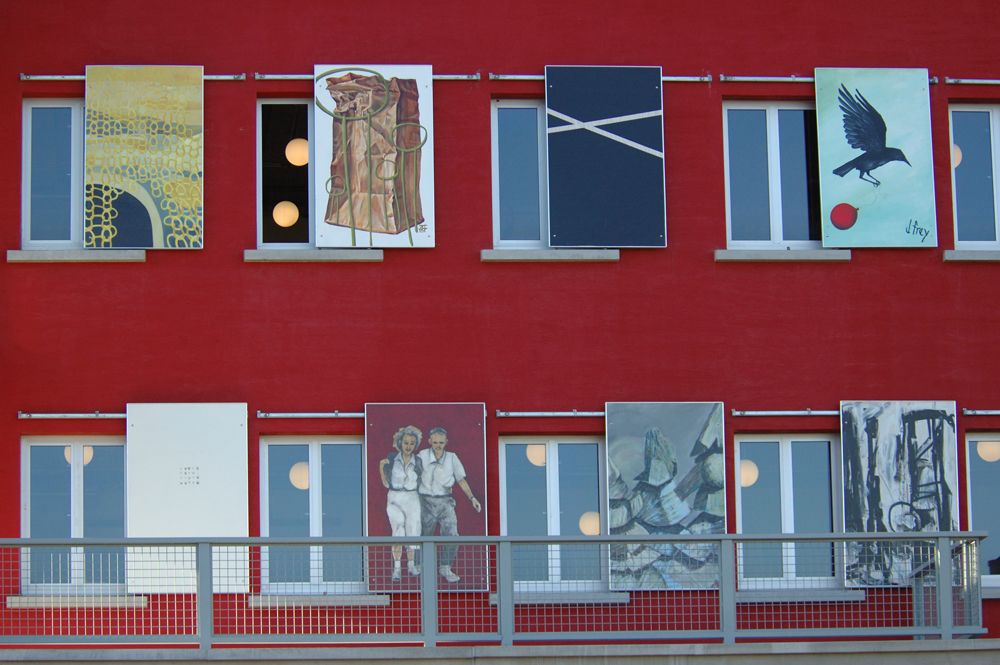
Tacking onto Elza’s post on Silver Spring’s future form, I came across this building a few weeks ago and couldn’t help but think of Fenton Village. It’s cheerful, gritty, and almost certainly would feel at home in a neighborhood that already boasts an array of colors, from the similarly red Pyramid Atlantic to the tastefully pink Jackie’s Restaurant.

And while the Burnside Rocket may seem to offer little in the way of architectural distinction other than a few eccentric shutters painted by local artists (which I think are quite neat), between its crimson painted walls is a powerhouse at work. The LEED-Platinum certified structure is built both to last, approximately 300 years according to the project’s website, and operate efficiently. Hollow-core concrete slabs distribute conditioned air in lieu of metal ductwork. The raw, industrial aesthetic reduces the need for finishing materials and interior partitions. And a ground source heat pump provides efficient indoor air conditioning while desuperheaters recover “waste heat” for domestic water heating. It is also the first building outside Portland’s downtown to not provide parking.

Even more interesting, the roof features an edible garden that is harvested by the restaurant tenant on the top floor. No, the garden is not as photogenic as say, Chicago’s City Hall. In fact it only about half of the green roof is built into the building. But the Burnisde Rocket maximizes its roof space by providing harvestable roof space in the form of “kiddie” pools planted with vegetables, and a planter-lined parapets.

The Burnside Rocket is also an excellent case study on the economic benefits of “going green.” Because of the massive energy savings, estimated at about a 50% reduction from traditional construction, the property owner can offer tenants a full-service lease. Unlike conventional triple-net leases (NNN) where lessee’s pay for all taxes, maintenance, and insurance associated with their tenancy, the property manager assumes these costs and leaves tenants only to account for rent. The result? Property owners can charge more for rent while offering savings when compared with a triple-net lease, and achieve higher profit margins from the reduced operating costs.

Additional Information:
The Greenroof
Green Renter

Feb 3 10

Suburban Food Trucks

by claudia kousoulas
Mohamed Elrafal is a native of Egypt and a former antiques dealer who runs the Ali Baba Falafel cart at the Bethesda Farm Women’s Market. By allowing a complementary use to lease space, the market gains income to stay viable in the midst of redevelopment (the market is zoned CBD-1).

Even in the snow, people want their falafel

Elrafal serves falafel, gyro, and his mother’s recipe for ful medames, a traditional Egyptian street food of stewed fava beans that is so good, it will make you rethink your relationship to legumes. The guy is really cooking. His falafel is spiced with whole cardamom seeds and accompanied by distinctly seasoned red cabbage, banana peppers, and vinegary lettuce. It’s wrapped in a thinner pita than the gyros, which get a puffier pita bread. Elrafal takes pride in his product.

Ful medames and a falafel sandwich

In the warm weather, he hangs a parakeet cage and he had built a little wooden deck where customers could stand at the truck’s window, but the County came around, told him he needed a permit, and that it would cost $2500. For a guy who sells beans, from a panel truck. The day we visited, Elrafal apologized for making us stand on a crumbling patch of asphalt and the rubber mats covering his power line. So good job there, a non-existent problem not solved.

The suburbs are not comfortable with low overhead. Food carts, corner vendors, itinerant knife sharpeners, and road verge farm stands are suspect.  But from mild disorder comes vitality and possibly success. Last summer farm stands were nearly thrown off the street sides until locavores spoke up. Irene’s pupusas in Wheaton is a classic boot-strap story. She started selling from a cart at soccer games, moved up to a panel truck, eventually to three different storefront locations, and has expanded into a nightclub.

The Clayboys shave ice stand in downtown Bethesda, a summer landmark that sets up outside the fountain at Barnes and Noble (watch John Styer sling syrup here), ran into some permit issues a few summers ago, but since the ices are well-loved by Bethesda children, this bit of civic disorder was given permit dispensation.

And I’m almost afraid to mention Jennifer’s Antojito truck that occasionally parks on River Road. Kids sneak out the back of Whitman to buy tacos and burritos. Why doesn’t he just park out in front of the school? Probably because his first market is the Hispanic workers paving the neighborhood with granite countertop, but also because—imagine the neighborhood outcry.

But other communities have recognized that food carts can add economic and social vitality. Los Angeles is setting up a mobile food court and the City of Portland just released this study as a baseline measurement of land use and other issues. The report is well-summarized here, and sees a planning role in:

  • identifying possible cart locations
  • connecting cart operators with existing programs
  • promoting innovative urban design elements that support food carts.

This last one is the most interesting. Know a dead corner that would benefit from a good hot dog? Let us know.

By the way, this is not a new idea, food carts have a creditable history in American cities and, dating to 1893, Haven Brothers in Providence, Rhode Island is the granddaddy of them all. As described online: “An aluminum pick up truck masquerading as a diner that serves the greasiest food imaginable to Providence’s wastoids, insomniacs and street walkers.” Aaah, city life.

Switch to our mobile site