farming
On a recent trip for my aunt’s wedding, I had a chance to stop by my grandparent’s place in a small town in CT. One of the first things I noticed, being who I am, is that the community open space was either play space or community garden space. My grandmother, of course, has a small plot where she can grow flowers and some veggies and generally keep active in a town where there isn’t much else to do – especially for seniors (or kids, for that matter). I don’t think we can overstate how important connections to nature and food are and how community gardens, playgrounds, and open space bring people together and promote health, well-being, happiness, etc. The American Community Gardening Association has summarized the benefits well:
Benefits of Community Gardens:
- Improves the quality of life for people in the garden
- Provides a catalyst for neighborhood and community development
- Stimulates Social Interaction
- Encourages Self-Reliance
- Beautifies Neighborhoods
- Produces Nutritious Food
- Reduces Family Food Budgets
- Conserves Resources
- Creates opportunity for recreation, exercise, therapy, and education
- Reduces Crime
- Preserves Green Space
- Creates income opportunities and economic development
- Reduces city heat from streets and parking lots
- Provides opportunities for intergenerational and cross-cultural connections
But, even without space for community gardens (as with most infill, gray-field projects), we can still benefit from creating our own little Edenic plots. A number of urban gardening stories have come across my desk/mailbox/computer recently; two that I’ll pontificate on here.
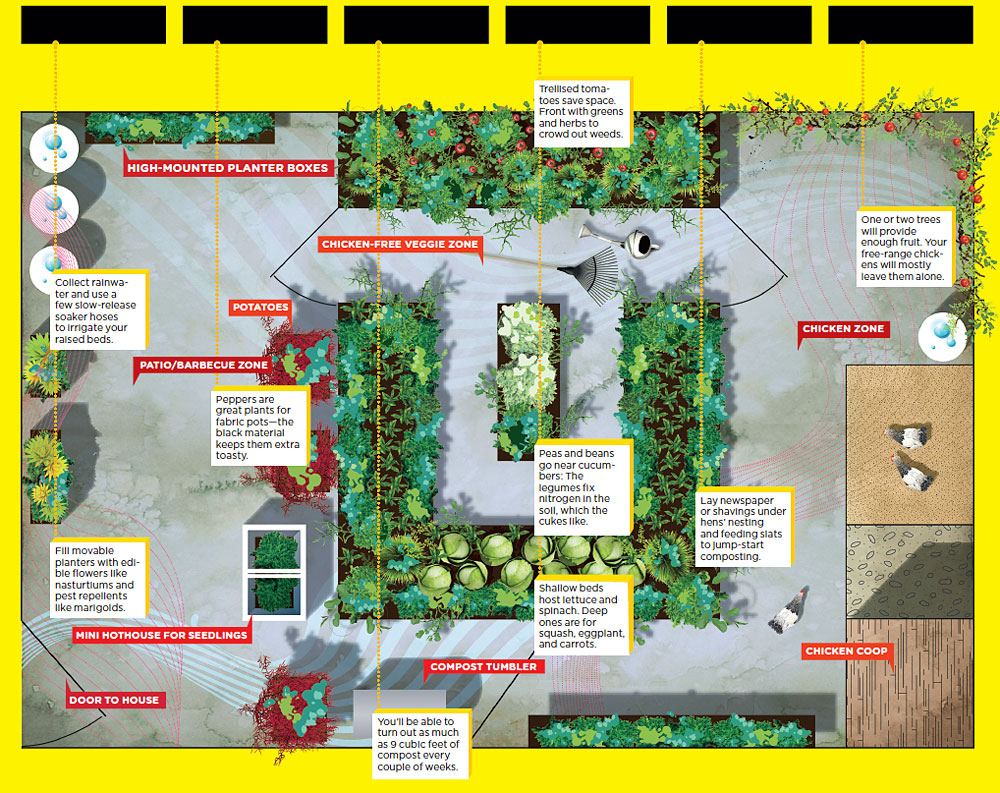
Wired magazine had an interesting story on creating gardens at various scales – from balcony to suburban lot. What was key to each of the scales was maximizing productivity (and luring nerds into the green-geek world of botanical names, grafting techniques, soil science, etc. of gardening). One aspect that didn’t escape my attention was the fact that virtually all the scenarios involved keeping animals of one kind or another, which is generally verboten in most of our denser residential and mixed-use zones. Is there tolerance to change this? Maybe step by step: bees, chickens, rabbits, goats……
Which brings me to a video I came across on an intensive farm created on an abandoned lot in Oakland, CA. In this case, the admitted state of anarchy in the area has allowed the gardener to be left to her own devices – the cops have better things to do. But, as the example shows, if the garden is technically illegal, doesn’t the fact that it co-exists peaceably, and may even be fostering some community bonds tell us something about our squeamishness regarding farming in urban areas? Many cultures live in and around their food sources. We generally don’t – our landscapes are aesthetically focused. It’s a shame we haven’t yet integrated the productive values of landscapes (ecologically, socially, nutritionally, economically) with our typically English pleasure garden aesthetic. Again, step by step: corn in the front yard, espaliered trees along fences rather than evergreen hedges, strawberries in our container plantings…..
I’m looking forward to keeping this conversation going during our zoning rewrite process and I’ll be interested to know what our tolerance really is. Can we put our farms where our mouth is?
Rethink Food in the Gazette
Thanks to Meghan Tiernaey for covering the Rethink serie’s interesting discussion about the future of farming in Montgomery County. Check out her story.
Rethink Food
Do you know where your food comes from? Probably not from Montgomery County, even if you shop at one of the County’s 14 farm markets, and even though nearly one third of the County’s land is in the Agricultural Reserve.
At last night’s 3rd Rethink event, the panel of two longtime farmers, Wade Butler and Ben Allnut; the County’s Agricultural Services Division Manager, Jeremy Criss; and community garden activist, Gordon Clark, discussed the difficulty of farming in Montgomery County.
Soil health is a challenge, but one that an experienced farmer will learn to deal with. More challenging are the regulations that require an expensive special exception for facilities that allow on-farm food processing. So, local meat and dairy are hard to get.
The cost of land is another challenge. It’s easier and more cost-effective to grow townhouses rather than food. And as nearly every County resident can tell you, the increasing deer population loves local food too.
There were also some challenging ideas addressed, including addressing farm needs in the current Zoning Rewrite, expanding community garden opportunities down-County, and reversing MCPS’s decision to not allow gardens on school property.
Both Butler and Allnut talked about educating their customers about the seasonality of their produce, but we also need to educate ourselves about local farming. Why not take a drive (or a bike ride) out to the Agricultural Reserve this spring and see another side of Montgomery County.