Energy
Rethink Energy
Last night Michael Schaal, of the U.S. Energy Information Administration spoke about the outlook for future energy demand in the world and the United States.
Some of what he reported will not surprise you; we’ve heard a lot of this before.
- Even with increased interest in renewable fuels, most of our energy needs will be met by fossil fuels.
- Demand increases with population and income, so demand is expected to increase in China, Russia, and India.
- Technology is helping us find new sources of fossil fuels.
- Technology is also helping us save energy; for example, the energy savings from more efficient appliances have helped keep US energy demand steady, even as we use more gadgets like cell phones and laptops.
Schaal pointed out that the projections are based on  current laws and technology, and that there is potential for change, both from legislation like cap and trade, as well as our own consumer choices.
For planners seeking to redesign communities to be more energy efficient, he stressed that turning around infrastructure is a long process.
You can see his slides here.
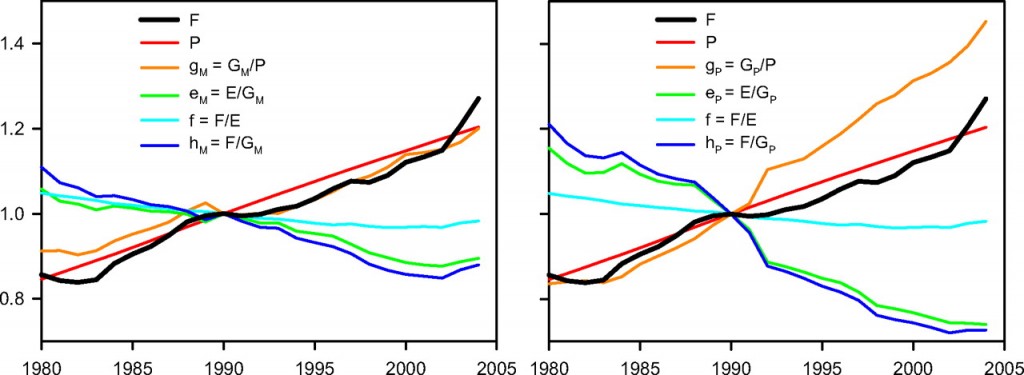
As we start writing the code for the new zoning ordinance, a “big picture” view seems in order. The biggest-picture formula in climate change, called the Kaya identity, is:
- F = Global CO2 emissions (combustion, flaring of natural gas, cement production, oxidation of nonfuel hydrocarbons, and transport)
- P = Global population (total number of human beings)
- g = Consumption per person (gross world product divided by population)
- e = Energy intensity of gross world product (global energy consumption divided by gross world product)
- f = Carbon used to make energy (global carbon dioxide emissions divided by global energy consumption)

Factors in the Kaya identity, F = Pgef = Pgh, as global averages. All quantities are normalized to 1 at 1990. Intensities are calculated by using G M (Left) and G P (Right). In both Left and Right, the black line (F) is the product of the red (P), orange (g), green (e), and light blue (f) lines (Eq. 2) or equivalently of the red (P), orange (g), and dark blue (h) lines (Eq. 3). Because h = ef, the dark blue line is the product of the green and light blue lines. Source: PNAS.
The most obvious thing about this equation – if you remember even grade-school math – is that to reduce F to zero, any of the four factors on the right must go to zero. Since even the most misanthropic earth-firster has not suggested that global population should be reduced to zero (or if they have and taken their own advice, they aren’t here to argue against me), efforts at reducing F should concentrate on the areas where we can have the most impact.
Here are a few basic suggestions on the issues over which we (planners and designers) have influence.
We can minimize g & e (consumption-related factors) by:
- Decreasing the need for energy for transport by co-locating as many jobs, houses, services, and amenities as is practical;
- Providing resource-sharing opportunities (like mass-transit and libraries);
- Allowing for development with minimal resources (one wall between two residences requires less resources than two walls and a strip of grass);
- Allowing for optimally efficient building siting (don’t penalize development with setbacks or height restrictions when those features are used to optimize passive energy use);
- Encouraging recycling, reuse, and retrofits of existing infrastructure;
- Providing flexibility for more locally-sustaining economic development (farms, markets, co-ops, craftspeople and artisans, localism generally);
We will have to wait for the scientists to provide an f that equals zero, but we can help minimize f (carbon use for energy) by:
- Ensuring that rules don’t get in the way of technology that uses renewable energy sources (geothermal, wind, solar); and
- Providing incentives to encourage use of the available renewable energy sources.
Thanks to Wired for reminding me of the useful perspective provided by this formula as we look to finalize some thoughts on sustainability and our zoning code rewrite efforts. Further suggestions to add to the list above are, of course, welcome.
Reminder: May 27, 7:30 ReThink Energy w/A. Michael Schaal.
Old Buildings and Old Energy
Guest Post by Lisa Mroszczyk
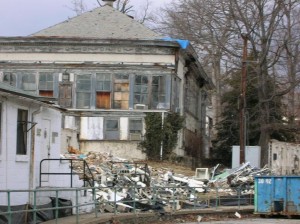
Think of all the energy it has taken over generations to build the County’s existing building stock. This expenditure is embodied energy—the energy already invested to process materials, transport them, and finally construct a building. Demolition wastes embodied energy. When that waste is factored in with the energy needed to transport demolished building materials to a landfill and the energy needed to construct a new building on the site, any net energy savings typically doesn’t kick in for three or four decades.
Reusing existing buildings conserves energy and reduces construction and demolition debris in landfills. During National Preservation Month, we are reminded of historic preservation’s role in sustainability.
- The Brookings Institution predicts that by 2030 we will demolish 82 billion square feet or 1/3 of the existing commercial space. This is enough construction debris to fill 2,500 football stadiums.
- According to information compiled by the National Trust for Historic Preservation, building a new 2,000 square foot house generates 4 pounds of trash per square foot, of which only 20-30% is recycled, and
- Construction of a new 50,000 square foot commercial building requires as much energy as it would take to drive a car 20,000 miles per year, for 730 years.
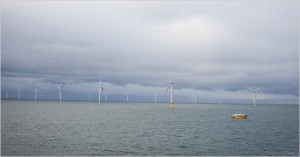
I think there is a particular kind of aesthetic beauty in the simple repetition of forms over large expanses of contrasting landscape. Even more so when those repeated forms provide sustainable energy. The just-approved off-shore wind farm is one such example, solar “farms” are another.
The well-heeled opposition to the mentioned wind farm has only posed the aesthetic argument that this visual intrusion into the seascape must by definition be negative. I disagree. I think it’s quite attractive, calming, and interesting. I think the connotations only increase our appreciation of the natural environment that serves as the backdrop (or, more appropriately, the visual context/physical participant). My interpretation is built on the “purely artistic” cues from the vocabulary of the landscape artworks of Smithson, Goldsworthy, or – the best exemplar to illustrate my perspective – Walter De Maria’s Lightning Field. Too bad we have more hot air than wind around here….
Project Profile: The Burnside Rocket
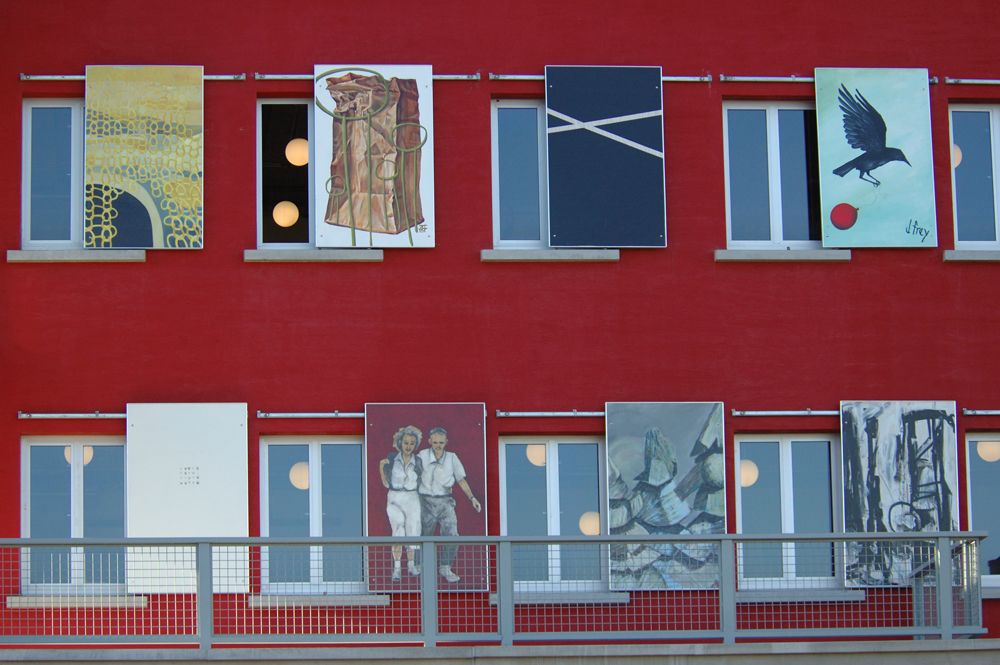
Tacking onto Elza’s post on Silver Spring’s future form, I came across this building a few weeks ago and couldn’t help but think of Fenton Village. It’s cheerful, gritty, and almost certainly would feel at home in a neighborhood that already boasts an array of colors, from the similarly red Pyramid Atlantic to the tastefully pink Jackie’s Restaurant.
And while the Burnside Rocket may seem to offer little in the way of architectural distinction other than a few eccentric shutters painted by local artists (which I think are quite neat), between its crimson painted walls is a powerhouse at work. The LEED-Platinum certified structure is built both to last, approximately 300 years according to the project’s website, and operate efficiently. Hollow-core concrete slabs distribute conditioned air in lieu of metal ductwork. The raw, industrial aesthetic reduces the need for finishing materials and interior partitions. And a ground source heat pump provides efficient indoor air conditioning while desuperheaters recover “waste heat” for domestic water heating. It is also the first building outside Portland’s downtown to not provide parking.
Even more interesting, the roof features an edible garden that is harvested by the restaurant tenant on the top floor. No, the garden is not as photogenic as say, Chicago’s City Hall. In fact it only about half of the green roof is built into the building. But the Burnisde Rocket maximizes its roof space by providing harvestable roof space in the form of “kiddie” pools planted with vegetables, and a planter-lined parapets.
The Burnside Rocket is also an excellent case study on the economic benefits of “going green.” Because of the massive energy savings, estimated at about a 50% reduction from traditional construction, the property owner can offer tenants a full-service lease. Unlike conventional triple-net leases (NNN) where lessee’s pay for all taxes, maintenance, and insurance associated with their tenancy, the property manager assumes these costs and leaves tenants only to account for rent. The result? Property owners can charge more for rent while offering savings when compared with a triple-net lease, and achieve higher profit margins from the reduced operating costs.
Additional Information:
The Greenroof
Green Renter